
- HOME
- OPINION
- ON GROUND
- INTERVIEW
- Neta Profile
- Editor's Pick
- INDIA
- NewsGram USA
- WORLD
- न्यूजग्राम
- POLITICS
- ENTERTAINMENT
- CULTURE
- LIFESTYLE
- ECONOMY
- SPORTS
- Jobs / Internships
- Misc.
- NewsGram Exclusive
This story originally appeared on Global Voices on November 14, 2026.
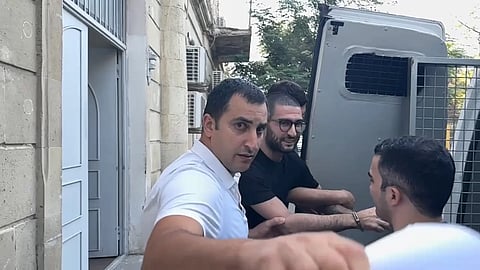
Bahruz Samadov is an Azerbaijani political scientist, peace activist, and PhD candidate at Charles University in Prague, or at least he was until the summer of 2024. On August 21, 2024, the State Security Service detained Samadov while he was visiting his grandmother in Baku. Global Voices reported on his arrest at the time, as part of a wider crackdown on critics before Azerbaijan hosted COP29 in November 2024.
Samadov was one of the few Azerbaijani voices to oppose the 2020 Karabakh war. In his writing for OC Media, Eurasianet and other outlets, he argued for dialogue with Armenia and criticized the expulsion of ethnic Armenians from Karabakh. Prosecutors charged him with high treason based on his WhatsApp exchanges with Armenian peace activists and on publicly available information. Samadov denied the charges and called himself a “prisoner of peace.” His lawyer argued that the prosecution’s theory of “indirect espionage” was vague and had no basis in case law.
On June 23, 2025, after a closed-door trial, the Baku Grave Crimes Court sentenced him to 15 years in prison. The Baku Court of Appeal upheld the verdict in September 2025, and the Supreme Court did the same in September 2026. Amnesty International, which considers him arbitrarily imprisoned, reports that he has been held in solitary confinement and denied medical care, and that he has twice attempted suicide, most recently in his Supreme Court hearing. Below, Global Voices publishes a letter Samadov wrote from prison and asked us to share.
The 2024 summer holidays ended in a nightmare: while visiting Baku, my home city, from my doctoral studies in Prague, I was detained by the notorious State Security Service of Azerbaijan and soon was charged with “high treason.”
Studying the ideological tenets of the hegemonic regime in my homeland, I directly connected its durability to the conflict between Azerbaijan and Armenia, revealing the narratives of “national unity” under the “savior strongman.”
During and after the outbreak of the 2020 War in Karabakh, I criticized the deployment of military means. Between 2021–2024, I partook in various conferences and meetings across Europe, presenting my perspective and calling for a meaningful and inclusive policy of peace and co-existence.
The Azerbaijani regime, having years of the crackdown experience, is aggressively intolerant to any kinds of contestation, and especially targets the independent academic voices. When the repressive machinery was re-launched in late 2023, the regime started the total crackdown on civil society, independent media, politicians, and academicians.
In private communications, more than five political prisoners connected it to the worsened relations with the Biden administration. The latter was highly critical to the human rights violations in Azerbaijan.
Weeks before leaving the White House, Blinken invited human rights defender Rufat Safarov to Washington to receive the Human Rights Defender Award. Several hours after visiting the US Embassy in Baku, Safarov was arrested and accused of hooliganism and fraud. It was an open signal to the US that the leaving administration had no power to endorse the Azerbaijani critical voices.
The Azerbaijani government acted differently with the Trump administration. The August 8, 2025 meeting and the peace agreement was the soon-disappeared sign of hope for us. Even if the peace agreement did not include any references to human rights, the current administration’s plans for the long-term involvement in the region brought hopes for at least minimal reforms in Azerbaijan.
Curiously, my sham trial was “fastened” and ended on June 23, 2025 — a process too explicitly controversial to the “peace agenda.” Following the US delegation’s visit to Baku in January 2026, a number of political prisoners, me among them, appealed to the US officials to raise the “political prisoners issue” to the official Baku — a policy that once partially worked during Obama’s second term.
However, the recent severe sentences and USA’s silence prove our call remained rather a mere cry from the chamber cells. The Baku-based team of Toplum TV, the veteran human rights defender Anar Mammadli and others have received up to 15 years of imprisonment. To compare, the EU Parliament recently adopted a resolution calling for the release of political prisoners in Azerbaijan. Similar calls were made by the PACE and even the UN.
Meanwhile, the Trump administration is proud to end the violence in the South Caucasus (by the way, this narrative is implicitly contested by the official Baku — there D. Trump remains a mere “witness.”) While the Administration of White House endorses officials like Hikmet Hajiyev for their nice compliments to D. Trump and villanization of “Biden–Blinken couple,” the sufferings of Azerbaijani imprisoned dissent keep going.
Many of those fellow political prisoners I had a chance to talk to remain pessimistic and sceptical regarding the US involvement in the region, dismissing the possibility of the “Belarusian scenario.” One prominent political prisoner even rejected to sign the aforementioned call: “They came for security-related issues, they do not care about human rights,” he shouted from the cell’s balcony. “We are Biden’s prisoners,” laughed my inmate, an imprisoned journalist and poet.
True, nothing publicly known has been made by the Trump administration related to severe human rights violations in Azerbaijan. If the Republican administration aspires to replace Russia in the long-term in the South Caucasus, it should not abandon the ideals of the Founding Fathers in the foreign policy standards. Washington has officially repeatedly mentioned the human rights violations in rival countries like Iran, Cuba, and formerly Venezuela. The selective attitude to the human rights issues and turning the blind eye to our suffering endangers the democratic security of the US itself, not to mention its international image. This policy raises questions about the adherence to the American ideals of the current administration.
Yet, it is still not too late to follow the recommendations of Amnesty International: “Use every available opportunity, in bilateral and multilateral forces, to raise concerns about Azerbaijan’s human rights record.”
Bahruz Samadov
Umbaku Prison
27.10.2026
[Wc/VP]
Suggested Reading:
Subscribe to our channels on YouTube and WhatsApp
Download our app on Play Store

