
- HOME
- OPINION
- ON GROUND
- INTERVIEW
- Neta Profile
- Editor's Pick
- INDIA
- NewsGram USA
- WORLD
- न्यूजग्राम
- POLITICS
- ENTERTAINMENT
- CULTURE
- LIFESTYLE
- ECONOMY
- SPORTS
- Jobs / Internships
- Misc.
- NewsGram Exclusive

I first came across ‘Great Minds on India’ about twelve years ago in circumstances so ordinary they might be forgettable had the book not proven so extraordinary. I was presented with a copy of the book by the author himself, who happens to be my best friend. At that time, I was also struggling with a feeling that few people admit to. From early schooling, we were quietly taught that real knowledge comes only from the West. It seemed to flow in one direction, from European and American centres of learning. We had no idea that India possessed such a wealth of knowledge.
For weeks, the book lay untouched on my shelf. When I finally opened it, I did not expect much. I thought I would simply get to know a few things. Yet very soon I realised this was not an ordinary publication, but a work that brought together profound thoughts of great minds, including scientists whose principles and theories I had been teaching to my students for many years. What stunned me most was the courage behind the whole effort by Salil Gewali. The author had spent more than 20 years gathering what the world's greatest minds had said about India and her deeper knowledge.
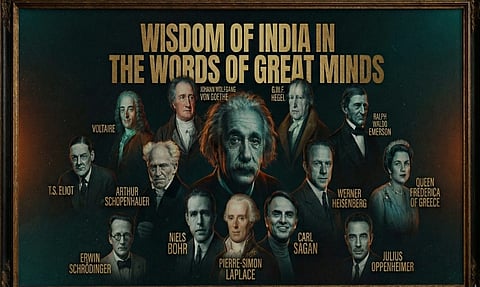
These were not polite compliments. They were honest acknowledgements of a debt. Albert Einstein, Niels Bohr, J. Robert Oppenheimer, Arthur Schopenhauer, Werner Heisenberg, T.S. Eliot, Voltaire, Johann Goethe, Carl Sagan, Mark Twain — all of them appear in the book, speaking with deep respect about Indian thought and its influence on their own work. As I turned the pages, I felt something inside me shift. I understood that I had quietly accepted a lie about where wisdom comes from.
What changed in me was not a sudden surge of patriotism, though that came too. It was something more personal. I suddenly saw that I had been believing a misconception about what human knowledge truly is and what it is meant for. That realization arrived not as abstract philosophy but as lived experience, the way a great book always works on us: it makes us feel seen, understood, validated. And it made me curious about the man who had been patient enough, obstinate enough, to gather all these voices across time.
Most readers know ‘Great Minds on India’ only as a finished book. They do not see the long road behind it. Salil Gewali did not work from a famous university or a large research centre. He worked from his modest home in Shillong, having completed his schooling at Mawprem Modern High School, far from the main corridors of power and publishing. For more than two decades, he read, searched, verified, and arranged the statements of scientists, poets, and philosophers, spanning both time and continents.
Gewali says he began this work in the 1980s, during his early youth, when access to rare books and scholarly material was far more difficult than it is today. There were no online databases at his fingertips. Every quotation had to be tracked down, checked, and placed in context. It was a lonely kind of labour. Around him, most people probably did not see the point of such a thankless project. Yet he persisted, believing that Indian wisdom could influence global ideas more than many realised, as the Nobel Laureate Erwin Schrödinger stated convincingly: “Vedanta teaches that consciousness is singular, all happenings are played out in one universal consciousness, and there is no multiplicity of selves.” Schrödinger, the man behind the groundbreaking wave equation of quantum physics, having deeply merged into the Upanishads, saw in Indian thought not merely a philosophy, but a remedy for the West’s intellectual exhaustion—a light strong enough to challenge and renew the very foundations of modern thought.
In 1998, he took his first small step. He brought out a slim Xeroxed booklet titled ‘What is India?’. It had only fifty copies. There was no marketing plan, no powerful patron, no promise that anyone would pay attention. Looking back, I see that act as an early sign of his courage. He was willing to share his work even when there was no guarantee of praise or success.
It was only in 2009 that the book, now expanded and refined as ‘Great Minds on India’, received a formal launch by Governor R.S. Mooshahary. With that event, the project finally had official recognition. More importantly, it offered proof of something simple but profound. Quiet persistence can eventually carry a work from a small room in Shillong to readers across India and the world, with a foreword by a NASA director.
I wish to underscore here: for generations, the West had celebrated its own classical works. Homer’s Odyssey, Virgil’s Aeneid, and Dante’s Divine Comedy stood as monuments to European thinking. Yet in the 20th century, T.S. Eliot, one of the most respected poets of the modern age, made a sincere observation about Indian philosophy. He said that the depth and subtlety of ancient Indian thinkers made most of the great European philosophers look like students still learning the basics. Eliot’s words were not casual praise. They came from a man who had devoted his life to understanding literature and philosophy.
An even prouder assertion comes from Queen Frederica of Greece, a scholar of advanced physics. She says, “You Indians are fortunate to inherit such knowledge. I envy you. While Greece is the country of my birth, India is the country of my soul.”
The great Greek philosopher and mathematician Pythagoras is believed to have endured tremendous hardship to reach India in pursuit of geometry and philosophy. References to this journey appear in the seminal writings of Voltaire.
Today Gewali’s book has been translated into sixteen languages. Each new translation, whether in an Indian language or a European one, is not just another edition. In addition to European countries, the book has gained appreciation in Islamic nations, with its Arabic edition translated by a scholar from Doha, Qatar. Among the latest developments is something that personally moves me. The Khasi edition of ‘Great Minds on India’ is now being translated by Paul Lyngdoh, an acclaimed poet and former Minister for Arts and Culture and Tourism in Meghalaya. This pairing feels exactly right. Lyngdoh knows the Khasi language from the inside. He understands its rhythm, its humour, its sense of dignity. He is not just converting words. He is carrying a whole atmosphere of respect for ancient literary strength into Khasi speech.
There is also a beautiful symmetry in this. For years, Gewali wrote from the hills of Meghalaya to address readers far beyond his own state. Now his research-based work is returning to its home ground in the language of the local community. When a respected literary figure like Paul Lyngdoh chooses to translate this book, it sends a strong message about the deeper knowledge of India that all seekers can confidently take refuge in. As Arthur Schopenhauer, the German philosopher deeply moved by the wisdom of the East, once proclaimed: “Knowledge of India has been the solace of my life, and it will be the solace of my death. They are the product of the highest wisdom.”
In the end, what stays with me is not just the story of one remarkable book, but the quiet invitation it extends to each of us. It asks us to look again at what we were taught to revere and what we were taught to ignore. It urges us to weigh borrowed assumptions against lived experience and the timeless wisdom that even the world’s most admired intellectuals openly acknowledged. If a single determined researcher in the hills of Meghalaya can help the world rediscover India’s intellectual light, perhaps each reader, in their own small way, can also become a custodian of that light. May that light inspire readers at home and beyond.
(Writer is an Associate Professor in the Department of Biochemistry at St. Edmund’s College, Shillong, India)
Suggested Reading:
Subscribe to our channels on YouTube and WhatsApp
Download our app on Play Store
