
- HOME
- OPINION
- ON GROUND
- INTERVIEW
- Neta Profile
- Editor's Pick
- INDIA
- NewsGram USA
- WORLD
- न्यूजग्राम
- POLITICS
- ENTERTAINMENT
- CULTURE
- LIFESTYLE
- ECONOMY
- SPORTS
- Jobs / Internships
- Misc.
- NewsGram Exclusive

Key Points:
Vinod Kumar Shukla was one of the greatest writers in the field of Hindi Literature, and the first author from Chhattisgarh to get awarded with Jnanpith award- Bharat’s highest literary honour.
Shukla passed away at AIIMS Raipur, on Saturday, December 23, 2025 due to organ failures. PM Modi and President Droupadi Murmu paid their respects to the writer, among others, stating that his contribution redefined Hindi Literature.
Shukla also received the prestigious Sahitya Akademi Award for his novel Deewar Mein Ek Khidki Rehti Thi in 1999. His prominent works include Naukar Ki Kameez, Lagbhag Jai Hind among others.
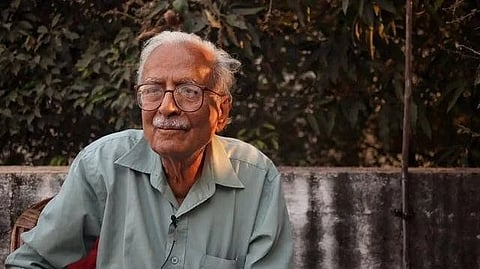
Vinod Kumar Shukla, a prolific Hindi writer, and one of the greatest Hindi Literateurs, passed away on Saturday, December 23, 2025. He was known for his writing style that depicted ordinary characters living simple lives, engaged in the difficulties of daily life. He was admitted to AIIMS Raipur on December 2, 2025 due to sickness. AIIMS authorities declared him dead on Saturday, and attributed the cause of death to multiple organ infection and organ failure.
Vinod Kumar Shukla was the first author from Chhattisgarh to have been awarded the Jnanpith Award, Bharat’s highest literary honour. He received the award on 21st November, 2025 at a special ceremony in his hometown. Earlier, he was announced as the 59th Jnanpith Awardee in March 2025. He received this award for his exceptional contribution in Hindi poems and novels.
Dignitaries from all over Bharat paid their respects and tributes to Vinod Shukla. In a post on X, PM Modi paid his tributes by saying that he was deeply saddened by the demise of Jnanpith Awardee Vinod Kumar Shukla Ji. He added: “He (Vinod Shukla) will always be remembered for his immense contribution in Hindi Literature. In this moment of mourning, I pay my condolences to his family and admirers. Om Shanti.”
President Droupadi Murmu also paid her tributes in a post on X. She remarked that Vinod Kumar Shukla Ji empowered and enriched the world of Hindi Literature through his impactful writings. Hindi literature has lost a gem today, she added. Many prominent celebrities and admirers of Vinod Kumar Shukla’s works paid their tributes and condolences.
Shukla’s writings were known for their simplicity, sensitivity and unique writing styles that maintained the story close to reality. His first work: “Lagbhag Jai Hind”, a collection of poems was published in 1971. A release by the Bhartiya Jnanpith at the time of awarding him the prestigious award, stated that Vinod Kumar Shukla’s poems and stories presented the nuances of a common man’s life in simple language. It also stated that he was famous for trying numerous experiments in modern Hindi writing.
While receiving the Jnanpith Award, Shukla said that he had heard, seen and felt a lot in his life, but could only write a little. He mentioned that a lot remained to write, and he would continue writing as long as he was alive. Upon receiving the magnanimous Jnanpith Award, acknowledging his contributions in the field of Hindi Literature, he humorously remarked that the moment didn’t feel too sweet, as he was diabetic.
See Also: Bajrang Dal Threatens Women and Children Wearing Santa Hats in Delhi, Alleging Proselytization
Shukla’s legendary career spanned over 5 decades, during which he wrote many novels, short stories, poems and essays. His prominent works include Deewar Mein Ek Khidki Rehtee Thi, Naukar Ki Kameez, Khilega To Dekhenge, Lagbhag Jai Hind, and Sab Kuch Hona Bacha Rahega among others. He received the prestigious Sahitya Akademi Award for his novel Deewar Mein Ek Khidki Rehti Thi in 1999. He was also awarded the PEN/Nabokov Award for Achievement in International Literature in 2023, becoming the first Indian writer to receive this international honour.
Vinod Kumar Shukla marked a crucial milestone in modern Hindi Literature. He didn’t create any superficial or extraordinary stories that praised a hero and displayed his acts of heroism. Rather, his creations focused on depicting the harsh realities of social life, bureaucracy and the burden common people face. The characters he produced displayed endurance, observation, patience and often achieving a brief moment of freedom that mostly remained out of their reach.
(GP)
Suggested Reading:
Subscribe to our channels on YouTube and WhatsApp
Download our app on Play Store

