
- HOME
- OPINION
- ON GROUND
- INTERVIEW
- Neta Profile
- Editor's Pick
- INDIA
- NewsGram USA
- WORLD
- न्यूजग्राम
- POLITICS
- ENTERTAINMENT
- CULTURE
- LIFESTYLE
- ECONOMY
- SPORTS
- Jobs / Internships
- Misc.
- NewsGram Exclusive

Sam Manekshaw and Yahya Khan served together in the British Indian Army before Partition but later led opposing forces during the 1971 India-Pakistan War.
Before Partition, Yahya Khan bought Manekshaw's red motorcycle for ₹1,000 but reportedly never paid for it. The story became one of the most memorable anecdotes associated with the two military leaders.
Following India's victory in the 1971 war, Manekshaw humorously remarked that although he had waited 24 years for the ₹1,000, Yahya Khan had "paid with half of his country" after the creation of Bangladesh.
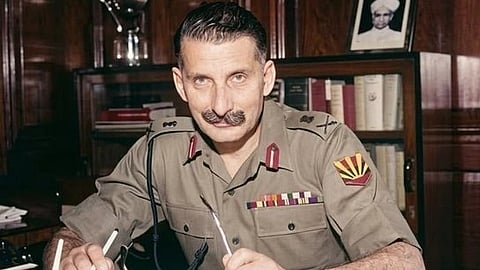
TODAY MARKS THE DEATH ANNIVERSARY of Field Marshal Sam Hormusji Framji Jamshedji Manekshaw, who died on June 27, 2008. The army general was popularly known as Sam Bahadur and was an Indian Army general who served as the Chief of the Army Staff during the 1971 India-Pakistan War. He was also the first Indian Army officer to be promoted to the rank of Field Marshal. He is celebrated for his brilliant military leadership and strategy, which helped India achieve victory in war.
He was given the name Sam Bahadur by the soldiers of the 8 Gorkha Rifles as a mark of affection. A movie titled Sam Bahadur (2023), starring Vicky Kaushal, was also made on his life. The leader was widely loved and respected. His military journey spanned over four decades and included four major wars, including World War II. He received many honours, including the Padma Bhushan in 1968 and the Padma Vibhushan in 1972, for his contribution to India's defence.
General Manekshaw was famous for his sharp wit and courage. He was never shy in front of the camera or journalists and always spoke his mind to politicians and the press. He was known for being unfiltered, and his humorous yet profound quotes on courage and leadership continue to be celebrated among the armed forces of India. During his military career, he shared a famous relationship with another army general, Yahya Khan. The two had deep appreciation and comradeship for each other, which was forged during World War II.
The two leaders served together in the British Indian Army before the Partition of India in 1947. After Partition, their relationship became more complex. Their personal bond was balanced by mutual military respect, rivalry, and wit. They eventually found themselves fighting against each other during the 1971 India-Pakistan War, which shaped their turbulent relationship. In the war, Manekshaw led India to victory, resulting in the surrender of tens of thousands of Pakistani troops.
There is one popular story from that period about a red motorcycle owned by General Sam Manekshaw. At that time, Manekshaw was a Lieutenant Colonel, while Yahya Khan was an Army Major. Yahya Khan had his eye on the motorcycle and wanted to own it. Pakistani columnist and social activist Ardeshir Cowasjee wrote about this incident in a column published in 2008.
In the column, Cowasjee wrote that before Khan left for Karachi after the Partition in 1947 and the formation of Pakistan, he made an offer to Sam Manekshaw. General Khan offered to buy the red motorcycle for Rs 1,000, and General Manekshaw agreed to sell it to him. Then Partition took place in August 1947, and Yahya Khan took the red motorcycle with him to Karachi, Pakistan, as planned.
But one thing was missing—Khan never paid the price of the motorcycle to its owner, Manekshaw. Then came 1971. By this time, Manekshaw had become the Chief of the Indian Army, while Yahya Khan had become the President of Pakistan. The two leaders found themselves on opposite sides of the 1971 India-Pakistan War. The war ended with India's victory over Pakistan, the liberation of East Pakistan, and the creation of Bangladesh.
General Manekshaw, who was well known for his sense of humour, took a jibe at Khan after India's victory. He said that he had waited 24 years for the Rs 1,000, "but now he has paid with half of his country." After the war, Pakistan's geopolitical landscape changed, and Bangladesh emerged as an independent country.
Mr. Cowasjee later said, as quoted by NDTV, that when he met General Manekshaw, he told him that Yahya Khan had never forgotten the debt he owed Manekshaw but had never got the opportunity to repay it, while offering to return the Rs 1,000 along with interest. Thus, the relationship between the two leaders was shaped by mutual military respect, a famous unfulfilled financial transaction, and eventually leading opposing forces in the historic 1971 Indo-Pak War.
(Edited by Harsh Pandey)
Suggested Reading:
Subscribe to our channels on YouTube and WhatsApp
Download our app on Play Store


