
- HOME
- OPINION
- ON GROUND
- INTERVIEW
- Neta Profile
- Editor's Pick
- INDIA
- NewsGram USA
- WORLD
- न्यूजग्राम
- POLITICS
- ENTERTAINMENT
- CULTURE
- LIFESTYLE
- ECONOMY
- SPORTS
- Jobs / Internships
- Misc.
- NewsGram Exclusive

Key Points
Delhi University has prohibited public meetings, rallies, demonstrations, processions and assemblies of five or more people on campus from 17 February 2026, citing concerns over traffic disruption, safety risks and law and order.
The decision comes after confrontations during a protest over UGC Equity Regulations, cross FIRs between student groups and a YouTuber, and an NHRC notice over an alleged assault of a journalist.
Teachers and student bodies have condemned the order, calling it a “blanket clampdown” and an attack on democratic space, demanding that the ban be withdrawn.
Delhi University (DU) on Tuesday, 17 February 2026, imposed a one-month ban on public meetings, demonstrations, processions and protests across its campus, citing concerns over traffic obstruction, safety risks and disturbance to public peace.
The order, issued by the Proctor’s Office, comes after recent protests in and around campus resulted in clashes between student groups and an attack on a professor.
The notification specifically bars:
Holding any public meeting, rally, dharna, protest or agitation
Assembly of five or more persons
Carrying hazardous materials including mashals, beacons or torches
Engaging in activities that affect public tranquillity or traffic flow
Shouting slogans and making speeches
The notification states that the decision was taken in view of “information received indicating that unrestricted public gatherings, processions, or demonstrations on campus may lead to obstruction of traffic, threats to human life, and disturbance of public peace.” It further notes that in the past, organisers have “often failed to control such protests, which have escalated and spread widely, resulting in deterioration of law and order within the University campuses”.
The Proctor’s office referred to an earlier directive issued by the Assistant Commissioner of Police, Civil Lines, which similarly prohibited public meetings and demonstrations that could disrupt peace or traffic in the area.
DU Proctor Manoj Kumar Singh described the move as a precautionary step aimed at preventing escalation. Referring to events on 13 February 2026, he said the university did not want a repeat of such incidents and emphasised the need to maintain law and order on campus. He added that while seminars are welcome, protests are completely banned for the duration of the order.
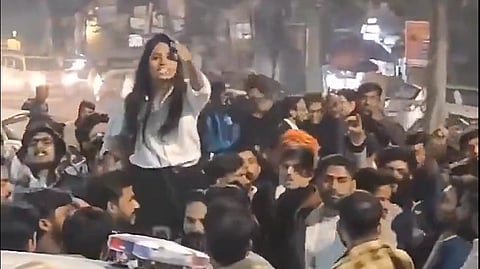
On 13 February 2026, the All India Students’ Association (AISA) took out an ‘Adhikar rally’ in support of the new University Grants Commission’s proposed Equity Regulations. At the rally, YouTuber Ruchi Tiwari, who refers to herself as a ‘Brahmin journalist’, was seen having an altercation with a Dalit journalist. AISA DU secretary Anjali Sharma attempted to intervene, resulting in a clash, with both sides accusing the other of violence.
Videos from the incident show Tiwari throwing Sharma to the ground and then being restrained by AISA activists. Tiwari later claimed that she was surrounded and targeted for her Brahmin identity. She alleged that the AISA activists issued rape threats against her and tried to lynch her. AISA refuted the allegations in a statement, saying that Tiwari had “a notorious reputation of creating chaos and inciting violence,” and adding that AISA activists were “getting rape and death threats constantly.”
The matter escalated when AISA attempted to file a complaint at Maurice Nagar police station. While inside, the building was surrounded by a mob, abusing and threatening the activists inside. Videos of the scene show another YouTuber, Megha Lawariya, shouting “Brahmanvaad Zindabaad” while part of the crowd.
Cross FIRs were later registered at the police station under multiple provisions of the Bharatiya Nyaya Sanhita (BNS), including sections related to assault, wrongful restraint and common intent. The National Human Rights Commission (NHRC) sent notices to the Deputy Commissioner of Police, North Delhi, and the Vice Chancellor of Delhi University regarding the alleged assault of a female journalist during the protest, seeking a report on the incident.
A day earlier, on 12 February 2026, AISA had organised a ‘People’s Literature Festival’ outside the DU Arts Faculty. At the event, historian Irfan Habib was disrupted during his address when a bucket of water was thrown at him, while attending students were pelted with bricks. AISA attributed the attack to the Akhil Bharatiya Vidyarthi Parishad (ABVP), which denied the allegation.
The university’s decision has drawn sharp criticism from sections of the faculty and student bodies, who have described it as a “blanket clampdown” on democratic rights.
Mithuraj Dhusiya, associate professor of English at Hansraj College, questioned the grounds cited by the administration. While acknowledging that protests must remain peaceful and that the university has a responsibility to maintain order, he argued that invoking “obstruction of traffic” to bar gatherings was unacceptable. He demanded that the order be withdrawn and raised concerns about whether the administration was attempting to curb mobilisations on issues such as appointments, implementation of the National Education Policy (NEP), the UGC Equity Bill and recent teacher suspensions.
Speaking to Newslaundry, Abha Dev Habib, associate professor at Miranda House and secretary of the Democratic Teachers’ Front, described the move as an “attack on a vibrant democratic space.” She argued that the right to protest is constitutionally guaranteed and said universities have established procedures to regulate demonstrations without imposing sweeping prohibitions.
The Students’ Federation of India (SFI) said the solution to campus incidents was not the suppression of democratic voices. The National Students’ Union of India (NSUI) termed the decision an attempt to silence student mobilisation, particularly on issues concerning equity and representation. Other faculty members also publicly opposed the order, describing it as an unacceptable restriction on democratic functioning within the university.
Delhi University has historically been a politically active campus, with student organisations mobilising on issues ranging from fee hikes and faculty appointments to national education reforms. The latest restriction has intensified debate over how universities should balance the maintenance of law and order with the protection of peaceful assembly and dissent within academic spaces.
[DS]
Suggested Reading:
Subscribe to our channels on YouTube and WhatsApp
Download our app on Play Store
