
- HOME
- OPINION
- ON GROUND
- INTERVIEW
- Neta Profile
- Editor's Pick
- INDIA
- NewsGram USA
- WORLD
- न्यूजग्राम
- POLITICS
- ENTERTAINMENT
- CULTURE
- LIFESTYLE
- ECONOMY
- SPORTS
- Jobs / Internships
- Misc.
- NewsGram Exclusive

The Supreme Court has put the UGC’s 2026 Equity Regulations on hold over vague provisions and the exclusion of general category students.
The Court noted inconsistencies in the discrimination provisions, particularly Regulation 3(c), and directed that the rules be reviewed by an expert committee.
The regulations had triggered nationwide protests, political backlash, and multiple legal challenges, with the next hearing scheduled for March 19, 2026.
On Thursday, January 29, 2026, the Supreme Court of India put on hold the University Grants Commission (Promotion of Equity in Higher Education Institutions) Regulations, 2026, following widespread objections, protests, resignations, and multiple petitions challenging the framework. The Court ordered that the regulations remain in abeyance until further orders and clarified that the 2012 UGC regulations on the same subject would continue to operate.
The 2026 regulations, notified by the UGC on January 13, 2026 were aimed at preventing discrimination and promoting equity across higher education institutions. However, several petitioners challenged the rules, arguing that they were arbitrary, exclusionary, and discriminatory towards students belonging to the general category. The petitioners contended that the framework denied grievance redressal and institutional protection to students from the unreserved category.
A Bench comprising Chief Justice of India Surya Kant and Justice Joymalya Bagchi observed that allowing the regulations to operate without judicial intervention could have serious social consequences. “If we don't intervene it will lead to dangerous impact, will divide the society and will have grave impact,” the Court said. The Bench further noted that the regulations required closer scrutiny by experts due to vague and potentially exploitable language. “Prima facie we say that the language of the regulation is vague and experts need to look into for the language to be modulated so that it is not exploited,” the Court observed.
The Court issued notice to the UGC and the Union government, directing that the matter be examined by an expert committee. It ordered that the notice be returnable on March 19, 2026 and recorded that the Solicitor General had accepted the notice. The Bench also noted that the issues raised in a 2019 petition would have a bearing on examining the constitutionality of the 2026 regulations. The Court directed that all related petitions be tagged together and reiterated that the UGC Regulations, 2026, would remain in abeyance until further orders.
A major point of contention before the Court is the inconsistency between Regulation 3(c) and Regulation 3(e). While Regulation 3(c) defines “caste-based discrimination” as discrimination only against members of Scheduled Castes, Scheduled Tribes, and Other Backward Classes, Regulation 3(e) provides a broader definition of discrimination. It includes any unfair or biased treatment against any stakeholder on the grounds of religion, race, caste, gender, place of birth, or disability.
Questioning the need for a separate provision, the Court asked, “Now looking at this, how does Section 3(c) become relevant when Section 3(e) is existing. When 3c() is already ingrained in 3(e) why to bring it as a separate provision.”
Advocate Vishnu Jain, appearing for the petitioners, argued that the narrow definition of caste-based discrimination was unconstitutional as it excluded the general category. Raising concerns about real-world application, Chief Justice Kant posed a hypothetical scenario: “Suppose a student from south gets admission in North or student from North takes admission in south. Some kind of sarcastic remark which is humiliating against him and if the caste of both parties are not known.. which provision covers it.” Jain responded, “Section 3(e) covers it all.”
The Court also reflected on the persistence of social divisions decades after independence. Chief Justice Surya Kant remarked, “In a country after 75 years all that we have achieved to become a classless society are we becoming a regressive society?” Justice Joymalya Bagchi added that while Article 15(4) empowers states to make special laws for Scheduled Castes and Scheduled Tribes, there should be no regression in progressive legislation. He said he hoped India would not move towards segregated schools, drawing a comparison with the segregation of Black and white students in the United States.
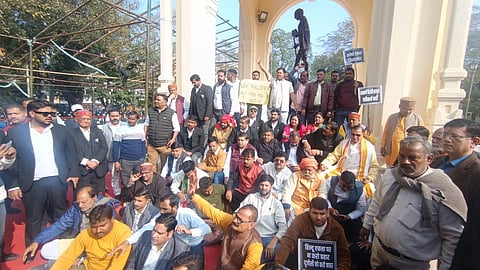
Since their notification, the regulations have triggered widespread opposition, including student protests, resignations within the BJP, criticism from Members of Parliament, and multiple legal challenges. Regulation 3(c) remains at the centre of the controversy, with critics alleging exclusion, the absence of safeguards against false or malicious complaints, and discrimination against general category students.
Under the 2026 framework, the UGC mandates that all higher education institutions establish an Equal Opportunity Centre (EOC), an Equity Committee, and Equity Squads to address identity-based discrimination. These bodies are to be chaired by members representing reserved categories, including women and persons with disabilities. However, the Supreme Court’s intervention has temporarily halted the implementation of these provisions. The next hearing in the matter has been scheduled for March 19, 2026.
Suggested Reading:
Subscribe to our channels on YouTube and WhatsApp
Download our app on Play Store
