
- HOME
- OPINION
- ON GROUND
- INTERVIEW
- Neta Profile
- Editor's Pick
- INDIA
- NewsGram USA
- WORLD
- न्यूजग्राम
- POLITICS
- ENTERTAINMENT
- CULTURE
- LIFESTYLE
- ECONOMY
- SPORTS
- Jobs / Internships
- Misc.
- NewsGram Exclusive

Key Points
The Centre has said there is no proposal under consideration for a complete waiver of farm loans, according to a reply in the Lok Sabha.
The government highlighted measures such as subsidised crop loans, increased collateral-free lending, and direct income support to farmers.
Official data shows agricultural credit disbursement has grown at a 15% annual rate in recent years, even as outstanding loans remain high across states.
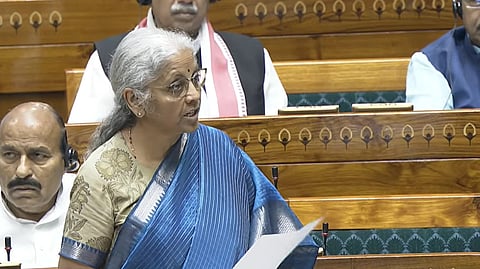
Finance Minister Nirmala Sitharaman announced in Lok Sabha that the Centre is not considering any proposal for a complete waiver of agricultural loans, reiterating its position that farmer support is being pursued through credit access, subsidies, and welfare schemes.
Responding to a starred question by Hanuman Beniwal of the Rashtriya Loktantrik Party on 23 March 2026, Sitharaman stated that no scheme for a full farm loan waiver is under consideration. The reply came in response to queries on whether the government planned to introduce such a measure to strengthen farmers’ economic conditions.
Instead, the Centre emphasised a set of ongoing interventions aimed at improving farm incomes and ensuring access to institutional credit. These include the Kisan Credit Card (KCC) system, which provides crop loans of up to ₹3 lakh at subsidised interest rates under the Modified Interest Subvention Scheme, with additional incentives for timely repayment.
The government has also increased the limit for collateral-free short-term agricultural loans, including loans for allied activities, from ₹1.60 lakh to ₹2 lakh. It further pointed to efforts to ensure adequate credit flow to agriculture through Priority Sector Lending guidelines issued by the Reserve Bank of India (RBI).
In addition to credit-based support, the Centre cited schemes such as crop insurance and direct income transfers under the Pradhan Mantri Kisan Samman Nidhi (PM-KISAN) as part of its broader approach to supporting farmers.
Data presented in Parliament also showed a steady expansion in agricultural lending. According to figures reported by the National Bank for Agriculture and Rural Development (NABARD), agricultural credit disbursement grew at a compound annual growth rate of 15% between financial years 2022-23 and 2024-25.
State-wise data indicates significant increases in credit flow across major agricultural states. For instance, credit disbursement in Uttar Pradesh rose from ₹1,51,452 crore in 2022-23 to ₹1,96,225 crore in 2024-25, while Maharashtra saw an increase from ₹1,50,532 crore to ₹2,01,867 crore during the same period. Tamil Nadu recorded among the highest disbursements, reaching ₹4,83,678 crore in 2024-25.
At the same time, outstanding agricultural loans remain substantial across states and banking categories. As of 31 December 2025, Tamil Nadu had the highest outstanding loans among scheduled commercial banks at ₹4,56,718 crore, followed by Andhra Pradesh at ₹2,85,380 crore and Maharashtra at ₹2,49,900 crore.
The data also shows the role of different banking channels in agricultural lending, including scheduled commercial banks, regional rural banks, and cooperative banks. For example, in Uttar Pradesh, outstanding loans stood at ₹1,69,112 crore through scheduled commercial banks and ₹60,985 crore through regional rural banks.
These figures underline both the scale of institutional credit available to farmers and the extent of their dependence on borrowing.
The statements were made during the ongoing Budget Session of Parliament, where multiple questions were raised regarding farm distress, credit access, and welfare provisions.
Earlier during the sitting, PM Modi had addressed the Lower House on the ongoing West Asia crisis. He had specified that Indian farmers would be supported through the crisis, similar to the Covid pandemic when they were provided with subsidised fertilizer during a global shortage.
Earlier during the Budget Session 2026, the Opposition had raised serious concerns over the impact of the recent US-India Trade Deal on India farmers. Several farmer unions and politicians had emonstrated against the deal nationwide, demanding guarantees for farmers from impending losses due to the opening of India’s market to the US agriculture sector. The Centre at the time had clarified its position to protect Indian farmers from any negative impact of the deal.
The government’s latest response closely follows these recent tensions and signals a continued preference for credit-led support rather than large-scale loan waivers. By expanding subsidised loans, increasing collateral-free limits, and strengthening credit flow mechanisms, the Centre has sought to improve liquidity for farmers without resorting to blanket debt relief.
[DS]
Suggested Reading:
Subscribe to our channels on YouTube and WhatsApp
Download our app on Play Store
