
- HOME
- OPINION
- ON GROUND
- INTERVIEW
- Neta Profile
- Editor's Pick
- INDIA
- NewsGram USA
- WORLD
- न्यूजग्राम
- POLITICS
- ENTERTAINMENT
- CULTURE
- LIFESTYLE
- ECONOMY
- SPORTS
- Jobs / Internships
- Misc.
- NewsGram Exclusive

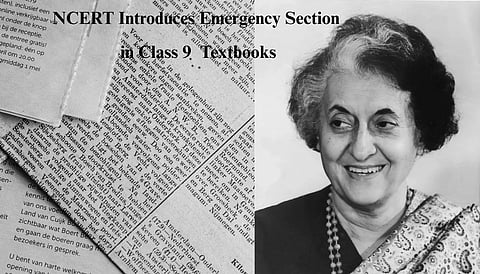
The NCERT has officially introduced the 1975 National Emergency topic into the Class 9th textbook
The NCERT included Emergency in the Class 9th textbook, presenting it as "one of the major challenges"
The National Emergency was declared by the former Prime Minister Indira Gandhi in 1975
MARKING A SIGNIFICANT MOMENT in Indian history, the National Council of Educational Research and Training (NCERT) has officially introduced the 1975 National Emergency topic into the Class 9th Social Science syllabus for the very first time. Five decades ago, the Emergency was imposed in India during which the majority of the fund rights were suspended. The NCERT included Emergency in the Class 9th textbook, presenting it as "one of the major challenges.”
A new section named as "Democracy and You", has been included for the first time to help students connect classroom learning with their role as the citizens of India and participants in the processes of democracy. It will examine the strengths and challenges of Indian democracy
The NCERT officials said that, “This is the first time in the history that a section on ‘National Emergency’ has been added in the textbook of Class 9th.” The inclusion marks a significant addition into the school curriculum, coming as India recently observed 50 years since the declaration of the Emergency in 1975. Previously, detailed lessons on the National Emergency were reserved strictly for the Senior Secondary (Class 12) Political Science students only.
"One of the major challenges to democracy in India was recorded when a national Emergency was imposed between the time period of 1975-77. In the early 1970s, the public were not satisfied with the government led by Indira Gandhi. During this period, rising unemployment, inflation, and allegations of misgovernance led to widespread protests in several parts of the country against the government," the NCERT section reads.
The National Emergency was declared by the former Prime Minister Indira Gandhi in 1975, it was imposed by the government on the ground of internal disturbance. During the time period of the National Emergency, the majority of fundamental rights were suspended, various activists and political leaders were arrested, and the press was also censored. Several democratic institutions came under severe strain, and citizens’ freedom was also restricted.
See also: NCERT’s Portrayal of Mohenjo-daro’s ‘Dancing Girl’ Draws Attention, Sparks Debate
The book also highlighted the role of Jayaprakash Narayan, political leader in the movement against the Emergency. Apart from the Emergency, the Class 9th textbook also discusses concerns such as misinformation, fake news, damaging public property, poverty, regionalism, violation of public rules, social discrimination, and gender inequality. The book also has a dedicated section on the role of media in a democracy, in which the media is described as the “fourth pillar of democracy” and also highlights its role in solving public issues and safeguarding democratic values.
The book reads, “Mass movements led by Jayaprakash Narayan—a political leader and social analyst, popularly known as Lok Nayak—mobilized students and citizens, especially in Bihar and Gujarat. The National Emergency was lifted in the year 1977, and general elections were conducted, allowing people to express their will and opinions through the ballot. The defeat of the Indira Gandhi led government demonstrated the strength of the democracy of India and highlighted the significance of democracy in the country.”
(Edited By Vaishnavi Sivadasan)
Suggested reading:
Subscribe to our channels on YouTube and WhatsApp
Download our app on Play Store
