
- HOME
- OPINION
- ON GROUND
- INTERVIEW
- Neta Profile
- Editor's Pick
- INDIA
- NewsGram USA
- WORLD
- न्यूजग्राम
- POLITICS
- ENTERTAINMENT
- CULTURE
- LIFESTYLE
- ECONOMY
- SPORTS
- Jobs / Internships
- Misc.
- NewsGram Exclusive

AI generated summary, newsroom-reviewed
AFTER A DRAMATIC sequence of events over the last month, the education sector has become the focus of the entire nation. Amidst the Jantar Mantar protest’s success, Prime Minister’s late night reels, and Dharmendra Pradhan’s resignation, Nandan Nilekani, one of co-founders of Infosys, has been appointed as the man to lead the task force given the responsibility to suggest reforms in education sector.
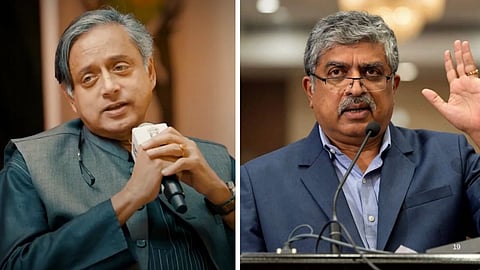
After the task force was announced by PM Narendra Modi on Sunday, July 26, 2026, Shashi Tharoor had his own set of suggestions for Nilekani. In the letter, addressed directly to the Task Force leader, Tharoor argues that India's present examination model has become “structurally obsolete, morally exhausted, and intellectually deadening." According to the Congress Member of Parliament, the crisis expands far beyond paper leaks and reflects a system that has repeatedly failed millions of students.
Welcoming Nilekani's appointment, Tharoor recalled that an earlier committee headed by former ISRO chairman Prof. K. Radhakrishnan was also formed for the same task after the 2024 examination controversies. That committee had submitted 101 recommendations to the center, many of which, according to Tharoor, still remain unimplemented.
"The nation now looks to your leadership with renewed hope," Tharoor wrote in the letter to Nilekani. Describing the mood among young people as one of "profound angst and unprecedented disillusionment," he said millions of students had spent years preparing for competitive examinations, “sacrificing sleep, health, and family resources, only to be betrayed by the failings of the system."
According to Tharoor, the protests witnessed in recent weeks were not merely a reaction to another paper leak but the inevitable result of years of accumulated frustration over repeated cancellations, examination failures and uncertainty about employment.
He writes, "The recent protests were not merely about a series of paper leaks. They represented the inevitable breaking point of a system that has become structurally obsolete, morally exhausted, and intellectually deadening.”
One of Tharoor's biggest suggested reforms is to move away from India's current single-day, high-stakes entrance examinations. He argued that when millions of students appear for the same examination on a single day, the chances of paper leaks, technical failures, and administrative mistakes increase significantly. A medical emergency or a traffic disruption can end a student's chances for an entire year.
However, Tharoor proposed a continuous, modular and computer-adaptive testing model similar to international examinations like the Graduate Record Examination (GRE) and Scholastic Assessment Test (SAT). He further proposes that secure examination centres should be established in every district, allowing students to appear for tests multiple times a year and submit their highest score for admissions.
The Congress MP also recommended the use of dynamically generated question banks, protected through cryptographic technology so that every candidate receives a different question paper. Such a model, he argues, would make traditional paper leaks "structurally impossible."
Tharoor also criticised India's examination culture for encouraging rote learning instead of genuine understanding. According to him, most national entrance examinations reward "high-speed pattern recognition and rote recall" instead of analytical thinking and conceptual clarity.
Repeating a point he has often made publicly, Tharoor said education should teach students "how to think" rather than "what to think." However, he argued, such ideas cannot succeed as long as examinations continue rewarding memorisation.
To change this, he suggested redesigning entrance examinations to focus more on analytical reasoning, problem-solving abilities, and conceptual understanding. He further argued that reforming examinations alone would not solve the larger problem in the system unless universities themselves become more relevant to contemporary times.
Every undergraduate programme, he suggested, should include internships, research projects, or community field work so that degrees reflect practical skills rather than classroom attendance alone. This further linked to his next point where the Congress MP also linked examination anxiety to the country's employment situation.
Pointing to high levels of graduate unemployment, he said public recruitment has become a major bottleneck, with lakhs of applicants competing for a handful of government jobs. He proposed replacing multiple recruitment examinations with a unified National Public Service Aptitude Assessment conducted twice every year while ensuring vacant government posts are filled without unnecessary delays.
Tharoor, while pointing out the recurring irregularities in the education system, called for a National Testing Standards Act. He proposed making testing agencies legally responsible for protecting students' interests, compensating candidates affected by cancellations, introducing strict grievance timelines and imposing severe criminal liability in cases of negligence or corruption.
He also suggested creating an independent Ombudsman for Educational Examinations to audit security systems and publish annual transparency reports.
Ending the letter while directly addressing Nilekani, Tharoor wrote that India now faces a choice between continuing to repair "a collapsing, century-old apparatus" or building "a resilient, world-class education system worthy of India's future." According to him, the present crisis offers an opportunity to reimagine how the country evaluates and prepares its young people for higher education and employment.
Suggested Reading:
Subscribe to our channels on YouTube and WhatsApp
Download our app on Play Store
