
- HOME
- OPINION
- ON GROUND
- INTERVIEW
- Neta Profile
- Editor's Pick
- INDIA
- NewsGram USA
- WORLD
- न्यूजग्राम
- POLITICS
- ENTERTAINMENT
- CULTURE
- LIFESTYLE
- ECONOMY
- SPORTS
- Jobs / Internships
- Misc.
- NewsGram Exclusive

Badnam Basti, based on Kamleshwar’s novel, portrayed a bisexual love triangle at a time when homosexuality was criminalised under Section 377, making it revolutionary for Indian cinema.
Heavy cuts, re-edits, and commercial failure led to the film’s gradual erasure, with no surviving prints in India for decades.
The film was accidentally found in Berlin in 2019, restored, and later screened internationally, finally receiving the recognition it deserved.
Long before hashtags and streaming platforms, Indian cinema had already dared to tell a bold queer story. In 1971, when conversations about sexuality were taboo and Section 377 was in force, a small but powerful film quietly broke all rules. Its name was Badnam Basti. For nearly 40 years, it was lost to history.
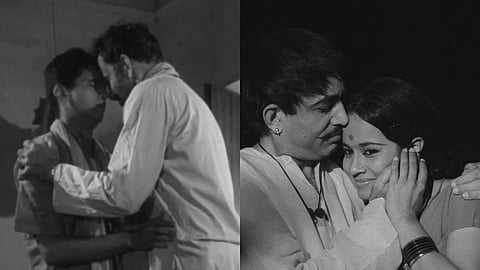
Based on Kamleshwar’s 1957 novel Ek Sadak Sattavan Galiyan, the film explored a bisexual love triangle in a small town in Uttar Pradesh. At a time when even talking about same-sex love was dangerous, Badnam Basti portrayed a man who loved both a woman and another man. It was revolutionary, gentle, and far ahead of its time.
The story followed Sarnam Singh, a former dacoit turned truck driver, and his emotional bonds with dancer Bansuri, whom he had rescued, and a young cleaner named Shivraj. Sarnam’s love for both Bansuri and Shivraj created a complex and layered love triangle. Their relationship unfolded quietly, but its impact was powerful. The film simply showed love — human, vulnerable, and real. However, society was not ready to accept it.
Because of its bold theme, the film faced heavy censorship. The censor board demanded several cuts and changes before allowing its release. Director Prem Kapoor was forced to heavily edit the film and remove many queer overtones to get clearance. As a result, Badnam Basti was released in 1971 with an ‘A’ certificate. This version, however, was far removed from Kapoor’s original vision.
Following the failure of the 1971 release, a re-edited version was released in 1978 with a ‘U’ certificate after further changes. Despite these efforts, the film failed commercially once again. Over time, it disappeared completely from circulation, with no prints available in India for decades. This led to its silent erasure and its status as a “lost film.”
The movie was financed by the Film Finance Corporation (now NFDC) with a budget of ₹2.5 lakh and was shot in just four weeks in Uttar Pradesh. It was made long before the decriminalisation of homosexuality, at a time when Section 377 of the Indian Penal Code criminalised same-sex relationships. Despite this, the makers placed a same-sex relationship at the centre of the story and treated it with dignity, without tragedy or ridicule. The film focused on the beauty and humanity of love.
The film starred Nitin Sethi as Sarnam, Nandita Thakur as Bansuri, and Amar Kakkad as Shivraj. Beyond its representation of bisexuality, Badnam Basti was also notable for its experimental style, including a non-linear and fragmented narrative structure. It portrayed subtle moments of intimacy, emotional tension, and quiet desire, hinting at Sarnam’s deep feelings for Shivraj.
For decades, film historians believed the movie was lost forever. But fate had written something else for it. In 2019, the film was rediscovered by accident in Berlin. Curators Simran Bhalla and Michael Metzger were searching the Arsenal Institute for Film and Video Art archives for work by another director when they unexpectedly found a 35mm print of Badnam Basti. The film had been screened in Germany in 1971 and then stored away. While it had not been preserved in India, it had survived in a faraway land.
After five decades, Badnam Basti finally found its audience. On May 7, 2020, the restored film was screened at the Block Museum of Art at Northwestern University in Illinois, USA. It was later premiered at the Kashish Mumbai International Queer Film Festival and, in August 2025, at the Indian Film Festival of Melbourne. At last, the film reached the queer community it was always meant for.
Despite its historical importance, Badnam Basti remains largely absent from official records. The A-rated film is not mentioned in the Encyclopaedia of Indian Cinema. Director Prem Kapoor passed away in 2011 at the age of 83, without seeing his debut film fully recognised. Today, Badnam Basti is remembered as India’s first queer film — a revolutionary story of a bisexual love triangle set in Uttar Pradesh that challenged social norms.
[VP]
Suggested Reading:
Subscribe to our channels on YouTube and WhatsApp
Download our app on Play Store
