--

Key Points:
Brand New Day is, first and foremost, a Tom Holland Spider-Man movie, not a fan-service circus for the audience.
The story isn't interested in expanding the mythology for its own sake, it's interested in Peter Parker.
Brand New Day isn't trying to be the loudest or most badass entry in the Spider-Man canon, and it's better for it.
By Gopal Ram Tripathi
THERE’S A VERSION of this film that could have easily existed. One stuffed to the seams with legacy cameos, multiversal elements, and a bunch of villains thrown at the screen just to keep the fan theories buzzing. Thankfully, that isn't the film we got. Brand New Day is, first and foremost, a Tom Holland Spider-Man movie, not a fan-service circus for the audience.
That restraint is exactly what this chapter of Peter's story needed. After the high intensity and scale of what came before, there's something refreshing about a Spider-Man movie that chooses to dive deeper into the humane aspects of our beloved character.
What sets this entry apart is its restraint. The story isn't interested in expanding the mythology for its own sake, it's interested in Peter Parker, the person underneath the mask, and everything he's had to sacrifice to keep being Spider-Man. After everything he's been through, the loss, the isolation, the world forgetting who he is, this film finally slows down long enough to ask what that's actually done to him. There's a quiet, aching quality to the way Peter carries himself here. He's not performing heroism anymore; he's trying to figure out whether he even wants to keep doing this, and what it costs him every time he pulls the mask on.
Holland has always been good at the wide-eyed, eager version of Peter. What's new here is how comfortable he is in the stillness, the moments where nothing is happening except a young man sitting with his own exhaustion. There's a quiet, largely dialogue-free scene where he simply sits with the suit in his lap, and it says more about where Peter is emotional than any monologue could.
Those scenes carry more weight than any big reveal the trailers promised, and that's very much the point. This isn't a film chasing spectacle for the ‘Wow’ factor. It's chasing character, and trusting the audience to stay invested in Peter even when nothing is exploding on screen. That's a genuine risk for a franchise this size, and it mostly pays off.
See Also: The Odyssey (2026): Christopher Nolan Elevates the Historic Epic to the Level of Spectacle
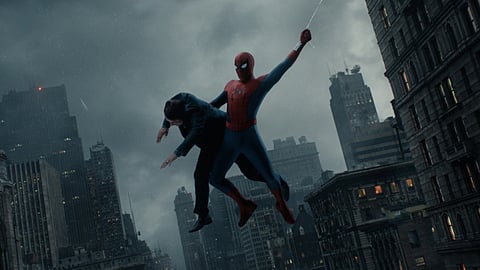
None of this means the film skimps on the parts that make Spider-Man, Spider-Man. The action sequences are some of the most kinetic and inventive the franchise has produced. There's a sense of weight and momentum to the swinging that feels genuinely improved, less like a camera chasing a CG blur and more like you're riding along with him through the city. A showcase of the city of New York that feels like a proper immersive experience once again, not just a backdrop for destruction, a lived-in city where Spider-Man stands beside.
The color grading deserves real credit too, and might be some of the best the franchise has looked. Gone is the slightly flat, over-lit look of earlier films; this one leans into moodier blues, warmer practical lighting, and a richer contrast that gives every frame more texture. Night-time sequences benefit especially, the city glows instead of just being lit, and shadows are allowed to sit on Peter's face in his quieter moments. It's not just a technical flex, it matches the introspective tone of the story. The suit in general immerses Tom Holland’s body completely, his gestures and emotions could be felt outside the suit as well.
The emotional high points land because the film earns them through Peter's internal conflict rather than shock value. Watching him wrestle with whether he's still the person he wants to be, whether being Spider-Man is a calling or a burden he can't put down, gives the quieter beats a real charge. There's a recurring pattern of Peter catching his own reflection, in windows, puddles on the street, that the film uses well without hammering the point. It's less about who might show up next and more about who Peter is becoming, and that pays off far more than a surprise cameo ever could.
If there's a real stumble, it's in how the film handles its bigger reveals. A couple of moments clearly built up as game-changing twists arrive with far less impact than the setup suggests. They're not badly executed, exactly, they're just under-sold, resolved a little too quickly to land with the weight the film seems to think they carry. You can almost feel it building toward a gasp that never quite arrives, and in a story otherwise so careful about earning its emotional beats, that mismatch stands out. It's a small but noticeable crack in otherwise confident pacing, and it leaves a couple of threads feeling slightly deflated rather than explosive.
It's a minor complaint in the grand scheme, but worth noting precisely because everything else is handled with such care. When a movie gets so many small, human moments right, it's a little jarring when the "big" moments don't carry the same weight.
Brand New Day isn't trying to be the loudest or most badass entry in the Spider-Man canon, and it's better for it. This isn't a film built to make you cheer at a cameo or gasp at a twist, it's built to make you sit with Peter Parker for two hours and actually feel something for him. There are no forced multiversal turn-overs, no villain showcasing in every act, no camera pleasing shots but a film standing in for genuine storytelling. Despite a few reveals that don't quite stick the landing, what remains is something rarer in this genre: a beautiful, sincere, character-first Tom Holland Spider-Man film, one that trusts its lead actor and its central question about who Peter Parker wants to be, more than it trusts spectacle to carry the day.
Suggested Reading:

Subscribe to our channels on YouTube and WhatsApp
Download our app on Play Store