
- HOME
- OPINION
- ON GROUND
- INTERVIEW
- Neta Profile
- Editor's Pick
- INDIA
- NewsGram USA
- WORLD
- न्यूजग्राम
- POLITICS
- ENTERTAINMENT
- CULTURE
- LIFESTYLE
- ECONOMY
- SPORTS
- Jobs / Internships
- Misc.
- NewsGram Exclusive
Chamba, Himachal Pradesh: Seventy-five-year-old Rana Pratap remembers the night of August 27, when heavy rain sent water, stones and debris rushing towards his house in Obdi village in Himachal Pradesh's Chamba district.
Around midnight, he heard stones falling and being swept away by the rushing water. A road runs above his house, and soon rainwater from the road began flowing towards it. Realising the danger, Pratap woke his family and moved them to safety.
“I have two sons and the whole family was at home. We could have all been finished that night. By God's grace, we survived,” he told 101Reporters.
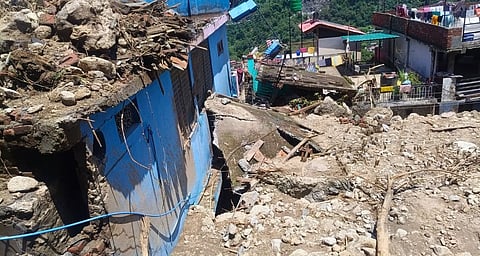
Moments later, a hillside collapse sent large rocks crashing onto the house.
For Pratap's family, escaping the disaster was only the beginning. Their house was completely damaged, forcing them to move into rented accommodation. His son Raj Kumar's house was also damaged.

The incident was part of a difficult monsoon for Chamba, where heavy rainfall and flash floods damaged homes, roads and public infrastructure. On July 28, torrential rain and flash runoff carrying boulders, mud and silt inundated residential and commercial neighbourhoods in Chamba town and adjoining areas.
In July, the district recorded 447.5 mm of rainfall against the monthly normal of 305.7 mm, marking a 46% excess. Between June and September, however, Chamba received 785.4 mm of rainfall, around 8% below its seasonal normal.
The uneven distribution of rainfall, with a particularly wet July followed by below-normal rainfall in August and September, highlights how seasonal totals can obscure the intensity of individual rainfall events.
The damage has also raised questions about how roads, drainage systems and settlements interact in the district's mountainous terrain, and whether inadequate drainage can increase the vulnerability of homes during heavy rainfall.
In mountainous areas, roads can alter the natural movement of rainwater. Road construction can intercept runoff flowing down slopes and concentrate it along roadside drains and culverts. If these structures are blocked, inadequately designed or poorly positioned, water can be diverted towards houses and settlements, erode slopes and contribute to flooding.
In Obdi, residents allege that changes to the drainage arrangement along the road above their houses worsened the situation.
For 47-year-old Ramesh Kumar, a taxi driver, the problem had begun before the disaster. He says rainwater previously passed beneath the road through a cross-drainage structure. However, he alleges that the existing water passage was blocked by a concrete wall.
Ramesh says he repeatedly approached the Public Works Department's Chamba Division-II, asking officials to construct a drain behind the road or provide a culvert to divert water away from the houses below.
He also raised concerns about the road's slope and the positioning of the drainage works, saying they could direct rainwater towards the residential area.
“I told both the contractor and the JE that they should not do the work this way. I warned them that if the water was diverted towards our houses, it could put our families and property in danger. But no one listened to us. They completed the work and left, and now we are the ones paying the price,” he said.
Ramesh alleges that the concrete wall was constructed before the necessary drainage arrangements were completed. He says crate work has only recently begun.
The allegations have not been independently established. An assessment of the site and its drainage design would be necessary to determine whether the road works contributed to the damage.
Kanav Badotra, executive engineer of the Public Works Department's Chamba-II division, told 101Reporters that the road was a panchayat road, with approximately two kilometres falling under the department's jurisdiction for maintenance and repair.
Addressing the risks posed by runoff, Badotra said the location of such incidents was difficult to predict and that water flowing down a slope could exert enough force to destabilise the ground and trigger a disaster. He added that the department could undertake only those works for which funds were available.
The department's response does not establish whether the drainage arrangement in Obdi was adequate or whether the concerns raised by residents were investigated.
Repeated monsoon damage has prompted the Himachal Pradesh government to introduce measures aimed at improving road drainage and protecting vulnerable mountain slopes.
The state notified its Road Drainage Policy on February 19, 2026, citing the particularly destructive monsoons of 2023 and 2025. The policy seeks to improve how roads are designed and maintained in relation to local terrain and rainfall conditions.
It emphasises drainage systems suited to the surrounding landscape, adequately designed culverts and arrangements to ensure that rainwater is safely channelled rather than discharged towards vulnerable slopes and settlements.
Separate guidelines for road drainage improvement works, notified in July 2026, provide for better-designed roadside drains and improvements across longer stretches of roads.
The state has also outlined a separate approach to slope protection and stabilisation, addressing risks such as landslides, soil erosion and falling rocks.
Ashok Kumar Thakur, a junior engineer with the State National Highway Division in Chamba, told 101Reporters that the policy was a necessary step given Himachal Pradesh's terrain and rainfall conditions.
“In hilly areas, road drainage is not just about constructing drains alongside roads. It also requires understanding the natural flow of water, ensuring that culverts have adequate capacity, and making sure that rainwater runoff does not create problems for slopes or nearby settlements,” he said.
However, improving drainage along newly constructed roads addresses only part of the problem. Existing roads and settlements may already have altered natural drainage patterns, making it necessary to assess and repair infrastructure that was built without adequate consideration of water flow.
The distinction is particularly important in Chamba, where settlements have developed over decades around valleys and natural drainage channels.
Kulbhushan Upmanyu, an environmentalist, said that simply moving people away from such locations was not always practical. The challenge, he said, was to ensure that construction and development took account of the natural movement of water.
Where a stream or natural drainage channel has historically carried large volumes of water, rocks and debris during the monsoon, ignoring that pattern can put homes, roads and residents at risk.
The problem also extends to new construction. While existing settlements may require better drainage and protective measures, new roads and buildings need to account for natural water channels and slope stability before construction begins.
The new policies seek to address some of these concerns, but their effectiveness will depend on how they are implemented and whether existing infrastructure is included in the improvements.
Arun Singh, a civil engineer from Shimla, said proper drainage was essential for the safety and long-term stability of roads in a mountainous state such as Himachal Pradesh.
He said drains could become blocked with silt and debris during heavy rainfall, while culverts with inadequate capacity might struggle to carry runoff. If water was not channelled safely, it could erode slopes and affect nearby houses and settlements.
Singh said the new policy was a useful step because it emphasised planned drainage systems, appropriately designed culverts, paved shoulders and the safe disposal of rainwater.
However, he said the engineering solutions needed to be suited to local conditions and accompanied by regular maintenance.
“Every road stretch has different terrain and drainage requirements. The system must be designed accordingly to ensure that water is not simply diverted from the road towards another vulnerable area,” he said.
The implementation of the policies also raises questions about the coverage of existing rural roads. While the Slope Protection and Stabilisation Policy includes rural, link and panchayat roads, the first phase of the Road Drainage Improvement Guidelines restricts proposals under its dedicated budget head to Major District Roads.
This leaves questions about how drainage problems along smaller roads will be addressed and which agencies will be responsible for the necessary improvements.
For the families in Obdi, the immediate challenge is rebuilding their homes and recovering from their losses.
Ramesh's elder brother, 49-year-old Raj Kumar, says 11 people lived in the two houses affected by the disaster. He estimates that he spent around Rs 15 lakh-Rs 17 lakh building his house over several years of work as a driver.
Household belongings, utensils and appliances, including a scooter and refrigerator, were damaged.
“We had built this house with a lot of hard work and sweat. I am a driver, and whatever I earned, I put into building the house. Seeing everything damaged is painful. It is not easy for us to build everything again,” he said.
Ramesh estimates that he spent nearly Rs 20 lakh building his house.
In Gholti, 29-year-old Vivek Kumar also lost his rented accommodation and household belongings. He had moved there from Larkha village in the Bharmour Assembly constituency in search of work and was doing daily-wage jobs.
A day before the disaster, Vivek moved to a neighbour's house with his wife and two-year-old daughter after stones began falling near their rented room.
He estimated that household items worth around Rs 5 lakh, including a bed box, sofa, cupboard, television and washing machine, were buried under the debris. His wife's gold ring and earrings were also lost, he said.
Following the incident, the administration arranged for families whose houses were completely damaged to move into rented accommodation.
A report submitted by the Tehsildar, Sadar Chamba, to the Sub-Divisional Magistrate recorded that Rana Pratap, Raj Kumar and Vivek Kumar had shifted to rented houses. Their monthly rents were recorded as Rs 4,000, Rs 5,000 and Rs 4,000, respectively.
Ravi Bhardwaj, pradhan of Draman panchayat, told 101Reporters that the panchayat had prepared the necessary documents for the affected families and forwarded them to the SDM's office for further processing.
He said the families had also received financial assistance, clothes and essential items from some non-governmental organisations in the immediate aftermath of the disaster.
The affected families were told during a visit by local MLA Neeraj Nayar that they would receive around Rs 7 lakh in government assistance, Bhardwaj said.
According to information from the SDM's office, the compensation files have been forwarded for further processing. However, the families say they are still waiting for the assistance and have had to meet their immediate expenses through their own earnings.
Ramesh said he had also hired labourers at his own expense to clear the debris from the damaged property.
For the families, rebuilding their homes remains a distant prospect. The immediate relief arrangements have provided temporary accommodation, but they are still waiting for compensation to help them recover their losses.
101Reporters also sought information from the Chamba Deputy Commissioner's office regarding the flood damage. Emails sent on September 11 and September 22, followed by a phone call to the Disaster Management Cell, did not receive a response.
[Wc/HP]
Suggested Reading:
Subscribe to our channels on YouTube and WhatsApp
Download our app on Play Store