
- HOME
- OPINION
- ON GROUND
- INTERVIEW
- Neta Profile
- Editor's Pick
- INDIA
- NewsGram USA
- WORLD
- न्यूजग्राम
- POLITICS
- ENTERTAINMENT
- CULTURE
- LIFESTYLE
- ECONOMY
- SPORTS
- Jobs / Internships
- Misc.
- NewsGram Exclusive

Key Points:
Chintz, a floral fabric originating in India, became a global fashion sensation in Europe during the 17th century.
Its popularity threatened European textile industries, leading France and Britain to ban the fabric to protect their domestic markets.
The cloth features floral patterns and designs in multiple yet subtle colours which became a global hit.
Long before the trend of baggy jeans and crop tops emerged, the world of fashion was much more rigid and restricted, and was often seen as a symbol of wealth and status. Clothing as a marker of social status still remains relevant in contemporary times.
However, fashion did not revolve solely around unbreathable corsets, big, upbeat hair, and ruffled collars; even fabrics mattered. Fabrics not only complemented the fashion styles that were trending but also intensified one’s elegance, grace and serenity.
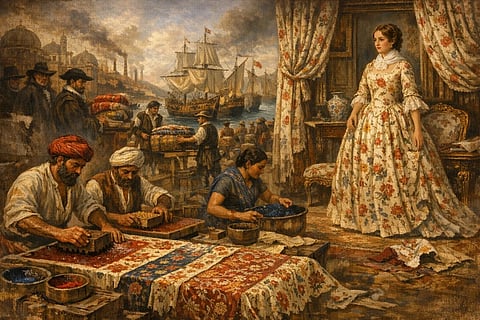
Centuries ago, one such fabric was introduced to the European market and became an instant hit, eventually turning into a global trend. A floral-designed fabric, it was brought to Europe by Dutch and Portuguese traders in the 17th century. This fabric was widely known as chintz.
Even though the fabric became a global success, many people tend to disregard its true origin—India. European households were dominated by the simple chintz fabric, which became so fashionable that it was eventually banned by the British Parliament.
The chintz fabric that rocked the European fashion world originated in Golconda, present-day Hyderabad, in the 16th century. It is printed using woodblock printing, a traditional technique for printing text, images, and patterns.
The cloth features floral patterns and designs in multiple yet subtle colours, usually printed against a bright background. Several reports suggest that the fabric existed long before it was “discovered,” with its origins dating as far back as the 10th century.
However, chintz fabric transcended borders after Portuguese navigator Vasco da Gama reached the Indian subcontinent on May 20, 1498. On the same day, he set foot in Calicut now known as Kozhikode on the Malabar Coast in present-day Kerala.
After Gama’s discovery of India, chintz reached Europe by the 1600s. It soon became one of the most widely used fabrics of the century and was used to make pillows, curtains, furnishing fabrics, bed hangings, and more. In the early 1600s, the fabric arrived in Europe in small quantities through Portuguese and Dutch traders.
Decades later, chintz had solidified its place in the European market, with millions of pieces being imported into England. The fabric also made its way into France and the Dutch Republican households.
Just as all empires eventually fall, the mania for chintz led to its ban beginning in 1686, as Indian craftsmanship came to be seen as a threat to the domestic market. Chintz became a victim of its own success—from boon to bane.
See Also: That Time When Hollywood Legend Anita Ekberg Shot the Paparazzi With a Bow and Arrow
In the 17th century, India began trading important goods with England, including textiles such as silk, cotton, jute, and wool, as well as spices, gems, and pearls. During this period, demand for the luxurious chintz fabric increased, which subsequently affected French and English mills. The fabric was produced by Indian craftsmen who had mastered the art over years of practice, drawing upon India’s diverse cultural traditions.
The English men had access to top-quality equipment but lacked the cultural heritage and historical knowledge needed to create an exact replica of chintz, a fabric that was simple, durable, and washable.
Thus began the fall of the favourite fabric that once thrived in the English market.
In an attempt to protect the domestic market, France banned all imports of chintz in 1686. Decades later, in 1720, a law was introduced to completely restrict its import. The Parliament of Great Britain implemented legislation to prohibit the use of chintz in clothing or household items.
There were several reports of both failed and successful attempts to replicate the entire process of this much sought-after product.
In 1734, French naval officer M. de Beaulieu sent letters and samples of the banned fabric, detailing its dyeing process. However, the code to the secret recipe of chintz was finally broken in 1742, when a French missionary based in Pondicherry catalogued key details such as local dyeing and mordanting methods in order to replicate the fabric while maintaining its originality and uniqueness.
Once the trade secret was made public, French and English mills entered a race to capture the market with their own versions of chintz. The ban on the fabric was revoked in 1759.
By the mid-18th century, the Industrial Revolution mechanised the manufacturing process, which strangled the Indian textile industry. The revolution lifted import duties on British goods in the Indian market, but skewed trade to fill British pockets. Meanwhile, the East India Company imposed heavy import duties on Indian goods.
The repercussions were heavily felt by the Indian textile industry, which could not withstand competition from machine-made items produced in Britain. With the fall of the Indian textile industry, the British Raj cashed in on India’s culture and assets.
According to a study by economist Utsa Patnaik, based on tax and trade records from 1765 to 1938, the British extracted an estimated $45 trillion from India.
The story of chintz is one of many that had the potential to make a significant impact on the world order. However, it is also a story rooted in Britain’s economic draining of India by exploitation and obliteration of indigenous cultural craftsmanship.
Suggested Reading:
Subscribe to our channels on YouTube and WhatsApp
Download our app on Play Store


