
- HOME
- OPINION
- ON GROUND
- INTERVIEW
- Neta Profile
- Editor's Pick
- INDIA
- NewsGram USA
- WORLD
- न्यूजग्राम
- POLITICS
- ENTERTAINMENT
- CULTURE
- LIFESTYLE
- ECONOMY
- SPORTS
- Jobs / Internships
- Misc.
- NewsGram Exclusive

Key Points
By the time of Dr. Babasaheb Ambedkar's death on 6 December 1956, at least 18 titles were in various stages of progress - some complete, others only outlines.
In the last year of his life and and for years later, Ambedkar's works struggled to get published - lying ignored, caught in disputes and relegated to storage.
Even today, translations of Ambedkar's works remain hard to find, limiting access to his writings for readers across India.
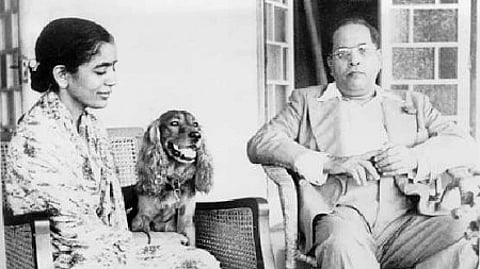
On the night of 5 December 1956, at his residence on Alipur Road in Delhi, Bhimrao Ramji Ambedkar spent what would become the final hours of his life doing what had defined his intellectual journey for decades: reading, revising and preparing manuscripts for publication.
That evening, Ambedkar listened to Buddhist chants playing on a radiogram, repeating the liturgy: “Buddham Sharanam Gachchhami, Dhamman Sharanam Gachchhami, Sangham Sharanam Gachchhami.” Even in this quiet moment, his work remained unfinished.
His assistant, Nanak Chand Rattu, who had been helping him with typing and editing manuscripts, left around midnight. Ambedkar instructed him to return the next morning and dispatch newly typed drafts, including the preface and introduction to The Buddha and His Dhamma, a book he had spent years preparing.
By the morning of 6 December 1956, Ambedkar had passed away in his sleep. The manuscripts remained on his desk. The struggle to publish his writings had only begun.
In his final years, despite declining health and growing political responsibilities, Ambedkar continued writing with urgency. He worked simultaneously on several major texts, including The Buddha and His Dhamma, Buddha and Karl Marx, Revolution and Counter-Revolution in Ancient India, and Riddles in Hinduism. These works were part of a broader intellectual project that sought to reinterpret religion, history and social structures through the lens of equality and justice.
Savita Ambedkar later wrote that he remained engrossed in writing “till the last moment of his life.” In an era before photocopying, Ambedkar relied heavily on handwritten notes and typed copies of rare books. Some of these materials were sourced from the British Library in London. His assistants often typed manuscripts late into the night, while Ambedkar revised them repeatedly.
According to Savita Ambedkar’s memoir, at least 18 titles were in various stages of progress at the time of his death. Some were complete manuscripts, while others were unfinished essays or outlines. Ambedkar had also written about 80 pages of an autobiography, later published in 1990 as Waiting for a Visa. He had plans to write biographies of Jyotirao Phule and Sayajirao Gaekwad, and a study of Mahatma Gandhi.
Ambedkar completed The Buddha and His Dhamma in March 1956 after five years of work. However, he struggled to find funds for publication. He needed Rs 20,000 to print the book, a significant amount at the time.
On 17 March 1956, he wrote to MR Masani, chairman of Tata Industries, requesting financial assistance from the Dorabji Tata Trust. In his letter, Ambedkar emphasised the urgency of publication. He wrote that if the request was denied, he would seek assistance elsewhere. The trust declined to publish the book but provided Rs 3,000 as financial assistance.
Ambedkar also approached Prime Minister Jawaharlal Nehru. In 1956, the government was organising events to commemorate the 2,500th birth anniversary of the Buddha. Ambedkar requested that the government purchase 500 copies of his book and distribute them to libraries and visiting dignitaries. Nehru declined, stating that the allocated funds had already been exhausted.
Ambedkar died before the book could be published. The Buddha and His Dhamma was eventually released in 1957, a year after his death, by the People’s Education Society, an institution he had founded in 1945. Even then, parts of the manuscript were missing. The preface written on 6 April 1956 was omitted from the first edition. It would only be published decades later through a digital archive created by Columbia University professor Frances W Pritchett.
Scholars later argued that the absence of this preface affected interpretations of Ambedkar’s understanding of Buddhism, which he framed as a social revolution against caste hierarchy.
See Also: Bhimrao Ramji Ambedkar: An Inspiration
After Ambedkar’s death, his manuscripts remained in the Alipur Road bungalow for years. Legal disputes between Savita Ambedkar and Yeshwant Ambedkar complicated matters further. The court ordered that Ambedkar’s belongings, including his papers, be sealed until the dispute was resolved.
In 1967, Savita Ambedkar was evicted from the bungalow. During the eviction, boxes containing Ambedkar’s manuscripts were reportedly removed and dumped in an open yard. According to Rattu, rain damaged several documents, including correspondence with political leaders, British officials and religious figures.
These documents included speeches, letters and notes dating back decades. Some were reportedly lost or damaged permanently. The bungalow itself was later demolished. Decades later, in 2018, the Government of India inaugurated a memorial at the site.
The loss and neglect of Ambedkar’s manuscripts during this period reflected a broader indifference towards preserving his intellectual legacy.
In the 1970s, activists from the Dalit Panthers began pressing the Maharashtra government to publish Ambedkar’s writings. Leaders such as JV Pawar and Raja Dhale raised the issue repeatedly.
In 1975, activists discovered that Ambedkar’s unpublished manuscripts were stored in government offices in old trunks. Pawar later described seeing cockroaches running through the papers, symbolising the neglect of Ambedkar’s legacy.
Following sustained pressure, the Maharashtra government established the Dr Babasaheb Ambedkar Source Material Publication Committee in 1977. However, publication did not begin immediately. It took several more years of sorting, editing and verification before the first volume was released.
The first volume of Dr Babasaheb Ambedkar: Writings and Speeches was published in 1982, 26 years after Ambedkar’s death. The committee, led by Vasant Moon, gradually released additional volumes. The process was slow and difficult. Manuscripts had been stored for decades and required fumigation. Staff handling the papers reportedly suffered infections due to the condition of the documents.
Despite these challenges, 22 volumes were eventually published. These included key texts such as Annihilation of Caste and Castes in India. The publication of Riddles in Hinduism in 1987 sparked major controversy. The book contained critiques of Hindu scriptures and social hierarchies.
Following its release, protests erupted across Maharashtra. Some groups demanded removal of sections discussing Ram and Krishna. Large demonstrations took place in 1988, and copies of the book were burned.
Ambedkarite organisations responded with counter protests, arguing that Ambedkar’s writings should not be censored. Eventually, the Maharashtra government retained the text but added a disclaimer stating that it did not endorse the views expressed. The episode highlighted the continuing political sensitivity surrounding Ambedkar’s writings.
The struggle to publish Ambedkar’s writings continues even today, particularly in translations. In the 1990s, the Narasimha Rao government announced a plan to translate Ambedkar’s works into all languages listed in the Constitution’s Eighth Schedule.
More than 25 years later, the project remains incomplete. Several languages still lack full translations. In some cases, translators reported delays of over a decade in receiving payment. Others said manuscripts remained unpublished for years awaiting ministerial approval. These delays have limited access to Ambedkar’s writings for readers across India.
More than six decades after his death, Ambedkar’s writings continue to shape debates on caste, democracy and social justice. At Chaitya Bhoomi in Mumbai, where Ambedkar was cremated on 7 December 1956, booksellers continue to sell his writings year round. Many rely on private publishers because government editions often go out of print.
Ambedkar spent his final hours preparing manuscripts for publication. His last instructions were about sending drafts to printers. The urgency he felt in December 1956 continues to echo today.
On this Ambedkar Jayanti, the unfinished task of publishing his complete works remains a reminder that Ambedkar’s intellectual legacy is still being assembled, decades after he wrote his final words.
Suggested Reading:
Subscribe to our channels on YouTube and WhatsApp
Download our app on Play Store

