
- HOME
- OPINION
- ON GROUND
- INTERVIEW
- Neta Profile
- Editor's Pick
- INDIA
- NewsGram USA
- WORLD
- न्यूजग्राम
- POLITICS
- ENTERTAINMENT
- CULTURE
- LIFESTYLE
- ECONOMY
- SPORTS
- Jobs / Internships
- Misc.
- NewsGram Exclusive

By Vishaarad Sharan
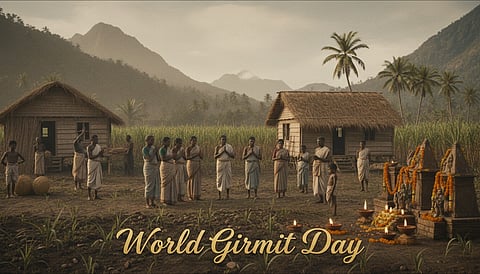
On this World Girmit Day, celebrated annually on May 14, let’s have a look at the treatment Hindus faced when they initially arrived in Fiji.
Missionaries in Fiji expressed deep anxiety at the arrival of Hindu indentured laborers, fearing the spread of “idolatry” and the erosion of Christian influence. Primary sources reveal their alarm at the persistence of Hindu rituals, temples, and resistance to conversion.
Reactions of the people of influence in those times in Fiji i.e missionaries, newspapers prove the xenophobia faced by the Hindus.
Methodist missionary Rev. Joseph Waterhouse, writing in 1879 after the arrival of the Leonidas, warned: “The influx of Hindoo coolies threatens to flood these islands with heathenism. Their idols, their caste prejudices, and their heathen festivals will corrupt the natives and undo the work of the Gospel.” The Fiji Times (May 1879), reflecting missionary sentiment, reported: “The arrival of the Indian coolies is a matter of grave concern. They bring with them strange gods and customs which may imperil the moral fabric of our Christian colony.” Methodist Missionary Conference minutes (1880) noted: “We must guard against the spread of Hindoo superstition. Already temples are being erected, and sacrifices offered. Unless checked, this heathen influx will rival our mission work.”
See Also: The Other Side of Francis Xavier: Missionary, Saint, and Architect of the Goa Inquisition
Rajendra Prasad, in Tears in Paradise, cites missionary correspondence: “The missionaries feared that the Girmitiyas, with their gods and rituals, would contaminate the Fijians, undoing decades of Christianization.”
There were many reasons Hindus were seen with suspicion. Missionary fear was twofold: 1) Religious contamination – Hindus were seen as bringing “idolatry” and “superstition”, 2) Cultural resilience – Despite indenture hardships, Girmitiyas maintained temples, festivals (e.g., Ram Naumi, Holi), and caste practices, which missionaries viewed as a direct challenge to Christian dominance.
In addition, Colonial authorities often sided with missionaries, restricting Hindu religious expression in plantations, yet Girmitiyas continued clandestine worship and later built temples openly in Navua, Nausori, and Labasa.
The construction of a North-South Hindu divide during the indenture period in Fiji (1879–1916) was not a naturally occurring friction, but rather a byproduct of colonial administrative logic, linguistic barriers, and missionary interventions. While both groups shared a foundational faith, the British "divide and rule" strategy codified regional differences into rigid social categories.
Colonial Administrative Categorization:
The British colonial government in Fiji viewed the indentured laborers (Girmityas) through a lens of bureaucratic efficiency. This led to the formal separation of "Calcuttyas" (those embarking from Calcutta, largely from North India) and "Madrasis" (those embarking from Madras, largely from South India).
Linguistic Isolation: The administration promoted Fiji Hindi (derived from Awadhi and Bhojpuri) as the lingua franca of the plantations. South Indians, arriving in larger numbers later in the period (1903 onwards), often spoke Tamil, Telugu, or Malayalam. Their inability to communicate fluently in the North Indian dialects led to social isolation and the colonial label of being "difficult" or "uncooperative."
Settlement Patterns: Colonial authorities often settled laborers based on their port of origin to simplify management, which inadvertently created geographic enclaves that mirrored the North-South divide of the subcontinent.
Missionary Activity and the "Dravidian" Narrative
Missionaries and early ethnographers played a significant role in applying European racial theories to the Indian population in Fiji.
The Aryan vs. Dravidian Myth: Evangelists influenced by 19th-century philology often categorized North Indians as "Aryans" and South Indians as "Dravidians." This was not merely a linguistic distinction but was framed as a racial and cultural hierarchy.
Targeted Proselytization: Missionaries sometimes found greater success or focused more intensely on South Indian communities, perceiving them as more "oppressed" by the Brahmanical structures of the North. This created a secondary layer of tension, as conversion to Christianity occasionally became a flashpoint between the two groups.
Cultural and Ritual Divergence
While both groups identified as Hindu, the colonial environment stripped away the nuance of their practices, forcing them into a binary comparison.
The Impact of the "Madrasi" Stigma
Colonial records often reflect a systemic bias against South Indians.
The colonial state utilized these differences to prevent a unified "Indian" identity from forming, which would have posed a greater threat to the plantation economy. By highlighting the "clannishness" of the Madrasis or the "orthodoxy" of the Calcuttyas, the missionary and colonial apparatus ensured that the Hindu community remained preoccupied with internal boundary-maintenance rather than collective resistance.
Despite these constructed divisions, the shared trauma of the Kulli (Coolie) experience eventually birthed a unique Indo-Fijian identity that, in the post-indenture era, sought to bridge these gaps through consolidated religious bodies like the Sanatan Dharm and the Then India Sanmarga Ikya (TISI) Sangam.
During the Indenture period in Fiji (1879–1920), many infants, sick, and elderly Girmitiyas in Navua and other plantation areas were buried without proper Hindu rituals due to harsh plantation conditions, lack of priests, and restrictions imposed by colonial authorities. The Vancouver-based Colonial Sugar Refinery (CSR) company oversaw these plantations, and records show that deaths were frequent, with burials often carried out hastily and without the traditional rites.
Indenture hardships: Girmitiyas faced poor living conditions, disease, and malnutrition. Infant and elderly deaths were common.
Absence of ritual specialists: Hindu priests were scarce, and plantation managers discouraged elaborate rituals.
Navua plantations: CSR’s Navua mill was one of the sites where Indo-Fijians worked under indenture. Burials here were often without cremation or full rites.
Cultural trauma: The lack of proper samskaras (funeral rites) was deeply distressing, as Hindu tradition emphasizes cremation and ritual purity.
Loss of ritual continuity: Cremation, mantras, and shraddha rites were often impossible.
Diaspora memory: Indo-Fijian oral histories recall the pain of “unritualized” burials.
CSR’s role: As a Vancouver-based company, CSR prioritized profit over cultural needs, leaving Girmitiyas spiritually bereft.
CSR Navua Mill Cemetery: Archival records and oral histories note that Girmitiyas who died on plantations were buried in unmarked graves near the mill. Infants and elderly were often interred without cremation.
Lack of cremation grounds: Hindu tradition requires cremation by riversides, but CSR restricted access to land and firewood. Navua’s riverbanks were often off-limits.
Oral testimony: Descendants recall “mass burials” where plantation overseers ordered quick interments without mantras or priests.
This expanded record highlights that the current wave of incidents is part of a decades-long pattern, often marked by state admissions of being unable to provide adequate protection and a shift toward ideological sacrilege rather than opportunistic theft.
Undocumented & Under‑Highlighted Issues
Community Testimonies: Many smaller acts — verbal abuse, intimidation during festivals, vandalism of roadside shrines — often go unreported due to fear of reprisal or lack of police follow‑up.
Media Silence: Local coverage tends to emphasize “isolated incidents” rather than systemic hostility, leaving diaspora communities to highlight issues through social media and grassroots networks.
Historical Continuity: These attacks echo earlier waves of hostility during the indenture era and post‑coup periods, where Hindu identity was targeted as “foreign” or “heathen.”
Why some incidents stay out of mainstream media
National outlets (Fiji Times, RNZ Pacific, Fiji Sun) cover temple attacks that result in arrests or high-profile damage, but smaller thefts, attempted arsons and verbal attacks often surface first on community Facebook reels or WhatsApp groups. The March 2026 Nadi fire and the January 2026 Sigatoka idol smashing were reported by diaspora radio and local creators days before appearing in print, illustrating a lag between community awareness and formal news cycles.
The result is a layered record: court-documented sacrilege cases, human-rights warnings about hate speech, and a parallel stream of community testimony describing frequent, lower-level targeting that rarely makes headlines.
The following timeline documents a sustained pattern of attacks on Hindu religious sites, demonstrating that recent events are part of a long-standing cycle of hostility.
Much of the Hindu experience in Fiji remains absent from formal media coverage, creating a significant gap in the public record.
Loss of Hope: Many victims have stopped reporting attacks because they feel the justice system will not act. The visible record is likely only a fraction of the reality.
Everyday Xenophobia: Verbal abuse like "Go back to India" or "This is not your land" in markets and public transport is pervasive but rarely documented.
Digital Hate Speech: Social media serves as a "transmission belt" for anti-Hindu content, which often intensifies around election cycles as a form of political scapegoating.
Structural Coercion: The non-renewal of agricultural land leases acts as a form of economic xenophobia, forcing the migration of thousands of Hindu farming families.
Unresolved History: The 1991 firebombing campaign, which targeted priests and sacred texts, remains largely uninvestigated and unprosecuted.
While government officials have made public statements condemning these acts, the community notes several critical failures:
Surveillance vs. Consequences: CCTV cameras provide evidence but do not act as a deterrent without successful prosecutions and legal reform.
Political Limitations: The 2013 "ethnically blind" constitution is often criticized for entrenching a status quo that limits the ability of the Hindu minority to participate fully in political life.
PATTERN ANALYSIS
The full scope of the record reveals four undeniable trends:
Cyclical Escalation: Rhetoric and incidents spike predictably during election periods.
Impunity: Cases are routinely left "pending," and convictions for sacrilege remain extremely rare.
Ideological Targeting: The shift toward destroying sacred texts (Ramayan) and dumping idols rather than stealing valuables signals deep-seated ideological hatred.
Acceleration: The period from 2022 to early 2026 shows a marked increase in both the frequency and severity of attacks across the entire country (Nadi, Suva, Labasa, Tavua, Sigatoka).
(Author is a 4th generation Fiji Indian)
Reference / Bibliography
Totaram Sanadhya, My Twenty-One Years in Fiji – First-hand account of Girmitiya life, including descriptions of improper burials.
Hinduism under Indenture: Totaram Sanadhya’s Account of Fiji (JSTOR) – Analysis of Sanadhya’s writings on disrupted rituals.
Hinduism in Fiji – Wikipedia – Overview of Hindu practices among Indo-Fijians, noting indenture disruptions.
New Girmit.org – Arrival of Indians to Fiji – Documents living conditions and deaths during indenture.
K.L. Gillion, Fiji’s Indian Migrants: A History to the End of Indenture – Classic scholarly work on indenture, including burial practices.
Brij V. Lal, Chalo Jahaji: On a Journey Through Indenture in Fiji – Detailed account of Girmitiya experiences, including death and burial.
Adrian Mayer, Indians in Fiji – Ethnographic study noting cultural loss and burial practices.
John Kelly, A Politics of Virtue: Hinduism, Sexuality, and Countercolonial Discourse in Fiji – Discusses ritual disruptions under CSR.
CSR Company Records (Vancouver/Colonial Sugar Refinery Archives) – Administrative records on plantation deaths and burials.
Ashwin Raj, “Girmit and the Politics of Memory” (Fiji Studies Journal) – Notes trauma of improper burials in Navua and other sites.
Totaram Sanadhya, My Twenty-One Years in Fiji (1914).
“Hinduism under Indenture: Totaram Sanadhya’s Account of Fiji.” JSTOR.
“Hinduism in Fiji.” Wikipedia.
“The Arrival of Indians to Fiji during the Indenture System.” NewGirmit.org..
Gillion, K.L. Fiji’s Indian Migrants: A History to the End of Indenture. Oxford University Press, 1962.
Lal, Brij V. Chalo Jahaji: On a Journey Through Indenture in Fiji. ANU Press, 2000.
Mayer, Adrian. Indians in Fiji. Oxford University Press, 1963.
Kelly, John. A Politics of Virtue: Hinduism, Sexuality, and Countercolonial Discourse in Fiji. University of Chicago Press, 1991.
Colonial Sugar Refinery Company Records, Vancouver Archives.
Raj, Ashwin. “Girmit and the Politics of Memory.” Fiji Studies Journal, 2004.
Who are Girmitiyas?
Girmitiyas were indentured labourers who travelled to British colonies such as Fiji, South Africa, and Mauritius for work.
Why is World Girmit Day celebrated?
World Girmit Day is celebrated to commemorate the Indian labourers who arrived in Fiji between 1879 and 1916.
Suggested Reading:
Subscribe to our channels on YouTube and WhatsApp
Download our app on Play Store
