
- HOME
- OPINION
- ON GROUND
- INTERVIEW
- Neta Profile
- Editor's Pick
- INDIA
- NewsGram USA
- WORLD
- न्यूजग्राम
- POLITICS
- ENTERTAINMENT
- CULTURE
- LIFESTYLE
- ECONOMY
- SPORTS
- Jobs / Internships
- Misc.
- NewsGram Exclusive

Key Points
India became a Sovereign Democratic Republic at 10:18 am on January 26, 1950, when the Constitution came into effect.
Dr Rajendra Prasad was sworn in as the first President, and emphasised that the Constitution was intended to serve as “the instrument through which the will of the people shall find expression.”
The day featured a ceremonial procession and India’s first Republic Day parade at the Irwin Amphitheatre in Delhi, with a crowd of nearly 15,000 people in attendance.
India formally became a Sovereign Democratic Republic on this day, January 26, in 1950, as the Constitution of India came into force, ending the country’s status as a British Dominion and establishing constitutional self-governance. Today, in 2026, India marks its 77th year as a constitutional republic. The theme of this year’s Parade is the celebration of 150 years of the national song Vande Mataram.
Every year, this day is marked with the country’s largest ceremonial event in New Delhi – the Republic Day Parade. Held along Kartavya Path, beginning near Rashtrapati Bhavan and proceeding past India Gate, the parade has become the most visible symbol of the day, combining a military march-past by the Army, Navy and Air Force with cultural tableaux representing states and Union Territories.
The event opens with the unfurling of the national flag by the President of India, who is the Supreme Commander of the Armed Forces. A 21-gun salute accompanies the national anthem, and gallantry awards are presented. The parade also features contingents from paramilitary forces, police units, schoolchildren’s cultural performances, and flypasts. The celebrations conclude on January 29 with the Beating Retreat ceremony at Vijay Chowk, marking the formal end of Republic Day festivities.
While today’s ceremony is defined by large-scale displays, synchronised drills and elaborate tableaux, it’s worth looking back at the celebration’s origins in 1950, which marked a much more modest but historically decisive day.
The central ceremony took place at the Durbar Hall of Government House, now Rashtrapati Bhavan. At precisely 10:18 am, the proclamation of the Republic was read out by outgoing Governor-General C Rajagopalachari. Shortly afterwards, Dr Rajendra Prasad was sworn in as the first President of India. Jawaharlal Nehru continued as Prime Minister under the new constitutional order.
In his address after taking the oath, President Prasad described the moment as the beginning of “a new phase of our national life” and said authority would now flow from “the Constitution and the people.” He emphasised that the Constitution was intended to serve as “the instrument through which the will of the people shall find expression.”
The date, January 26, was chosen to honour the 1930 Purna Swaraj declaration, when complete independence from colonial rule was proclaimed as India’s goal. While 15 August 1947 marked independence, 26 January 1950 marked the start of governance under a Constitution framed by Indians.
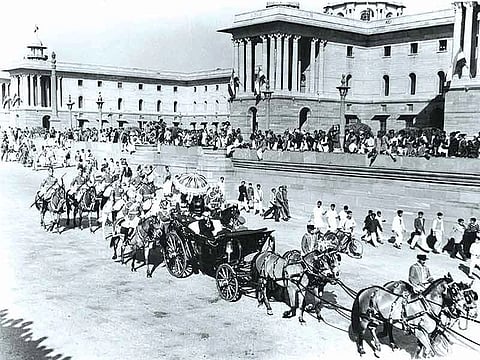
Following the swearing-in, President Prasad travelled in a ceremonial procession through Delhi. He rode in a state coach drawn by six horses, escorted by the President’s Bodyguard, along a route of about eight kilometres from Government House to the Irwin Amphitheatre, now the Major Dhyan Chand National Stadium. Crowds lined the roads, rooftops, balconies, and trees to witness the procession. Archival footage shows citizens gathering along the entire route to express their joy at the inauguration of the Republic.
At the Irwin Amphitheatre, around 3,000 officers and personnel of the armed forces and police assembled for the first Republic Day parade. Nearly 15,000 people gathered at the venue. The parade included a march-past by the Army, Navy, and Air Force units. A 31-gun salute marked the occasion, and aircraft of the Indian Air Force, including Harvards, Dakotas, Liberators, Tempests, Spitfires, and jets, took part in the flypast, with more than 100 aircraft participating.
President Sukarno of Indonesia was the chief guest, reflecting India’s engagement with newly independent Asian nations. The ceremony combined solemn constitutional observance with a display of military presence, a format that later became central to Republic Day celebrations.
Underlying the public ceremonies was the implementation of the Constitution, drafted by the Constituent Assembly under the leadership of Dr BR Ambedkar as Chairman of the Drafting Committee. The Constitution established India as a sovereign democratic republic and introduced universal adult franchise, granting voting rights to nearly 300 million people regardless of gender, literacy, or property.
In his message, President Prasad underlined that the Constitution aimed to secure “justice, liberty, equality and fraternity” and cautioned that its success would depend on how citizens and those in authority conducted themselves. He said the welfare of the country would rest not only on institutions but also on civic conduct.
As evening fell, public buildings in New Delhi were illuminated to mark the historic transition. This day, 77 years ago, thus marked the operational beginning of the Republic of India, with sovereignty vested in constitutional institutions and, through them, in the people.
[DS]
Suggested Reading:
Subscribe to our channels on YouTube and WhatsApp
Download our app on Play Store

