
- HOME
- OPINION
- ON GROUND
- INTERVIEW
- Neta Profile
- Editor's Pick
- INDIA
- NewsGram USA
- WORLD
- न्यूजग्राम
- POLITICS
- ENTERTAINMENT
- CULTURE
- LIFESTYLE
- ECONOMY
- SPORTS
- Jobs / Internships
- Misc.
- NewsGram Exclusive
By Partha Sarathi Biswas
Pune, Maharashtra: When Madhavrao Roasaheb Kadam (43) approached the private sugar mill in his area in January to ask why the declared payment for sugarcane was lower than expected, the answer unsettled him. The farmer from Akoli village in Basmath taluka of Hingoli district in Maharashtra was told that the mill would not be able to pay more because the “ethanol” it had manufactured was not being purchased by the government.
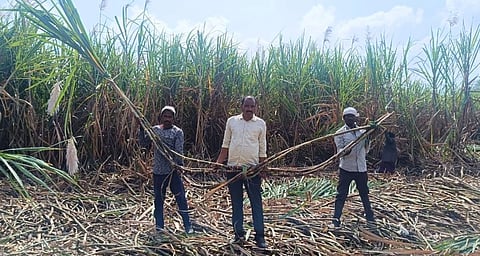
“Millers in districts of Kolhapur and Sangli are paying Rs 3,500 per tonne and in our region the payment is just about Rs 2,500 per tonne. The mill said they would not be able to pay more than this and the lower than expected revenue from ethanol is to be blamed. They promised to pay us more when they are able to raise more funds but maybe it would happen later in the season,” said Kadam, who grows cane on one acre of his four-acre holding. He grows soyabean, chana (Bengal gram) and wheat on the remaining land.
The explanation did not convince him. “It seems odd. The mill has invested a substantial amount to set up the new ethanol plant, but when it comes to paying the farmers they always have an excuse,” he said.
The apprehension among farmers is echoed within the industry. Bhairavnath B Thomabre, president of the West Indian Sugar Millers Association (WISMA), which represents private sugar mills in Maharashtra and Gujarat, said the industry is under strain.
“The sugar industry is now facing financial stress. At present, mills in Maharashtra have run up unpaid dues of over Rs 4,000 crore. The industry is unable to clear farmers’ dues in time,” he said.
Unlike most other crops, sugarcane farmers are assured payment in the form of the Fair and Remunerative Price (FRP). The Sugarcane Control Order of 1966 mandates that payment must be made within 14 days of cane delivery, failing which mills can face action including attachment of property for revenue recovery. Mills failing to pay is therefore a warning sign for both farmers and millers.
For the sugar industry, ethanol had emerged as a stabilising revenue stream. Produced by fermentation of carbohydrates, ethanol is blended with petrol to reduce emissions and curb fossil fuel imports. While sugar mills had long produced ethanol as a byproduct, production accelerated after 2018 when Oil Marketing Companies (OMCs) became assured buyers.
Ethanol in the sugar industry can be manufactured directly from sugarcane juice or from B-heavy and C molasses, the byproducts obtained after sugar extraction. Procurement from higher sugar-content feedstock encouraged mills to divert excess sugar into ethanol.
The central government incentivised the setting up and expansion of ethanol capacity in sugar mills, including through interest subvention on loans for new projects. Industry sources estimate total investments at around Rs 40,000 crore across the country. More than the interest support, it was the assurance of a stable market that encouraged mills to invest and diversify.
“The sudden change in policy for ethanol procurement is not good for farmers or millers. Mills are unable to utilise their distilleries at full capacity and are thus stuck,” Thomabre said.

The drought of 2019-20 saw a decline in sugarcane area and ethanol output. Subsequently, the government began augmenting ethanol production from food grains such as maize and broken rice, often referred to as second-generation (2G) ethanol.
In November 2020, the government permitted the use of maize as a feedstock for ethanol production. Over the past few years, OMC procurement from maize-based units has increased steadily.
Unlike the financial year, the Ethanol Supply Year (ESY) runs from December 1 to November 30.
In ESY 2022-23, maize-based ethanol manufacturers were given a target of 2.70 crore litres but supplied 31.51 crore litres. By ESY 2023-24, allocation rose sharply to 205.88 crore litres, with actual supplies touching 289.91 crore litres.
The shift became more pronounced in ESY 2024-25. OMCs allocated 520.27 crore litres to maize-based ethanol and procured 419.97 crore litres. The sugar industry, by contrast, was allocated 349.97 crore litres and supplied 306.7 crore litres. In pricing terms too, maize-based distilleries have received better rates compared to sugar-based units.
Maize acreage has expanded year on year, with kharif 2025 touching a record 71.21 lakh hectares.
For the sugar industry, the shift in ethanol procurement has translated into underutilised capacity. Maharashtra industry sources said that of roughly 300 crore litres of distillery capacity, only about one-third is currently being used.
A tentative survey by the National Federation of Cooperative Sugar Factories Association showed that against an installed distillery capacity of 1,822 crore litres with sugar mills, only 1,003.1 crore litres was utilised in ESY 2024-25.
A Maharashtra miller described the situation as uncertain. “Sugar millers have loans to service and the assured payment from ethanol helped both in clearing farmers’ dues as well as servicing those loans. Now, as capacities lie idle, we are not sure of the financial future of distilleries,” he said.
Vijendra Singh, executive director of Renuka Sugars Limited, which operates in Maharashtra and Karnataka, called for equitable distribution. “Ultimately, sugar millers pay their farmers… thus it is in the interest to ensure equitable allocation,” he said.
The uncertainty around ethanol is something Bhagvat Jadhav (38) has also heard cited repeatedly by millers in his region. Jadhav grows cane on four acres in Nave Khed village in Walwa taluka of Sangli district.
“Mills here have higher recovery which is the percentage between sugar produced and cane crushed which determines the payment to farmers under the Sugarcane Control Order, 1966. So they are able to pay us Rs 3,500 per tonne. But they say they would not be able to continue the payment trend for the entire season,” he said.
Jadhav, who is an active member of the farmer’s union Swambimani Shetkari Sanghatana, alleged that the explanation could be a pretext. “The Sanghatna would hit the roads if any move is made in our region to lower the payment,” he said.
For farmers like Kadam, the policy shift has immediate consequences. “Cane is the only crop which has assured payment. Now the mills are trying to use the guise of ethanol to get away from better payment. For us farmers this sudden change in payment is out of the blue,” he said.
This article was originally published in 101 Reporters under Creative Common license. Read the original article.
[DS]
Suggested Reading:
Subscribe to our channels on YouTube and WhatsApp
Download our app on Play Store
