
- HOME
- OPINION
- ON GROUND
- INTERVIEW
- Neta Profile
- Editor's Pick
- INDIA
- NewsGram USA
- WORLD
- न्यूजग्राम
- POLITICS
- ENTERTAINMENT
- CULTURE
- LIFESTYLE
- ECONOMY
- SPORTS
- Jobs / Internships
- Misc.
- NewsGram Exclusive

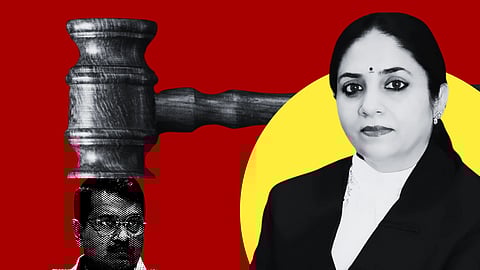
At a time when public debate is often driven more by rhetoric than facts, the recent stand taken by Justice Swarna Kanta Sharma sends a strong and necessary message. By refusing to step aside from the case despite serious personal allegations, she upheld a basic principle of the justice system that decisions must be based on evidence, not on pressure, perception, or political narratives.
The situation took an unusual turn when Arvind Kejriwal chose to appear in court himself. While he began by expressing respect for the judge, he soon moved to make allegations, question her neutrality, and even hint at ideological bias. His legal team went further by using emotionally charged language, suggesting that the judge should undergo an “agnipariksha.” Such remarks appeared less about legal reasoning and more about creating pressure inside the courtroom.
Justice Sharma firmly rejected these claims. She made it clear that courts do not function on assumptions or personal opinions. The idea that “justice is blind” exists for a reason; it means that a judge looks only at facts and evidence, not at a person’s identity, background, or public image. In this case, no solid evidence was presented to question her integrity, which made the demand for recusal baseless.
She also addressed a larger concern. If judges start stepping aside simply because allegations are made, it can create a false impression that something is wrong. Judges are bound by ethics and cannot publicly defend themselves, which makes them easy targets for such tactics. Allowing this would set a dangerous precedent, where anyone could try to delay or influence cases by attacking the judge personally.
A key claim made during the proceedings was that Justice Sharma’s past decisions in cases related to the Aam Aadmi Party were frequently overturned by the Supreme Court. However, this claim does not stand up to facts. In the case of Sanjay Singh, bail was granted after the Enforcement Directorate (ED) itself made a concession.
This was not a rejection of the High Court’s reasoning. Similarly, in the case of Manish Sisodia, while the Supreme Court granted bail, it did not state that the High Court had made any legal error. Bail, in such situations, is often granted based on evolving circumstances rather than a judgment on the correctness of earlier decisions.
Even in Arvind Kejriwal’s own case, the Supreme Court referred the question of the “necessity of arrest” to a larger bench and granted bail. At no point did it criticise or question the conduct or reasoning of Justice Sharma. These examples clearly show that the narrative being pushed was misleading and not based on factual accuracy.
Beyond the courtroom, this issue also raises concerns about political values and governance. The Aam Aadmi Party was founded on promises of transparency, accountability, and clean politics. However, over time, critics argue that these ideals have weakened. Internal checks have reduced, power has become more centralised, and questions around funding continue to surface.
On governance, the gap between promises and delivery remains visible. Assurances were made about transforming Delhi’s infrastructure, improving healthcare, fixing water supply, and solving waste management issues. Yet, many of these problems continue to affect everyday life, raising doubts about the effectiveness of governance.
In the end, this case is not just about one leader or one judge—it is about the strength and independence of institutions. Justice Swarna Kanta Sharma’s decision shows that the judiciary can stand firm even in the face of pressure, personal attacks, and political narratives.
In a democracy, the rule of law must remain above politics. Attempts to influence or intimidate the judiciary weaken the very foundation of the system. What this moment demonstrates is that institutions still have the strength to resist such pressures.
(Writer is the editor-in-chief of NewsGram and former President of the Bharatiya Liberal Party. He is also a former member of the Aam Aadmi Party.)
Suggested Reading:
Subscribe to our channels on YouTube and WhatsApp
Download our app on Play Store
