
- HOME
- OPINION
- ON GROUND
- INTERVIEW
- Neta Profile
- Editor's Pick
- INDIA
- NewsGram USA
- WORLD
- न्यूजग्राम
- POLITICS
- ENTERTAINMENT
- CULTURE
- LIFESTYLE
- ECONOMY
- SPORTS
- Jobs / Internships
- Misc.
- NewsGram Exclusive

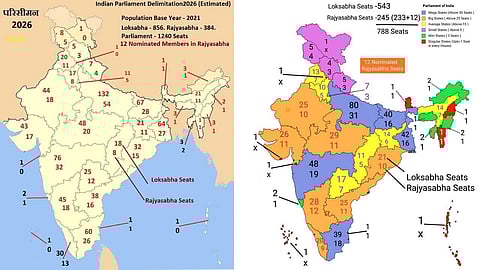
The Centre on 14 April 2026 circulated draft legislation to Members of Parliament proposing a major increase in the strength of the Lok Sabha to 850 seats and enabling fresh delimitation of constituencies.
The proposed changes are part of a broader legislative package expected to be introduced during a special three day session of Parliament scheduled from 16 April to 18 April 2026. The draft bills aim to operationalise the 33% reservation for women in Parliament and state Assemblies while resetting constituency boundaries based on updated population data.
The proposed expansion of the Lok Sabha, combined with delimitation, has triggered political debate, with opposition parties, southern state leaders and civil society groups raising concerns about representation, timing and transparency.
The Constitution (131st Amendment) Bill, 2026 proposes increasing the Lok Sabha’s strength from the current 543 members to 850. Of these, 815 seats would be allocated to states and 35 to Union Territories.
Currently, the Constitution allows a maximum of 530 members from states and 20 from Union Territories, though the present strength stands at 543 following earlier delimitation exercises.
The proposed amendment seeks to modify Article 81 of the Constitution to raise the ceiling and accommodate updated population figures. The government has circulated copies of the draft to MPs ahead of the special session.
The proposal also seeks to remove the decades old freeze on allocation of seats among states.
The 42nd Constitutional Amendment in 1976 froze seat allocation based on the 1971 census to encourage population control. The freeze was later extended by the 84th Amendment in 2001 until after the first census post 2026.
As a result, the number of seats allocated to states has remained unchanged for decades, even as population patterns shifted.
The new proposal removes this freeze and enables redistribution of seats based on updated population data. This may alter the relative share of seats among states, particularly between northern and southern regions.
Southern states have recorded lower population growth due to family planning measures, while several northern states have seen higher growth. Population based delimitation could therefore change representation patterns.
The government has convened a special Parliament session from 16 April to 18 April 2026 to introduce 33% reservation for women in the legislature. The session will cover three bills: the Constitution Amendment Bill, the Delimitation Bill 2026 and the Union Territories Laws Amendment Bill.
Together, these proposals aim to enable fresh delimitation of parliamentary and Assembly constituencies and implement the women’s reservation provision passed under the Constitution (106th Amendment) Act, 2023.
The Women’s Reservation Act, passed in September 2023, reserves one third of seats in the Lok Sabha and state Assemblies for women. However, implementation was linked to a future census and delimitation exercise, delaying the rollout.
The new amendment proposes to delink delimitation from the post 2026 census requirement. This would allow delimitation based on earlier census data and enable reservation to be implemented sooner, potentially by the 2029 Lok Sabha elections.
The Delimitation Commission, to be constituted under the proposed law, would reallocate seats among states, redraw constituency boundaries, and determine reservations for Scheduled Castes, Scheduled Tribes and women.
The Commission will be chaired by a current or former Supreme Court judge and include election officials. Its orders, once published, would have the force of law and cannot be challenged in court.
The amendments require a two thirds majority in both Houses, making opposition support crucial.
With the draft bills now circulated to MPs, the coming parliamentary session is expected to see intense debate over delimitation, women’s reservation and the future structure of India’s parliamentary representation.
Opposition leaders have raised concerns over the timing and implications of the proposed changes.
Senior advocate Kapil Sibal alleged that the move was aimed at securing political advantage ahead of the 2029 elections. He argued that women’s reservation could be implemented within the existing 543 seats instead of increasing the House strength.
Sibal also claimed that increasing seats proportionately could benefit northern states more than southern states. He cited examples suggesting that Uttar Pradesh’s seats could increase significantly compared to states such as Tamil Nadu.
Congress has issued a whip to its Lok Sabha MPs ahead of the special session and is expected to take a formal position after a meeting of the INDIA bloc. Party leaders indicated that they may support women’s reservation but oppose delimitation linked to seat expansion. Congress leaders including Sonia Gandhi have argued that delimitation must be politically equitable and not merely based on arithmetic population calculations.
Tamil Nadu CM MK Stalin warned of protests if delimitation disproportionately increased representation of northern states. He said the process lacked consultation and transparency.
Telangana CM Revanth Reddy said women’s reservation and delimitation should be treated separately and called for national consensus before implementing major electoral changes.
Political commentator Yogendra Yadav also expressed concern that the proposed amendment removes safeguards maintaining current seat proportions and allows reallocation based on future decisions.
Several public figures and activists issued statements expressing concern that major constitutional changes were being introduced without public consultation. They called for publication of draft legislation and wider debate.
[DS]
Suggested Reading:
Subscribe to our channels on YouTube and WhatsApp
Download our app on Play Store
