
- HOME
- OPINION
- ON GROUND
- INTERVIEW
- Neta Profile
- Editor's Pick
- INDIA
- NewsGram USA
- WORLD
- न्यूजग्राम
- POLITICS
- ENTERTAINMENT
- CULTURE
- LIFESTYLE
- ECONOMY
- SPORTS
- Jobs / Internships
- Misc.
- NewsGram Exclusive

Key Points
As Berlinale jury president, Wim Wenders said films can change people but not politicians, and that filmmakers should “do the work of people, not the work of politicians” when asked about Gaza and Germany’s support for Israel.
Calling the jury’s remarks “jaw-dropping” and “unconscionable,” Arundhati Roy pulled out of Berlinale 2026, stating that artists should speak out against what she described as genocide in Gaza.
In response to criticism, the Berlinale issued a statement saying artists should not be expected to comment on every political issue and reaffirmed its commitment to free expression and diverse perspectives.
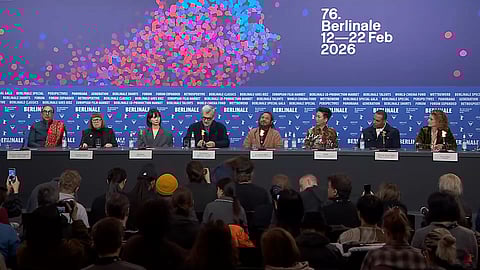
The 76th Berlin International Film Festival – the Berlinale – sparked controversy soon after opening on 12 February 2026, when jury president Wim Wenders said filmmakers “have to stay out of politics” when asked about the war in Gaza and Germany’s support for Israel. In response, Indian author Arundhati Roy withdrew from the festival, describing the jury’s comments as “unconscionable.”
The incident unfolded during the opening press conference of the Berlinale, which is largely financed by the German federal government. The question was posed by journalist Tilo Jung to the seven-member international jury, chaired by Wenders and including Polish producer Ewa Puszczyńska, among others.
When asked whether films can influence political change, Wenders responded that “movies can change the world,” but “not in a political way.” He said that while films may change “the idea people have of how they should live,” no movie has changed a politician’s position. He added that there is “a big discrepancy on this planet between people who want to live their lives and governments who have other ideas,” and that films enter that discrepancy.
The jury was then asked specifically about the ongoing Gaza genocide and the German government’s support for Israel. Puszczyńska described the question as “a bit unfair,” saying filmmakers cannot be responsible for how viewers interpret their work or what political positions governments adopt. “There are many other wars where genocide is committed, and we do not talk about that,” she said.
Wenders reiterated his position, stating: “We have to stay out of politics because if we make movies that are dedicatedly political, we enter the field of politics. But we are the counterweight of politics, we are the opposite of politics. We have to do the work of people, not the work of politicians.”
During the exchange, the press conference livestream experienced technical difficulties. Some observers questioned whether the feed had been deliberately cut. The Berlinale later said the disruption was due to technical problems and apologised, stating that the full recording would be made available online.
The remarks drew immediate criticism.
Writing in The Wire on 13 February 2026, Roy announced she would not attend the festival, where her 1989 short film, In Which Annie Gives It Those Ones, had been selected for screening in the Classics section.
Roy said she had been “profoundly disturbed” by the positions taken by the German government and some cultural institutions on Palestine, but had previously experienced solidarity from German audiences. However, she described the jury’s statements that art should not be political as “jaw-dropping.”
“It is a way of shutting down a conversation about a crime against humanity even as it unfolds before us in real time,” she wrote. She described what is happening in Gaza as “a genocide of the Palestinian people by the State of Israel,” and said it is “supported and funded by the governments of the United States and Germany,” making them complicit.
“If the greatest film makers and artists of our time cannot stand up and say so, they should know that history will judge them,” she added, “I am shocked and disgusted.”
The controversy intensified after reports noted that in 2024 Wenders had praised the Berlinale’s political character, saying it had “traditionally always been the most political of the major festivals” and that it “doesn’t stay out of things.”
In response to what it described as a “media storm,” the Berlin Film Festival issued a statement defending the jury and its president. The festival said some remarks were being circulated “detached not only out of context of the full conversations but also from the lifetime of work and values these artists represent.”
Festival director Tricia Tuttle published a reflection titled “On Speaking, Cinema and Politics.” She wrote that artists are free to exercise their right to free speech, but “should not be expected to comment on all broader debates about a festival’s previous or current practices over which they have no control.” Nor should they be expected to speak on every political issue raised to them unless they wish to do so, she added.
Tuttle emphasised that the Berlinale programme includes 278 films carrying diverse perspectives, including works addressing genocide, sexual violence in war, corruption, colonialism and abusive state power. She said the festival remains committed to creating a space where different viewpoints can be heard and respected.
Meanwhile, other attendees and panelists at the festival took varied stances when posed with similar questions. Some, like actor Neil Patrick Harris, maintained an apolitical stance, while others, like musician Charli XCX and screenwriter Ilja Rautsi, lauded the festival’s past political stances and expressed solidarity with Palestine.
As the festival continues until 22 February 2026, the debate over the relationship between art and politics has moved to the centre of public discussion. While Wenders maintains that filmmakers must remain outside the domain of politics, Roy’s withdrawal signals a sharply different position: that silence in the face of violence is itself a political act.
[DS]
Suggested Reading:
Subscribe to our channels on YouTube and WhatsApp
Download our app on Play Store
