
- HOME
- OPINION
- ON GROUND
- INTERVIEW
- Neta Profile
- Editor's Pick
- INDIA
- NewsGram USA
- WORLD
- न्यूजग्राम
- POLITICS
- ENTERTAINMENT
- CULTURE
- LIFESTYLE
- ECONOMY
- SPORTS
- Jobs / Internships
- Misc.
- NewsGram Exclusive

Key Points:
India's Road to Gold in Commonwealth Games 2026 has already taken a huge blow due to drug violation.
Judoka Arun Kumar and Weightlifter Dilbagh Singh are the two athletes under inspection.
India's history around doping violation, not the first time the country is caught in doping violation.
By Gopal Ram Tripathi
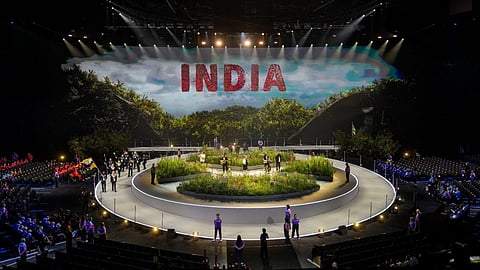
INDIA’S CAMPAIGN at the 2026 Commonwealth Games has run into trouble even before it truly began. The Games officially opened in Glasgow on Thursday, July 23, 2026, with Britain's King Charles declaring them open. But for India, the excitement was quickly overshadowed by bad news because of the drug violations. Two athletes have been forced out of the Indian squad, dealing a blow to the country's medal hopes at an event that had already been scaled down this year.
The two athletes affected are Judoka Arun Kumar and weightlifter Dilbagh Singh. While their situations are different, both cases are linked to doping rules, and both mean India will have one less shot at a medal in their respective sports.
Arun Kumar, who competes in the 78 kg judo category, was removed from India's squad after India's National Anti-Doping Agency (NADA) provisionally suspended him. This happened even before the Indian team left for Glasgow. Making matters worse for India, the rules of the competition do not allow any replacement athlete to be sent in his place. This means India's judo team will simply compete with one fewer athlete, and that spot is lost for good.
Dilbagh Singh's case is a little different. He personally has not been accused of doping. Instead, he is paying the price for other athletes' mistakes. Between June 1, 2025, and July 22, 2026, Indian weightlifting recorded five separate doping violations. Because of this poor track record, the total number of weightlifting slots allotted to India for these Games was cut down from 16 to just 11.
Dilbagh Singh had been named as part of a 12-athlete squad, but with the quota reduced, he has now been recalled from Glasgow and will return home without competing.
The rule behind this decision is spelled out clearly in the competition's qualification system. It states that if any weightlifting athlete or support staff member from a country commits an anti-doping violation during the set period, that country's total number of qualification slots gets reduced by one. If there are multiple violations, the number of slots cut goes up by the same number. In India's case, five violations meant a heavy price to pay.
This isn't the first time doping has put a dent in India's sporting reputation. India recently topped a global list published by the Athletics Integrity Unit (AIU), ranking highest among countries with the most doping offenders. This raised serious questions about why the problem keeps repeating itself.
Speaking on this issue, Dr. Sumiran Passey, a sports medicine expert based in India's National Capital Region, offered some insight. He pointed out that India has a very large number of athletes competing and training at different levels, many of whom gradually work their way up to the national level. However, he noted that awareness remains a big gap. Many athletes simply do not fully understand what counts as doping and what doesn't. There is confusion around which substances are banned and which are considered safe to use, and this lack of clarity often leads to accidental violations rather than deliberate cheating.
This explanation suggests that the doping problem in Indian sports may not always be about athletes intentionally trying to cheat. In many cases, it could come down to poor awareness, inadequate education, and a lack of proper guidance at the grassroots level, where thousands of athletes train without full knowledge of anti-doping rules.
India's Commonwealth Games 2026 campaign has taken an early hit, with two athletes forced out of action due to doping-related issues before the Games even got underway. While Arun Kumar's case involves a direct doping suspension, Dilbagh Singh's exit shows how the actions of a few athletes can affect the entire team, costing India valuable qualification slots. With India already grappling with a reputation for high doping numbers globally, experts suggest the real problem may lie in a lack of awareness among athletes rather than deliberate rule-breaking. As the Games continue in Glasgow, questions around India's anti-doping systems and athlete education are likely to remain in focus.
(Edited by Harsh Pandey)
Suggested Reading:
Subscribe to our channels on YouTube and WhatsApp
Download our app on Play Store
