
- HOME
- OPINION
- ON GROUND
- INTERVIEW
- Neta Profile
- Editor's Pick
- INDIA
- NewsGram USA
- WORLD
- न्यूजग्राम
- POLITICS
- ENTERTAINMENT
- CULTURE
- LIFESTYLE
- ECONOMY
- SPORTS
- Jobs / Internships
- Misc.
- NewsGram Exclusive
This article was originally published in Radio Free Europe/Radio Liberty (RFE/RL). Read the original article.
Russian deadly air strikes across Ukrainian regions continue as trilateral negotiations between Kyiv, Moscow, and Washington to end the war, now in its fifth year, are effectively paused amid the conflict in the Middle East.
At least three people were killed and more than a dozen injured in Ukraine on March 22 after Russian forces launched missiles and nearly 140 drones toward the country's territory.
According to Ukrainian officials, more than five regions in Ukraine's east, north, and south, including the war-torn Donetsk region, came under attack.
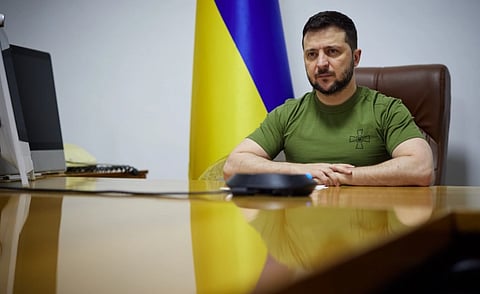
Ukrainian President Volodymyr Zelenskyy said the strikes came as Moscow felt "impunity" after the United States has temporarily lifter sanctions on Russian oil stranded in the seas amid soaring global prices spiked by its war with Iran.
"During this week, due to the easing of sanctions, Russia increased its crude oil sales to fund its war," he wrote on Telegram. "The profits give Russia a sense of impunity and the ability to continue the war. Therefore, pressure must continue."
Separately, as Russian forces continued to target Ukraine's civilian, energy, and railway infrastructure, a train attendant in Odesa died while helping with evacuation efforts amid the threat of drone attacks.
"At Odesa railway station, a train attendant was fatally injured by an oncoming train while passengers were being evacuated from a stopped train. The other train was also heading to its evacuation stop," Ukraine's state railway operator, Ukrzaliznytsia, reported.
Russia's latest attacks come amid great uncertainty in the negotiation process earlier initiated and mediated by the United States.
Ukrainian, Russian, and US officials met for talks in Geneva nearly a month ago. But the war in Ukraine has shown no signs of easing, with fighting continuing across the front lines on a daily basis.
After weeks of new rounds being postponed, on March 21-22, Kyiv's diplomats, including Ukraine's chief negotiator Rustem Umerov, met in Florida with US Special Envoy Steve Witkoff and President Donald Trump's son-in-law Jared Kushner, who are overseeing the Ukraine peace talks.
"It is clear that the attention of the American side at this time is primarily focused on the situation around Iran," Zelenskyy said following the talks, adding that he saw signals for a new prisoner exchange with Russia -- the only visible outcome of previously held trilateral negotiations.
A day earlier, he said the key issue was to understand if Moscow was really ready to "move toward a real end to the war...especially now, when the geopolitical tensions have only increased due to the situation around Iran."
Witkoff on March 22 called the talks "constructive' and said they "built on yesterday’s progress and focused on key points to define a durable and dependable security framework for Ukraine, as well as critical humanitarian efforts in the region."
Last week, one of the Kremlin's main envoys, Kirill Dmitriev, also flew to Florida to meet with the US officials. He described the talks as "productive."
Some experts believe Russia has benefited from the conflict in the Middle East, as it has partially filled Moscow's budget gaps and shifted global attention away from its war, giving it more room to continue military operations in Ukraine.
Copyright (c)2025 RFE/RL, Inc. Used with the permission of Radio Free Europe/Radio Liberty
[GP]
Suggested Reading:
Subscribe to our channels on YouTube and WhatsApp
Download our app on Play Store


