
- HOME
- OPINION
- ON GROUND
- INTERVIEW
- Neta Profile
- Editor's Pick
- INDIA
- NewsGram USA
- WORLD
- न्यूजग्राम
- POLITICS
- ENTERTAINMENT
- CULTURE
- LIFESTYLE
- ECONOMY
- SPORTS
- Jobs / Internships
- Misc.
- NewsGram Exclusive

AI generated summary, newsroom-reviewed
West Bengal politics has taken a cultural turn, with food emerging as a central issue in the battle between the Trinamool Congress (TMC) and the Bharatiya Janata Party (BJP) ahead of the 2026 Assembly elections. Polling is scheduled for April 23 and April 29, with counting set for May 4, 2026. The election atmosphere in the state remains tense, marked by instances of poll violence, continuous targeting, and aggressive political campaigning.
The food politics row began after Union Home Minister Amit Shah announced that he would stay in West Bengal for 15 days during the election period. He said, “In the Bengal elections, for fifteen days I will be living in Bengal only. I will get many chances to talk to all of you.” His remark drew a sharp response from the TMC.
In a post dated April 2, 2026, the All India Trinamool Congress took a sarcastic swipe at Shah, calling him a “tourist.” The post read, “@AmitShah has announced his decision to spend 15 days in Bengal. Good. Bengal welcomes tourists with open arms.” It further invited him to stay as long as he liked and added, “Do not miss out on some of our finest delicacies.”
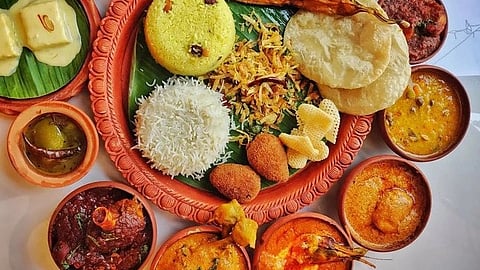
The TMC also shared a curated “menu” for Shah, recommending six popular Bengali dishes—Muri Ghonto, Pabda Macher Jhal, Ilish Bhapa, Chingri Malai Curry, Bhetki Paturi, and Kosha Mangsho. The post, accompanied by an image of a traditional Bengali thali with rice, sweets, and non-vegetarian items, quickly went viral and was widely seen as a sarcastic political jab at the BJP.
At the heart of the controversy lies the issue of food practices, particularly non-vegetarian consumption, which is deeply embedded in Bengal’s culture. Fish and meat are staple foods in the state, and the TMC has long accused the BJP of promoting ideas that go against these dietary habits.
Chief Minister Mamata Banerjee strongly criticised such ideas during her campaign, calling them “anti-people and condemnable.” She alleged that if the BJP comes to power, it could impose restrictions on fish, meat, and even eggs, thereby disrupting Bengal’s food culture. These concerns stem partly from actions in some northern states, where restrictions on non-vegetarian food have been reported during certain festivals.
An example often cited is a statement by Bihar Deputy Chief Minister Vijay Kumar Sinha, who proposed restricting the open sale of meat and fish near educational institutions, religious places, and crowded public areas. This has been used by the TMC to reinforce its claims.
As the debate intensified, BJP leaders have attempted to counter the narrative, with visuals of party members eating fish and engaging with local food culture during campaigns.
State BJP president Samik Bhattacharya dismissed the allegations, stating that people in West Bengal are free to eat whatever they choose. “People in Bengal will eat whatever they want to eat. Bengal will have its fish and meat,” he said. He clarified that the party has not proposed any blanket restrictions and accused the TMC of misrepresenting statements for political gain.
With the election drawing closer, the issue of food has evolved beyond a cultural practice into a powerful political narrative. It now reflects broader ideological differences, touching on identity, livelihood, and personal choice in West Bengal’s high-stakes 2026 Assembly elections.
(Editor by Dhruv Sharma)
Suggested Reading:
Subscribe to our channels on YouTube and WhatsApp
Download our app on Play Store
