
- HOME
- OPINION
- ON GROUND
- INTERVIEW
- Neta Profile
- Editor's Pick
- INDIA
- NewsGram USA
- WORLD
- न्यूजग्राम
- POLITICS
- ENTERTAINMENT
- CULTURE
- LIFESTYLE
- ECONOMY
- SPORTS
- Jobs / Internships
- Misc.
- NewsGram Exclusive

Key Points
The Tata Nano project in Singur triggered protests over forcible land acquisition, becoming a turning point in West Bengal politics
Mamata Banerjee’s anti-land acquisition movement between 2006 and 2008 reshaped rural political loyalties and weakened the Left Front
The Singur and Nandigram movements together led to the collapse of the Left Front’s 34 year rule and the rise of the Trinamool Congress in 2011
For decades, land redistribution defined the political identity of the Left Front government in West Bengal. Beginning with Operation Barga in 1978, the CPI(M)-led government strengthened its rural base by granting sharecroppers land rights and security. The policy reshaped Bengal’s agrarian economy and built deep political loyalty across rural districts such as Bardhaman, Hooghly and East Midnapore.
But three decades later, land once again became the issue that transformed Bengal’s politics. This time, however, the debate shifted from redistribution to acquisition, and from empowerment to displacement. The proposed Tata Nano project in Singur between 2006 and 2008 became the flashpoint that altered West Bengal’s political landscape and ultimately ended 34 years of Left Front rule.
In 2006, the Left Front returned to power for a seventh consecutive term under Chief Minister Buddhadeb Bhattacharjee. Unlike earlier Left leaders, Bhattacharjee pushed aggressively for industrialisation, hoping to revive Bengal’s stagnant economy and reverse decades of capital flight.
Shortly after the 2006 election, Bhattacharjee announced that Tata Motors would set up a manufacturing unit for the Tata Nano, a low-cost car priced at around ₹1 lakh. The project was presented as a major investment that would create jobs and signal Bengal’s return as an industrial hub.
Singur in Hooghly district was chosen for the project. The area was known for fertile multi-crop agricultural land, and the government moved to acquire nearly 1,000 acres for the plant. While many farmers accepted compensation, others refused to give up their land, fearing loss of livelihood.
The acquisition triggered widespread unrest. Farmers, activists and political groups began protesting what they described as forcible acquisition of fertile agricultural land. The protests soon gained political momentum.
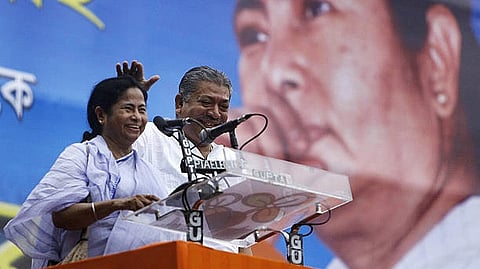
Mamata Banerjee, then leader of the opposition, quickly aligned herself with protesting farmers. Between late 2006 and 2008, she led sustained protests against the project, arguing that fertile farmland should not be acquired for industry. When prevented from entering Singur, Banerjee launched a hunger strike in Kolkata. The fast lasted 26 days and drew support from activists, intellectuals and opposition groups. The Singur movement soon became a state wide political issue.
Banerjee demanded that 400 acres of land be returned to farmers who had not willingly sold their land. Her campaign gained momentum in June 2008, when the Trinamool Congress secured major victories in panchayat elections in Singur, South 24 Parganas and Purba Medinipur.
In August 2008, Banerjee began an indefinite sit-in outside the factory gates. The protest drew thousands of supporters and intensified the political standoff.
Despite mediation efforts by then West Bengal Governor Gopal Krishna Gandhi, negotiations between the Left Front government and the opposition failed. The protests continued, and tensions escalated.
On 3 October 2008, Tata Motors announced its decision to withdraw from Singur. Industrialist Ratan Tata described the move as painful and blamed the protests for derailing the project.
At a press conference, Tata said, “I think Ms Banerjee has pulled the trigger,” referring to the continued agitation. In an open letter published in newspapers, Tata warned that Bengal risked being consumed by confrontation, agitation and instability. Shortly after the withdrawal, Tata Motors relocated the Nano plant to Sanand in Gujarat. The Gujarat government fast tracked approvals, and production began there within 14 months.
The Singur withdrawal became a defining moment in Bengal politics. What had begun as a local land protest evolved into a broader political narrative around land rights, development and governance.
Around the same time, another land conflict emerged in Nandigram in East Midnapore district. In early 2007, the state government proposed setting up a chemical hub in the area. The announcement triggered fears of large scale displacement.
Protests escalated, and violence followed. Police firing on demonstrators in 2007 killed at least 14 villagers, triggering nationwide outrage. The Nandigram incident further weakened the Left Front government and strengthened the opposition.
Together, Singur and Nandigram reshaped Bengal’s political mood. Mamata Banerjee positioned herself as the defender of farmers and rural communities. Her slogan “Maa, Maati, Manush” (Mother, Soil and Man) resonated widely.
Between 2008 and 2010, the Trinamool Congress made steady electoral gains. The party won panchayat elections in 2008, performed strongly in the 2009 Lok Sabha elections and swept municipal polls in 2010.
The political tide had turned.
The 2011 Assembly elections marked the culmination of this shift. After 34 years in power, the Left Front was defeated by the Trinamool Congress.
The Singur and Nandigram movements were widely seen as key factors behind the Left Front’s defeat. Mamata Banerjee’s anti-land acquisition campaign helped her emerge as a champion of rural voters and marginalised communities.
Soon after coming to power in 2011, Banerjee moved to return land acquired for the Nano project. The state government passed the Singur Land Rehabilitation and Development Act, 2011, to return 400 acres to unwilling farmers.
Tata Motors challenged the decision in court, triggering a prolonged legal battle.
In 2016, the Supreme Court declared the Singur land acquisition illegal and ordered the return of 997 acres to farmers within 12 weeks. The land was eventually handed back, and farming resumed in parts of the area.
Sixteen years after the Tata withdrawal, Singur continues to shape Bengal’s political narrative. The abandoned factory site became symbolic of both missed industrial opportunities and land rights victories.
Some residents who expected jobs from the Nano plant expressed disappointment after the project collapsed. Others said the movement protected farmland and livelihoods. Political parties continue to debate whether the Tata exit helped or harmed Bengal’s development. Critics argue that Singur damaged Bengal’s investment climate. Supporters say it protected farmers from forced acquisition.
Even in recent years, Singur has remained central to political debates. In January 2026, Prime Minister Narendra Modi criticised West Bengal’s industrial record during a visit to Singur. The TMC responded by organising its own rally at the same location, highlighting the continuing political relevance of the issue.
Meanwhile, new land controversies such as Sandeshkhali have revived comparisons with Singur and Nandigram. Opposition parties argue that land politics remains central to Bengal’s governance debate.
The irony of Bengal’s political transformation lies in its origins. The Left Front built its support through land redistribution in the late 1970s and 1980s. But decades later, land acquisition for industrialisation weakened that same political base.
Singur marked the shift from land redistribution to land capture in Bengal’s political imagination. The Tata Nano project, intended to revive industry, instead triggered a political movement that ended the longest-serving democratically elected communist government in the world.
Suggested Reading:
Subscribe to our channels on YouTube and WhatsApp
Download our app on Play Store
