
- HOME
- OPINION
- ON GROUND
- INTERVIEW
- Neta Profile
- Editor's Pick
- INDIA
- NewsGram USA
- WORLD
- न्यूजग्राम
- POLITICS
- ENTERTAINMENT
- CULTURE
- LIFESTYLE
- ECONOMY
- SPORTS
- Jobs / Internships
- Misc.
- NewsGram Exclusive

Amit Shah unveiled BJP’s ‘Sankalp Patra’ in Kolkata, targeting TMC’s 15-year rule and pitching it as a roadmap from “darkness to development.”
The manifesto includes ₹3,000 monthly aid for women and unemployed youth, one crore jobs, 7th Pay Commission implementation, and full rollout of central schemes like Ayushman Bharat.
BJP promises UCC within six months, a crackdown on illegal immigration, action against corruption, and probes into political violence.
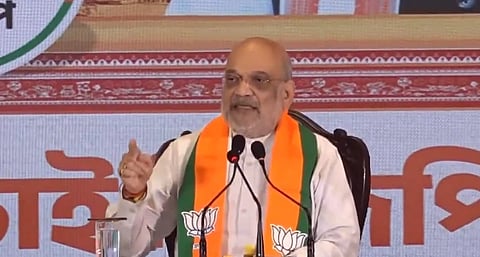
On Friday, April 10, 2026, the Bharatiya Janata Party (BJP) announced its ‘Sankalp Patra’ (manifesto) for the 2026 West Bengal Assembly elections. The manifesto, titled “Bhoroshar Shopoth”, is positioned as a roadmap to transform the state from what the party describes as “darkness” to development, in line with the vision of Viksit Bharat.
The manifesto was released in Kolkata by Union Home Minister Amit Shah and outlines 15 key promises for the people of West Bengal. Addressing the media after the launch, Shah strongly criticised the All India Trinamool Congress (TMC), led by Chief Minister Mamata Banerjee, describing its 15-year rule as a “period of darkness.” He alleged a breakdown in law and order and claimed that the people of the state are now seeking change.
“This manifesto is a path to bring every section of Bengal out of despair. It will show a new way out for farmers surrounded by various kinds of fears. This manifesto will also place before the people of Bengal the roadmap for the developed India envisioned by Prime Minister Modi,” Shah said, adding that people feel “frightened and disillusioned” and are now looking for hope.
The manifesto is themed around “Sonar Bangla” (Golden Bengal) and outlines a mix of welfare measures, economic initiatives, and governance reforms. A key highlight is the promise of monthly financial assistance of ₹3,000 for women. The party has also emphasised women’s safety and empowerment through proposals such as women-only police battalions, 33% reservation for women in state government jobs, and initiatives like “Durga Suraksha.”
A ₹3,000 support scheme has also been proposed for unemployed youth, along with a broader commitment to generate one crore jobs and self-employment opportunities over the next five years. For government employees and pensioners, the BJP has promised to clear pending Dearness Allowance (DA) dues and implement the recommendations of the 7th Pay Commission.
A strong focus on law and order and national security forms a central part of the manifesto. The BJP reiterated its “zero tolerance” approach towards illegal immigration, proposing a strict ‘detect, delete and deport’ policy. Shah also promised to curb cattle smuggling and strengthen border security.
The manifesto includes a proposal to implement a Uniform Civil Code (UCC) within six months of forming the government. Additionally, the party has pledged to set up a commission headed by a retired Supreme Court judge to investigate instances of political violence and ensure accountability.
To address corruption, the BJP announced plans to release multiple white papers detailing alleged irregularities during TMC’s rule, including issues related to governance failures and law and order. The manifesto also promises action against “syndicate culture” and the controversial “cut money” system linked to government contracts.
On the welfare front, the BJP has pledged full implementation of central schemes such as Ayushman Bharat, along with expanded healthcare initiatives including free vaccination, breast cancer screening, HPV immunisation, and institutional delivery support for women.
In the agricultural sector, the party has promised increased support for key crops such as rice, potato, and mango to boost farmers’ incomes. It also aims to strengthen the fisheries sector through the Pradhan Mantri Matsya Sampada Yojana and position West Bengal as a hub for fisheries exports.
Industrial revival is another focus area, with plans to rejuvenate tea gardens, strengthen the Darjeeling tea brand, modernise the jute industry, and develop a broader “blue economy” roadmap.
Invoking Bengal’s cultural legacy, Shah referenced Rabindranath Tagore’s iconic lines, “Where the mind is without fear,” stating that the BJP aims to build a state where people live with dignity and pride.
The manifesto proposes cultural recognition measures, including the inclusion of Kurmali and Rajbanshi languages in the Eighth Schedule of the Constitution. It also promises the establishment of a “Vande Mataram” museum to celebrate India’s heritage.
Following the manifesto launch, Amit Shah is scheduled to address a public rally in Debra and participate in a roadshow in Kharagpur, signalling an intensification of the BJP’s campaign. With polling set to be held in two phases—April 23 and April 29—for the 294-member West Bengal Assembly, and counting scheduled for May 4, the political contest in the state is set to intensify.
Suggested Reading:
Subscribe to our channels on YouTube and WhatsApp
Download our app on Play Store
