
- HOME
- OPINION
- ON GROUND
- INTERVIEW
- Neta Profile
- Editor's Pick
- INDIA
- NewsGram USA
- WORLD
- न्यूजग्राम
- POLITICS
- ENTERTAINMENT
- CULTURE
- LIFESTYLE
- ECONOMY
- SPORTS
- Jobs / Internships
- Misc.
- NewsGram Exclusive

Key Points:
An exclusive report by the Caravan states that AAIB attempted to substantiate claims that Sabharwal had mental health issues.
On June 12, 2025 the AI171 plane crash claimed the lives of 241 people onboard leaving only one survivor Ramesh Vishwaskumar.
The Aircraft Accident Investigation Bureau (AAIB), under the Ministry of Civil Aviation, is investigating the Boeing 787 Dreamliner crash.
THE TRAGIC AIR INDIA FLIGHT 171 PLANE CRASH that claimed the lives of 241 people onboard left several questions regarding the root cause of one of the deadliest crashes in the history of Indian aviation. On June 12, 2025, the Boeing 787 Dreamliner crashed into a student hostel in Ahmedabad just 32 seconds after taking off. Exactly one year has passed since the fatal plane crash.
While answers to the pending questions are still awaited, the Aircraft Accident Investigation Bureau (AAIB), under the Ministry of Civil Aviation, is responsible for investigating the Boeing 787 Dreamliner crash. The AAIB's second preliminary report, released on June 12, 2026, a year after the crash, revealed no major updates. In its interim statement, the AAIB said that the probe into the Boeing 787 Dreamliner crash is currently ongoing. Questions still linger: What happened that day?
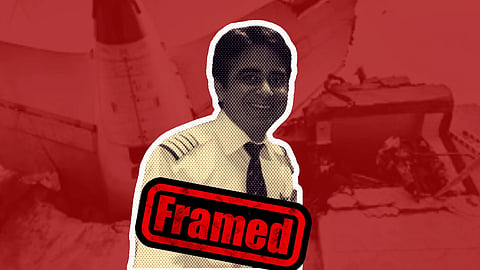
Among the various narratives that emerged, the Western media shifted its focus to the pilot who was commanding the aircraft at the time of the crash. A Wall Street Journal report published on July 17, 2025 asserted that senior co-pilot Sumeet Sabharwal had turned off the switch that controlled the fuel flow to the engines. Thus began Sabharwal's crucifixion.
Sumeet Sabharwal, 56, was commanding AI171. With decades of flying experience, Sabharwal had logged approximately 15,600 flight hours, including 8,600 hours on the Boeing 787 Dreamliner.
Suggested Reading : LONG READ
According to an exclusive report by The Caravan, AAIB investigators allegedly attempted to drag Sabharwal's name through the dirt following the plane crash. Writer Rachel Chitra reported that Sabharwal's colleagues shared how the AAIB was allegedly hell-bent on determining whether Sabharwal had any role in the plane crash that killed 260 people. "AAIB investigators had asked whether he suffered from depression, diabetes, high blood pressure, or substance abuse," Chitra wrote.
The report further added that AAIB investigators allegedly attempted to substantiate claims that Sabharwal had mental health issues by approaching his ex-wife. Sabharwal's ex-wife refused to support the claim. "They were using any and all means to get dirt on him," said one of Sabharwal's batchmates, as quoted by The Caravan.
His father, Pushkaraj Sabharwal, 91, told the BBC, "He is no more, but I have to protect his reputation." Pushkaraj Sabharwal, a former official with the Directorate General of Civil Aviation, stated that blaming a pilot after an airplane crash is an easy way out of the situation. "It's the simplest way to close the chapter. He is no more and cannot defend himself," Pushkaraj said.
Calling his son "a good pilot," he remembered the young Sabharwal, who spent hours watching planes land and take off when he was 10 years old. Pushkaraj even explained to The Caravan the process of investigating a crash. He said, "One must look into the life cycle of the engine and its maintenance chain." He continued that, during an investigation, every minute element is examined, from the tensile strength of the wiring to possible electrical failures.
The crash killed almost everyone on board, including pilots Captain Sumeet Sabharwal and Clive Kunder. One man, Ramesh Vishwaskumar, survived the deadly plane crash, making him the lone survivor. The 38-year-old British citizen became a crucial figure in uncovering what really happened that day. He was seated in seat 11A, right next to the emergency exit. Vishwaskumar recalled hearing a loud noise from the back of the aircraft just before the crash, a detail that became a turning point in the investigation.
Watch Full Report:
Suggested Reading:
Subscribe to our channels on YouTube and WhatsApp
Download our app on Play Store
