
- HOME
- OPINION
- ON GROUND
- INTERVIEW
- Neta Profile
- Editor's Pick
- INDIA
- NewsGram USA
- WORLD
- न्यूजग्राम
- POLITICS
- ENTERTAINMENT
- CULTURE
- LIFESTYLE
- ECONOMY
- SPORTS
- Jobs / Internships
- Misc.
- NewsGram Exclusive
This story written by Amanuel Tesfaye Kebede originally appeared on Global Voices on March 11, 2026.
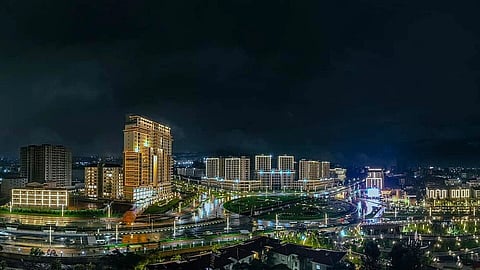
After Turkish President Recep Tayyip Erdoğan visited Addis Ababa, Ethiopia, on February 17, it wasn’t the diplomatic and geopolitical importance of his visit that captured the internet’s attention. It was a video of his motorcade racing through a newly completed boulevard in Addis Ababa, with wide, clean streets, surrounded by high-rises and bright lights. Amassing more than five million views in a day, the footage quickly spread to far corners of the world. Ethiopians shared the video — and several others like it — with pride. Commentators from African countries as well as places as far as Iran and Pakistan expressed admiration and contrasted it with dilapidated streets in their own countries.
This is the second time Addis Ababa’s cityscape has gone viral in recent months. In January, a visit by renowned US influencer Darren Watkins Jr., known online as IshowSpeed, garnered 10 million views in a day and similar buzz about Addis Ababa’s urban transformation, with his YouTube livestream and snippets of clips from it going viral on X and TikTok. Many saw the video as a direct challenge to outdated Western stereotypes of limited African infrastructure, and evidence that the country is transforming at a breakneck pace.
The corridor development project, an urban transformation project “aiming to improve infrastructure, housing, and public spaces,” has become the centerpiece of the Ethiopian government’s agenda. Over the past three years, Addis Ababa’s corridor project has added and expanded walkways, bike lanes, green spaces, and vibrant streetlights, complemented by an associated riverside development. The project has also come under criticism regarding the forced eviction of the urban poor, the erasure of cultural heritage, and the lack of transparency.
More importantly, it has been criticized for misprioritizing and misallocating government resources, given the socio-economic and political challenges Ethiopia faces. Large swaths of the country are experiencing civil wars and remain outside government control, with 4.5 million people internally displaced, and 10 million citizens requiring humanitarian aid in 2025. Additionally, 9 million school-age children are out of school due to conflict and resource scarcity.
In the face of such a systemic crisis, urban renewal and accompanying imagery pushed by state actors and supporters — and amplified by a willing and unsuspecting assemblage of influencers, travelers, and social media users — have become an important source of aesthetic propaganda.
To push back against criticism, state actors and their digital proxies resort to visually striking transformations of urban spaces as proof that the government is succeeding despite naysayers. Aesthetic propaganda thus expands the toolkit of what has invariably been described as network propaganda, computational propaganda, and, recently, influencer propaganda.
This turn to aesthetic propaganda is borne out of shifting technological trajectories. Images and short-form videos have emerged as the predominant features of social media. This has especially been the case since the launch of TikTok in 2018, quickly becoming one of the largest video-sharing platforms globally. Scholars have argued that visual media tends to be “attention-grabbing, emotion-eliciting, and easy-to-digest,” making it versatile in the digital age of information overload. Authoritarian states have recognized this visual turn in social media and have adapted their propaganda efforts accordingly to appeal to wider and younger audiences.
Unlike traditional propaganda, in which the state tends to be the sole producer and amplifier of material, aesthetic propaganda is produced in a distributed manner, including by state actors, influencers, tourism agencies, travelers, and citizens themselves. A large portion of content related to the corridor project comes from government social media accounts, including those of the Prime Minister’s Office and the Addis Ababa City Administration, which share high-production-value video footage, including drone shots, on X and TikTok. Snippets of these videos are then clipped and amplified by supporters and followers. However, the state is not the only source. International influencers like IshowSpeed, African influencers such as Wode Maya, and lesser-known local influencers produced visual content highlighting the city’s transformation.
This trend is not limited to Ethiopia. Influencers have increasingly become important in popularizing selective authoritarian stories from Dubai to China, and thereby legitimizing authoritarian narratives.
In addition to supplying the underlying content, state actors also amplify content created by influencers and leverage accidental virality, as the motorcade video of Erdoğan’s visit illustrates.
The moment the video went viral and garnered international attention, state actors worked to amplify it and spread it further. Thus, diplomatic missions, ministers, and pro-government accounts not only retweeted this viral video but also added additional visual material of urban corridor projects throughout the country, further solidifying these images as the official story. In some cases, it also receives amplification through traditional state-owned media and feeds government propaganda beyond the internet.
These visuals are also powerful because they are presented as authentic accounts of Ethiopia’s reality, thereby bypassing stereotypical Western representations of Africa. Of course, Western media has severe credibility issues on the continent as it has historically represented Africa and Africans as less than, by amplifying stories of violence and poverty and deprioritizing uplifting stories. In this context, the visual content of African skylines feels emancipatory.
However, this is an illusion. Instead of presenting the reality of Africa and Africans as it is, it simply replaces foreign/Western framing with domestic elitist framing, while the majority of society remains invisible. And by doing so, it undermines critical interrogation into the socio-economic and political realities. While it feels — and looks — uplifting, it reproduces state legitimacy at the expense of the underprivileged and invisibilized populations.
While these videos of urban transformation do not misinform, they still displace criticism through compelling visual narrative. They decontextualize the image from the country’s underlying political economy. Short-form content also discourages critical and causal questioning, as it emphasizes the repetitive display of roads, skylines, and streetlights. As video becomes the dominant political medium, propaganda shifts from narration to visualization, making aesthetics central to authoritarian legitimacy.
Of course, it is important to recognize that such visual material aimed at boosting tourism and popularizing destinations is neither new nor unique to Ethiopia. The Ethiopian case becomes concerning when situated within the broader political context, where a political crisis is tearing the country apart, and a spectre of a new war looms, in addition to multiple growing insurgencies. In this context, aesthetics does more political work of legitimizing the political elite and obfuscating the reality on the ground.
While most of the literature on digital propaganda focuses on superpowers such as China, which marshals unparalleled surveillance capacity and narrative control, the Ethiopian case illustrates that a fragile state whose monopoly of violence is challenged can also resort to such visual propaganda to legitimize itself and distract from multiple political, economic, and military challenges.
[VP]
Suggested Reading:
Subscribe to our channels on YouTube and WhatsApp
Download our app on Play Store


