
- HOME
- OPINION
- ON GROUND
- INTERVIEW
- Neta Profile
- Editor's Pick
- INDIA
- NewsGram USA
- WORLD
- न्यूजग्राम
- POLITICS
- ENTERTAINMENT
- CULTURE
- LIFESTYLE
- ECONOMY
- SPORTS
- Jobs / Internships
- Misc.
- NewsGram Exclusive

Key Points
Newly released DOJ files show Jeffrey Epstein provided funding to study led by neuroscientist VS Ramachandran after being introduced by Deepak Chopra.
Emails indicate Ramachandran discussed research on an “autistic savant who displays telepathy” and expressed no objection to Epstein funding his lab. Epstein later transfered $25,000 to support Ramachandran’s research.
Epstein’s correspondence with Chopra reveals an interest in brain research, longevity and metaphysics, and conversations about Epstein's "girls" and charges.
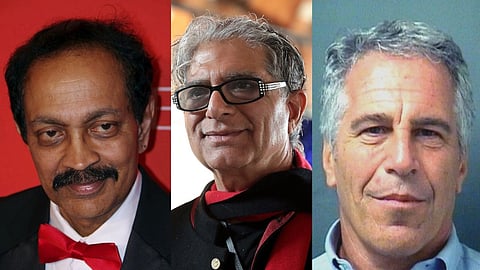
The latest batch of the Epstein files has uncovered a connection between the notorious sex trafficker and renowned Indian-American neuroscientist VS Ramachandran. Correspondences buried in the over 3 million documents reveal that Jeffery Epstein funded a study by Ramachandran on an “autistic savant who displays telepathy”.
According to emails published by the US Department of Justice (DOJ) on 30 January 2026, Epstein funded research at the Center for Brain and Cognition at the University of California, San Diego (UCSD), where Ramachandran works as director. He is also a distinguished professor in the university’s Department of Psychology.
The correspondence shows that Deepak Chopra, a wellness author and former UCSD clinical professor, played a role in introducing Epstein to Ramachandran’s lab. While speaking to CBS News in October 2025 about his relationship with Epstein, Chopra said: “At my suggestion, he also visited Dr. VS Ramachandran’s lab at [the University of California San Diego] to learn about ongoing brain research.”
An email dated 25 September 2017 shows Ramachandran responding to Chopra about a study his lab was conducting on an “autistic savant who displays telepathy.” In the exchange, Ramachandran wrote that he did not “have problem with his lab [being] funded by Epstein.”
In another message, Ramachandran asked whether Chopra’s “pal [Epstein] is serious about setting in motion a lab for the study of extraordinary brain potential … something like 500,000 to 3 million would get the administrators excited.”
Subsequently, Epstein emailed his accountant, Richard Kahn, directing him to transfer $25,000 from his private foundation, Gratitude America Ltd., to the University of California Board of Regents to support Ramachandran’s research on savant syndrome. The payment was to be mailed to Peter Hinkley, then director of the psychology department and current chief administrative officer.
Further correspondence dated 5 October 2017 shows Chopra updating Epstein about spending the day with Ramachandran to discuss a “pilot study of autistic savants,” confirming the relationship between the three.
Emails also indicate that Ramachandran’s name appeared as early as April 2009 in a message from Epstein listing “smart” and “out of the box” individuals to invite to Florida. Epstein described those listed as “good friends of mine for years.”
Regarding the development, UCSD’s University Communications told the UCSD Guardian: “The university is aware of this issue, and are reviewing the matter.”
Vilayanur Subramanian Ramachandran, born 10 August 1951 in Tamil Nadu, India, is widely known for his work in behavioural neurology. A graduate of Stanley Medical College in Chennai and Trinity College, Cambridge, where he earned his PhD in 1978, Ramachandran later joined UCSD, becoming a distinguished professor and director of the Center for Brain and Cognition.
He is known for research on phantom limbs, visual perception, synesthesia and autism. His invention of mirror therapy for phantom limb pain gained international attention and has been studied as a low-cost intervention for pain relief and motor recovery.
Ramachandran has authored several books, including Phantoms in the Brain (1998) and The Tell-Tale Brain (2010), and delivered the BBC Reith Lectures in 2003. He appeared on the Time 100 list of “the most influential people in the world” in 2011 and was awarded India’s Padma Bhushan in 2007. Newsweek once described him as one of the “100 Most Prominent People to Watch in the 21st Century.”
His work has also drawn skepticism in certain areas, particularly speculative theories involving mirror neurons and autism. Ramachandran has defended his intuition-driven experimental approach, stating in an interview that “intuition is what gets you started; then you need empirical studies.”
The Ramachandran connection forms part of a broader pattern documented in the DOJ files concerning Epstein’s interest in medicine, science and longevity.
Records cited by CBS News show that as early as 2012, Epstein planned to launch a company focused on gene sequencing. His calendar included multiple meetings with Chopra in 2016, 2017 and 2019. Chopra told CBS News that their meetings were primarily related to Epstein’s insomnia and meditation practice. “Our meetings, focused solely on practicing meditation, lasted about 30 minutes each,” Chopra said.
Chopra also stated that Epstein was introduced to him by Barnaby Marsh, former CEO of the Templeton Foundation, as a potential funder of brain and consciousness research. According to Chopra, “While several of these institutions had received some funding from him, no projects were ever initiated as a result of our interactions.”
Epstein’s interest in longevity extended beyond Chopra and Ramachandran. He met repeatedly with physician Peter Attia, a specialist in longevity medicine. Jail records from the weeks before Epstein’s death documented his sleep difficulties and the provision of a CPAP machine.
The emerging picture from the DOJ files suggests that Epstein sought associations with scientists and intellectuals as part of his engagement with research on consciousness, brain science and life extension. Many exchanges between Epstein and Chopra touch on topics such as awareness, meaning and reality, amongst references to Epstein’s “girls” and the charges against him.
Deepak Chopra himself has come under the scanner for his relationship with Epstein as the true depth of their correspondence has now come to light. Earlier, he had dismissed any inquiries under the guise of doctor-patient confidentiality and stressed that he and Epstein had strictly professional and limited interactions.
But the recent slew of evidence shows Chopra frequently professing his love for Epstein and touting him as a close friend. He even advised Epstein on how to deal with the scrutiny against him. With all this now out in public, Chopra furnished an apology for his ‘tone’ in the exchanges and an affirmation that he ‘supports all survivors’.
With the release of millions of pages of documents, scrutiny of such connections continues, even as those named in the correspondence review the implications of their past interactions with Epstein.
[DS]
Suggested Reading:
Subscribe to our channels on YouTube and WhatsApp
Download our app on Play Store
