
- HOME
- OPINION
- ON GROUND
- INTERVIEW
- Neta Profile
- Editor's Pick
- INDIA
- NewsGram USA
- WORLD
- न्यूजग्राम
- POLITICS
- ENTERTAINMENT
- CULTURE
- LIFESTYLE
- ECONOMY
- SPORTS
- Jobs / Internships
- Misc.
- NewsGram Exclusive
This story written by Lina Ma originally appeared on Global Voices on March 28, 2026.
When Afghan journalist Khadija Haidary fled the Taliban, she never imagined that her writing would reach readers thousands of miles away in China. Yet it did — prompting small but meaningful acts of support that empowered her to move forward amid her uncertain situation. In China, where civil society is tightly regulated and spontaneous cross-border humanitarian support is rare, her letters, which evolved into a book titled “A Letter from an Afghan Woman,” sparked an unexpected cross-border solidarity with the oppressed women from far away. Rather than forming a visible movement, these responses took shape as quiet, individual acts, revealing how solidarity adapts under constraint.
The story began in October 2024, when a Chinese journalist, Weilin Hong (洪蔚琳), translated and published her month-long email correspondence with “Haidary on Positive Links” (正面連結), a medium-sized WeChat account covering social issues to enlighten Chinese readers on the transformation of Afghan society under the Taliban. The Islamic militant organization, which ruled the region between 1996 and 2001, recaptured Kabul in 2021, after the U.S. withdrew its troops.
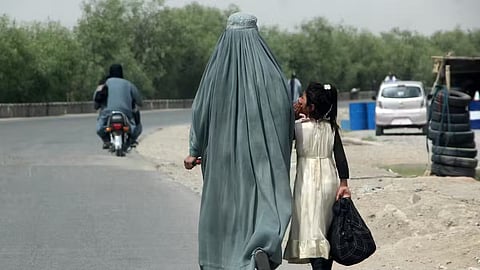
Through emails, Haidary explained how women lost their rights between 2021 and 2024: they were forced out of their jobs and forbidden from walking the streets alone; women were not allowed to be treated by male doctors, even as women were blocked from attending medical schools; girls were barred from schools, parks, and swimming pools, and many were forced to marry before reaching adulthood; journalists were imprisoned and in some cases killed for telling the truth. These accounts are not abstract statistics — they are Haidary’s lived experiences. She lost her job, male friends, social life, and bore witness to the harassment of women every day.
In China, where civil society is limited, and media coverage of foreign crises is selective, such storytelling carries particular weight. Haidary’s personal narrative on gender oppression in Afghanistan quickly went viral online and generated emotional resonances among female Chinese readers. One Chinese reader wrote on Weibo, addressing the subtle connection among women across the border:
Across borders and walls, human nature remains the same, and hearts are connected / They want women shut up; she becomes the light that cuts through the darkness at night.
Haidary was writing for Zan Times, an Afghan women’s media outlet, and taking refuge in the countryside to avoid the Taliban when the Chinese journalist first reached out to her in September 2024. The email exchanges encouraged Haidary to consider leaving the country:
For the first time, I realized that my story, my struggles, and my suffering matter; I had to find a place where I could speak freely and tell everything that had happened to us. You know, Hong Weilin’s email made me aware that there are people in the world who care about our pain. I knew I had to muster all my courage and do everything in my power to get out of here.
By early October 2024, Haidary and her family were settled in Pakistan. As her letters gained public attention, a Chinese publisher reached out to offer her a publishing contract and a royalties advance, which could help her family end their status as exiles in Pakistan and resettle in Canada.
The book was eventually published in August 2025, and within months, more than 10,000 copies were sold. Knowing that the book's royalties would help Haidary’s family resettle in a less precarious environment, many Chinese have helped promote her book through reviews and reflections on social media.
In one widely circulated post on the Instagram-like Xiaohongshu, the user “WOMEN’s view on the world” (WOMEN看世界) contrasted historical images of empowered, free Afghan women with today’s restrictions, accompanied by the following caption: “They, too, once lived vivid and vibrant lives.” The main text of this post says:
Opening the book, readers encounter some of the most authentic voices, as 18 short stories unveil deeply painful memories / To look beyond borders and prejudice, and to truly see people as they are, is in itself a form of strength.
In this sense, Afghan women’s stories function not only as distant narratives but as a mirror through which Chinese readers negotiate their own unarticulated experiences. Some readers have drawn parallels between Afghan women’s experiences and ongoing gender-related conversations in China, particularly around restrictions on personal autonomy, social expectations, and the shrinking space for feminist expression. These reflections can be seen in discussions among overseas Chinese students and feminist communities on platforms such as WeChat and Telegram, where participants related Haidary’s accounts to their own experiences.
These perspectives are also reflected, though less explicitly, in mainstream media discourse. A book review published in the state-sponsored outlet Beijing Daily noted that Haidary’s story is not only read as a distant narrative of suffering but also interpreted through readers’ own social realities:
Although the stories take place in Afghanistan, the fear, the struggles, and the family ties are universal sentiments. It [the book] reminds us that peace and freedom is not given, but something that we have to treasure and safeguard.
Some also lauded the resilience of Afghan women living in an oppressive environment. One user left the following comment on a book review on Douban, a Chinese platform for user-generated reviews of books, films, and cultural content:
Even under such pressure, Haidary managed to capture the resilience, passion, and yearning for freedom that are unique to Afghan women. The women portrayed in the book are not passive victims: some joined the National Army to reclaim their dignity, some seek out shamans in their desperation to fight back, and some remain true to themselves amid rumors and gossip. As Haidary writes in her preface: ‘Beyond war and destruction, people must have something else to define themselves.’
In addition to online promotion, some readers took further steps to support her. One reader even delivered the book to Haidary during a business trip to Pakistan in November 2025.
In such a constrained environment, solidarity does not disappear; it becomes quieter, more fragmented, and often deeply personal.
All these small acts of feminist solidarity were carried out without widespread mobilization or calls to action, as feminist social media outlets have been banned and related networks repressed in recent years. Citizen-initiated fundraising and advocacy work is highly sensitive and almost impossible under China’s tightly regulated online environment. Hong highlighted the cross-border solidarity among women in a reflective piece in January 2026:
As the world is becoming more conservative and xenophobic, this touching and selfless act of kindness has spread like a relay across China, and miraculously helped a woman from another country.
Indeed, the willingness to learn and understand others’ suffering is precious in today’s chaotic world, as explained in a post on Sohu:
Haidary’s work serves both as a mirror and a key. It reflects the suffering of Afghan women while also challenging every reader to consider their responsibility: When the world, overwhelmed by noise, forgets the pain in certain corners, are we willing to be among those who ‘know’? The book’s answer may not lie in offering solutions, but rather in awakening empathy. As the book states: ‘They are not far away.’
[VP]
Suggested Reading:
Subscribe to our channels on YouTube and WhatsApp
Download our app on Play Store

