
- HOME
- OPINION
- ON GROUND
- INTERVIEW
- Neta Profile
- Editor's Pick
- INDIA
- NewsGram USA
- WORLD
- न्यूजग्राम
- POLITICS
- ENTERTAINMENT
- CULTURE
- LIFESTYLE
- ECONOMY
- SPORTS
- Jobs / Internships
- Misc.
- NewsGram Exclusive

AI generated summary, newsroom-reviewed
FOR CENTURIES, farmers across Africa have struggled with the same problem. Every night, lions hunt their livestock as farmers wake up to their cattle being dead. For many, losing even a single cow meant losing a significant part of their livelihood. However, a decade ago an unusual research led to a solution that was as simple as making lions believe they were being watched.
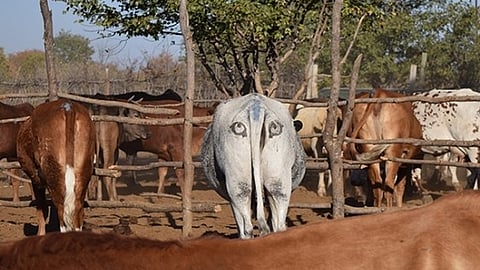
That unusual study was “cheekily” named the i-Cow Project in Botswana, where conservationists painted large eyes on the backsides of cattle in an attempt to fool lions into abandoning their attacks. What first sounded like an absurd idea, met with skepticism from peers, soon turned into one of the most talked-about wildlife conservation studies. The four-year experiment eventually found that not a single cow painted with artificial eyes was killed by ambush predators during the research period.
The study, led by Neil Jordan of the University of New South Wales in collaboration with Botswana Predator Conservation researchers, suggests that a simple coat of paint could become a major aid in reducing the long-running problem of livestock being hunted.
The idea came from an observation in the wild. In 2016, while working in Botswana's Okavango Delta, Neil Jordan watched a lion stalking an impala for nearly half an hour. Just when the hunt appeared certain, the impala turned and looked directly at the predator, making the lion abandon the hunt.
That moment made Jordan wonder whether lions disliked losing the element of surprise. Since lions are ambush predators, they rely on quietly approaching prey without being noticed. If the prey spots them first, the chances of a successful hunt become much lower.
The UNSW researcher wondered whether that instinct could be used against them. Thus, he came up with his solution to wildlife conservation — paint a pair of large eyes on the back of the cattle so that, from behind, it appeared as though the cattle was already watching the predator.
Jordan later jokingly named the experiment the "i-Cow Project", calling it the opposite of Apple's high-tech innovations because it relied on an inexpensive, low-technology solution.
The research was carried out in Botswana's Okavango Delta, a UNESCO World Heritage Site where livestock often graze close to lands used by lions, leopards, spotted hyenas, cheetahs, and African wild dogs. Although cattle spend nights inside predator-proof enclosures, they usually graze freely during the day, when most attacks take place.
Over four years, researchers worked with 14 cattle herds, comprising 2,061 livestock animals, that had recently suffered lion attacks. Around one-third of each herd received artificial eye-spots, another one-third was painted with simple cross marks, while the remaining animals were left unpainted for comparison as part of the study.
When Jordan first shared the idea, even he admitted that it sounded unusual. The concept of frightening one of Africa's most powerful predators with painted eyes on cattle’s butts seemed too simple to be taken seriously.
Several wildlife experts also raised similar questions, asking whether lions could really be fooled in such a way. Carnivore biologist Gus Mills argued that lions were intelligent opportunists and would probably realise that the painted eyes posed no threat.
South African animal behaviourist Kevin Richardson, also known as the "Lion Whisperer", was also doubtful. He said lions learn quickly through experience and questioned whether fake eyes could deceive them for long. Paul Funston of global wild cat conservation organisation Panthera offered a more cautious view. While acknowledging that lions are naturally wary of unfamiliar objects, he said the real test would come from long-term scientific evidence rather than early observations.
Jordan himself never claimed to have discovered a miraculous solution. From the beginning, he warned that predators could eventually become accustomed to the markings, a phenomenon scientists call habituation. He also acknowledged that no single method could completely solve the conflict between farmers and large carnivores. However, despite the skepticism, the final results surprised many researchers.
See Also: Scientists Discover New "Orange-Lipped" Monkey Species Hidden in the Congo Basin
According to the study, none of the 683 cattle painted with artificial eye-spots were killed by the wild predators during the four-year experiment. In comparison, lions and other predators killed 15 of the 835 unpainted cattle and four of the 543 cattle marked only with crosses.
Interestingly, researchers found that even the simple cross marks appeared to reduce attacks compared with completely unmarked cattle, an outcome they had not expected. Overall, lions accounted for most of the attacks recorded during the study. Researchers observed lions killing 18 cattle, while a leopard killed one and spotted hyenas killed three.
The findings supported Jordan's original theory that predators may abandon an attack if they believe the prey has already detected them. At the same time, the researchers stressed that the technique is not a guarantee. Since every herd still contained some unpainted cattle, scientists could not determine whether the method would remain equally effective if every animal carried artificial eyes, making the predators more habituated over time.
Still, the researchers believe the "eye-cow" method could become an important addition to non-lethal wildlife conservation tools. The issue has become increasingly important as human settlements continue to expand into wildlife habitats. Farmers often suffer heavy financial losses when livestock are killed, but on the other hand, retaliatory poisoning or shooting of lions contributes to declining population of the species across Africa.
Rather than choosing between protecting farmers or managing wildlife, the Botswana experiment suggests there may be room for both. Sometimes, keeping a lion away may not require stronger fences or bigger weapons. It may simply require convincing the predator that someone is already watching.
Suggested Reading:
Subscribe to our channels on YouTube and WhatsApp
Download our app on Play Store
