
- HOME
- OPINION
- ON GROUND
- INTERVIEW
- Neta Profile
- Editor's Pick
- INDIA
- NewsGram USA
- WORLD
- न्यूजग्राम
- POLITICS
- ENTERTAINMENT
- CULTURE
- LIFESTYLE
- ECONOMY
- SPORTS
- Jobs / Internships
- Misc.
- NewsGram Exclusive

Key Points:
An incident in Gujarat’s Patan highlighted a deep rooted social stigma still prevalent across many parts of India. A Dalit person, Vishal Chavda, was stopped and attacked by Upper Caste Thakors for riding a horse during his wedding procession.
The incident occurred on February 2, 2026, in Chandrumana village of Patan district while the Varghodo was ongoing. The disruption reflects how the idea of Equality of status and opportunity enshrined in the Indian Constitution falters at ground level.
The Patan Police registered an FIR against eight accused under the BNS and the SC/ST Prevention of Atrocities Act. Incidents like this raise serious questions about effective implementation of Article 15 and highlight concerns of social stigma and weak law enforcement.
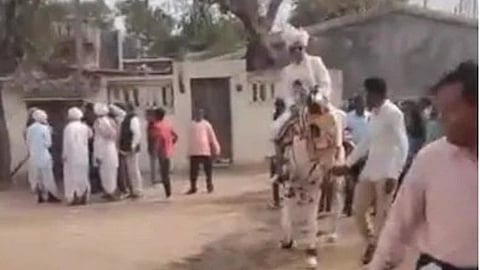
An incident in Gujarat’s Patan has highlighted a deep rooted social stigma still prevalent across many parts of India. A Dalit person, Vishal Chavda, was setting off for his wedding procession on a horse. However, he was stopped and attacked by Upper Caste Thakors of the region, questioning his audacity to ride a horse. “How dare a Dalit ride a horse in this village?”, shouted the agitators, allegedly carrying and slinging sharp weapons to stop the procession.
The troublesome incident occurred on Monday, February 2, 2026, in Chandrumana village in district Patan of Gujarat. The wedding procession of the Chavda community is locally known as Varghodo. The disruption of the Varghodo reflects how the idea of Equality of status and opportunity, as enshrined in the Indian Constitution, often falters at the ground level, particularly in rural India where caste hierarchies continue to dominate social life.
A video of the aforementioned is spreading across social media platforms. Several Dalit activists say that these incidents highlight how social equality doesn’t find itself properly enforced in many villages of India. Despite constitutional guarantees of equality, caste-based discrimination remains a lived reality for many marginalised communities.
Social And Caste Inequality Issues Still Persist In Rural India
In India, during marriage rituals, the groom generally goes on a horse to his wedding. This is a usual practice of many communities in India, but in villages where social and caste based issues are still prevalent, and atrocities occur in the name of caste inequality, rituals like these get questioned by orthodox upper caste communities. Such acts of resistance by orthodox upper-caste groups often result in violence and humiliation, reinforcing long-standing patterns of social exclusion.
The family members of the groom alleged that the attackers hurled casteist abuses and slurs. They also said that the agitators threatened to stop the wedding ceremony. Local media reports have stated that the family members were assaulted by the accused, which forced the procession to halt.
The groom’s father later approached the Police to file a complaint. The Patan Police has taken affirmative action in the matter and registered FIR against eight people (including a minor). The Police have booked the accused under relevant sections of the BNS (Bhartiya Nyaya Sanhita) - rioting, unlawful assembly, wrongful restraint and criminal intimidation. The accused have also been booked under relevant provisions of Scheduled Castes and Scheduled Tribes (SC/ST) Prevention of Atrocities Act.
Officials from the Police have told the local media that while three accused have been apprehended, enquiry is ongoing for further investigation. A senior Police official also reported that ongoing investigations have revealed that there was a death in the accused community and they had asked the DJ (Disco Jockey) to stop playing music. However, the situation escalated leading to confrontation from both sides, added the officer, also mentioning that there was a long standing dispute between the accused and complainant.
Article 15 of the Indian Constitution explicitly prohibits discrimination on grounds of religion, race, caste, sex or place of birth, and guarantees social equality as a Fundamental Right. Yet, incidents like the one in Chandrumana village raise serious questions about the effective implementation of these constitutional protections. They point to deeper concerns related to social stigma and continued caste prejudice.
(GP)
Suggested Reading:
Subscribe to our channels on YouTube and WhatsApp
Download our app on Play Store
