
- HOME
- OPINION
- ON GROUND
- INTERVIEW
- Neta Profile
- Editor's Pick
- INDIA
- NewsGram USA
- WORLD
- न्यूजग्राम
- POLITICS
- ENTERTAINMENT
- CULTURE
- LIFESTYLE
- ECONOMY
- SPORTS
- Jobs / Internships
- Misc.
- NewsGram Exclusive
By Manoj Thakur
Karnal, Haryana: It was close to 10 pm when Kapil Dev Rajak (36) heard movement on the roof of his house in Karnal. He and his wife had shut the doors and windows and were preparing to sleep. Their two sons, aged 11 and 9, had finished their schoolwork and gone to bed.
“About 20 minutes later, it felt like someone was climbing onto the roof,” Kapil Dev said.
What followed that night, police entering his home, assaulting him and his wife, and keeping the family in a police station till morning, had no basis in law, Jagmal Singh Jatain, a Karnal-based advocate working on human-rights issues said.
Deepak Kamboj, a local journalist who later helped secure Kapil Dev’s release, said there was no case registered against him.
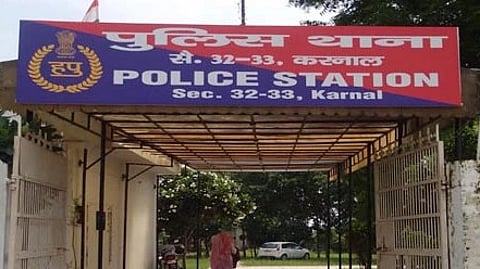
Kapil Dev said the police told him there had been a dispute among migrant workers on January 30 in Sector 8 of Karnal, during which one worker was stabbed. A case had been registered at Sector 32 police station and the accused were absconding.
According to Kapil Dev, the police alleged that his brother-in-law, Gautam Kumar, was involved and that he had been picked up to force him to reveal Gautam’s whereabouts.
“He was present in the area that night but he was not involved in the dispute,” Kapil Dev said. The injured worker survived after a week of treatment at PGI, he added.
Kamboj said the police’s justification did not hold since Kapil Dev’s name did not figure in any first information report. “This was clearly a case of illegal custody,” he said.
Advocate Surjit Singh said police personnel had no authority to pick someone up at night in this manner. “If the police suspected Kapil was harbouring someone, they were required to issue a notice and call him for questioning during the day,” he said. “This was not custody. It was illegal detention meant to intimidate the family.”
Jatain explained that the Article 21 of the Constitution requires that any deprivation of personal liberty must follow a procedure that is fair, just and reasonable. Arbitrary pick-ups, physical assault and overnight detention of an un-accused person fall outside this protection.
Article 22(1) and (2) further mandate that anyone arrested must be informed of the grounds of arrest and produced before a magistrate within 24 hours. The Supreme Court has repeatedly held that failure to communicate the grounds of arrest vitiates both the arrest and continued custody, Jatain said.
“In this case, there was no formal arrest, no disclosure of grounds and no production before a magistrate within 24 hours,” he said. “The detention was in open violation of Articles 21 and 22.”
Recent jurisprudence, now reflected in Section 35 of the Bharatiya Nagarik Suraksha Sanhita, also requires police to record specific written reasons for arrest in offences punishable up to seven years and to issue a notice of appearance instead of making an arrest. Mechanical or template reasons render an arrest illegal. None of these safeguards were followed, Jatain said.
The law also provides that, as a rule, women are not to be arrested or detained at police stations at night, except in exceptional circumstances, which must be recorded in writing and involve the presence of women police officers.
Kapil Dev lives with his wife Kajal Devi Rajak (30) and their children on the second floor of house number 321 in an unauthorised residential colony near ITI Chowk in Karnal. The family migrated from Samastipur district in Bihar for work.
That night, a group of men surrounded their room. The door began to break from outside.
Realising what was happening, the couple woke their children. There was no way out. The room had a small window, but the roof was too high.
“If we had jumped, we might not have survived,” Kapil Dev said.
Before they could react further, the door broke open.
“As soon as they entered, they pushed my wife and me to the ground,” he said. “The children were thrown aside. One man kicked me in the stomach. Another grabbed my wife by her hair and dragged her.”
The men were armed. One of them claimed to be from Sector 32 police station and repeatedly demanded information about Kapil Dev’s brother-in-law while assaulting him.
“They kept hitting me even while taking me to the police station,” Kapil Dev said. “They beat me there too, in front of my wife.”
Kapil Dev and Kajal Devi were taken to Sector 32 police station in a vehicle and made to sit on the floor through the winter night. Their children were kept with them and cried continuously.
“Keeping children in a police station is completely illegal,” Surjit Singh said.
Advocate Vasundhara Chauhan, who practises in Ambala court, said that if both parents are detained, police are duty-bound to inform the district child welfare authorities and ensure that the children are produced before the Child Welfare Committee. “The objective is to ensure that children are not exposed to trauma,” she said.
Failure to follow this procedure can attract action under the Juvenile Justice Act, including penal consequences for the concerned police officers, she added.
Kajal Devi said the police repeatedly interrogated her husband, asking for names and addresses of relatives.
“They kept saying, ‘Tell us where Gautam is. You have hidden him. If you don’t hand him over, we will put Kapil in jail,’” she said.
She said they had no information about Gautam’s whereabouts. “If we knew, we would have told them,” she said.
Later that night, the police summoned Kajal’s sister, Devchand Kumari, from Phusgarh. The children were eventually handed over to her.
Kapil Dev said he was more worried about his wife than himself. “I pleaded with them to release my wife or at least call a woman police officer, but they did not listen,” he said. He believes his wife was deliberately kept at the station to pressure him.
Around 5 am, Kajal Devi was asked to leave the police station.
Kajal Devi first went to the house where she works as a domestic helper but received no help. She then went to house number 1008 in Sector 13, where her husband works as a caretaker. The owners live in Chandigarh.
From there, she contacted Kamboj and narrated the incident. Around 9.30 am, Kamboj went to Sector 32 police station and secured Kapil Dev’s release.
“There was no arrest memo, no written order and no explanation,” Kamboj said.
Kapil Dev said he did not file a complaint because he feared losing his job. “We are migrants. No one listens to us,” he said. “If I complain, I won’t get work anywhere. How will my family survive?”
He said the Haryana Police’s Operation Track Down had intensified his fear. The police continued to call him, asking him to produce Gautam.
“If the police themselves cannot find him, how can I?” he said.
He added that the police told him the harassment would stop if he publicly declared that he had no relation with Gautam. Kapil Dev and his wife subsequently published an affidavit to that effect in a local newspaper.
Rights groups and human-rights reports have repeatedly documented that migrant workers—particularly inter-state migrants, linguistic minorities and Muslims—are more likely to face arbitrary detention during police “verification” drives and be branded as “illegal immigrants” despite having valid Indian documents.
Jatains said, said migrants are often presumed to be criminals. “They are visible when elections come around but abandoned when they face injustice,” he said.
He added that most migrants are unaware of their legal rights and accept illegal detention as inevitable. “They fear that if they raise their voice, the police will make their lives miserable,” he said.
Surjit Singh said not a single case of police brutality had reached the local court in the past year. “It’s not that excesses don’t happen,” he said. “Victims are simply too afraid to approach the courts.”
In Kapil Dev’s case, Singh said even basic safeguards were ignored. “After an assault, a medical examination should have been conducted. Photographs of the broken door could have been taken,” he said.
Jatain said pursuing legal remedies is difficult for victims who are already traumatised. “People often don’t believe migrants,” he said. “Release usually happens through personal contacts. But once someone tries to take legal action, the harassment tends to escalate.”
Kapil Dev said he never approached a lawyer. “I don’t have the money,” he said. “And I am afraid that if I go against the police, my family will not be safe. If something happens to me, who will look after them?”
This story was produced for and originally published as part of the Crime and Punishment project in collaboration with Vidhi Centre for Legal Policy.
This article was originally published in 101 Reporters under Creative Common license. Read the original article.
[DS]
Suggested Reading:
Subscribe to our channels on YouTube and WhatsApp
Download our app on Play Store

