
- HOME
- OPINION
- ON GROUND
- INTERVIEW
- Neta Profile
- Editor's Pick
- INDIA
- NewsGram USA
- WORLD
- न्यूजग्राम
- POLITICS
- ENTERTAINMENT
- CULTURE
- LIFESTYLE
- ECONOMY
- SPORTS
- Jobs / Internships
- Misc.
- NewsGram Exclusive

India and the European Union have concluded a long-awaited FTA, dubbed the “mother of all deals,” covering nearly 25% of global GDP
The pact will sharply reduce duties on fully imported European luxury cars within a quota, while lowering or removing tariffs on a wide range of goods
India is expected to gain wider access to EU markets for key exports such as textiles, leather and marine products
India and the European Union have concluded a long-awaited Free Trade Agreement (FTA), described by European Commission President Ursula von der Leyen as the “mother of all trade deals.” The pact is expected to benefit several sectors, with the most visible impact likely in the luxury automobile market, where European brands such as Mercedes, BMW, Audi and Porsche could see lower prices in India. Under the FTA, import duties on fully built unit (CBU) vehicles—currently as high as 110%—will be gradually reduced to 10%.
However, the concessions come with conditions. The duty reduction will apply only to CBUs and will exclude completely knocked down (CKD) vehicles assembled in India. It will also be capped at an annual quota of 2.5 lakh vehicles. Electric vehicles will not receive any duty relief for the next five years.
As a result, price reductions are expected to be largely limited to niche luxury and high-performance models imported directly into India. Vehicles from brands such as Mercedes-AMG, BMW M, Audi RS, Porsche, Lamborghini and Rolls-Royce are likely to benefit. In contrast, mass-market European manufacturers such as Volkswagen, Skoda and Renault—most of whose models are assembled locally—are unlikely to see significant price cuts.
Under the agreement, European cars priced above €15,000 (around ₹16 lakh) will initially face a reduced duty of 40%, which will eventually fall to 10% within the annual quota. This could lower prices by several lakhs. To protect India’s small-car segment, dominated by vehicles priced between ₹10 lakh and ₹25 lakh, the EU will not export cars in this category, though manufacturing in India will remain permitted. Indian officials noted that EU manufacturers are primarily focused on the premium segment above this price range.
Beyond automobiles, the FTA will eliminate or reduce tariffs on 96.6% of EU exports to India, covering sectors such as machinery, chemicals, pharmaceuticals, medical equipment, aircraft parts, food products, wines and spirits. In return, India will gain expanded duty-free access for key exports, including textiles, leather and marine products.
While the deal will not make luxury cars instantly affordable for mass consumers, it is expected to expand choices, improve access to global technology and encourage gradual market shifts. Social media reactions have been mixed. One user wrote, “If India cuts EU car import duty from 110% to 40%, a ₹1 crore fully imported BMW could get cheaper by ₹50–70 lakh—a 30–35% price drop, massive for luxury car buyers.” Another responded, “RIP #MakeInIndia, the Gujju model of running the country.”
Others welcomed the agreement. One post said, “The impact of the EU–India FTA is reflected in the latest MoU signed by the Rekha Gupta-led Delhi government, which aims to support small businesses and MSMEs while boosting swadeshi products and services.” Another user hailed it as the “‘mother of all deals’, creating a vast market for Indians in the EU. Who would want to get over such an amazing achievement!”
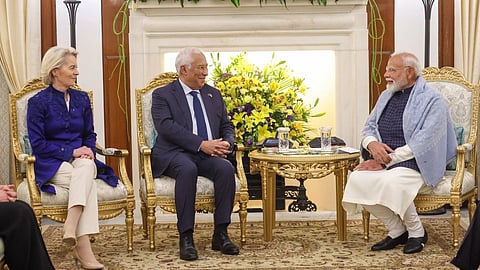
The trade deal was finalised in the presence of Prime Minister Narendra Modi and EU leaders and aims to deepen economic, strategic and trade ties between two blocs that together account for nearly 25% of global GDP. The agreement is expected to be formally signed later this year after approval by the European Parliament and EU member states.
On January 27, 2026, Prime Minister Modi described the pact as “historic,” calling it a major milestone in bilateral relations and thanking European leaders for their support. The agreement concludes nearly 18 years of negotiations between India and the European Union.
Suggested Reading:
Subscribe to our channels on YouTube and WhatsApp
Download our app on Play Store
