
- HOME
- OPINION
- ON GROUND
- INTERVIEW
- Neta Profile
- Editor's Pick
- INDIA
- NewsGram USA
- WORLD
- न्यूजग्राम
- POLITICS
- ENTERTAINMENT
- CULTURE
- LIFESTYLE
- ECONOMY
- SPORTS
- Jobs / Internships
- Misc.
- NewsGram Exclusive

Key Points:
The bust of colonial-era British architect Sir Edwin Lutyens at Rashtrapati Bhavan has been replaced after being displayed for decades.
President Droupadi Murmu unveiled the bust of Chakravarti Rajagopalachari (Rajaji) on 23 February 2026.
President Murmu stated that the move symbolises "shedding the colonial mindset" and embracing India’s cultural heritage.
The bust statue of colonial-era architect Edwin Lutyens, which had been placed at Rashtrapati Bhavan for decades, has been replaced. Following the replacement announcement made by Prime Minister Narendra Modi on 22 February 2026, President Droupadi Murmu unveiled the bust of Chakravarti Rajagopalachari, also known as Rajaji, India’s first and last Governor-General on 23 February 2026.
The unveiling ceremony took place as part of the Rajaji Utsav at the Rashtrapati Bhavan Cultural Centre. As of now, the bust of Rajagopalachari is situated at the Grand Open Staircase near Ashok Mandap. President Murmu took to her X account to explain that the move to replace the decades-old bust of Lutyens was meant to forego the past, especially the colonial mindset, and embrace Indian culture.
She wrote, “This initiative is part of series of steps being taken towards shedding the vestiges colonial mindset and embracing, with pride, the richness of India’s culture, heritage, timeless traditions and honouring those who served Bharat Mata with their extraordinary contributions.”
The event was attended by many dignitaries, along with the family of Rajaji. Other attendees included Vice President of India Shri C. P. Radhakrishnan; the Minister of Health and Family Welfare; and the Minister of External Affairs, Dr. Subrahmanyam Jaishankar, among several others.
The news about the bust of Rajaji was announced during the 131st episode of PM Modi’s Mann ki Baat. He said during his segment that, “Today, the country is leaving behind the symbols of slavery and has begun to value symbols related to Indian culture.”
Rajaji served as the last Governor-General of India when the country became a republic in 1950. Chakravarti Rajagopalachari was an independence activist born in Thorapalli village in the Madras Presidency under the British Raj. He hailed from a Hindu Brahmin family and was married to Alamelu Mangalamma.
See Also: Did a Sikh officer actually Slap Mahatma Gandhi? Know the Facts
He was a devout follower of Mahatma Gandhi and even participated in the Non-Cooperation Movement in 1920. He also served on the Working Committee of the Indian National Congress from 1922 to 1942. He later became the Chief Minister of his home state of Madras, now known as Tamil Nadu from 1952 to 1954.
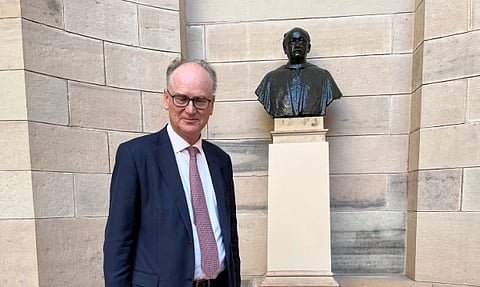
Decades later, the bust of Rajaji has now been placed at the presidential palace, replacing Sir Edwin Lutyens. Journalist and writer Mathew Ridley, the great-grandson of Lutyens, took to X to share a photograph of Sir Edwin Lutyens’ bust from when it was installed at the site.
He had also expressed his doubts over why his name had been removed from the plinth of the statue when he visited Delhi earlier. He added, “Sad to read that the bust of Lutyens (my great grandfather) is to be removed from the presidential palace he designed in Delhi.”
Who was Sir Edwin Lutyens?
Sir Edwin Lutyens was a British architect born in London in 1869, widely acknowledged for his contributions and designs that helped shape the architectural history of the Indian subcontinent. His prominent work ranged from building war memorials and English country houses to designing major public buildings.
In 1912, Lutyens was selected for his exceptional craftsmanship to help design India’s new national capital, Delhi. Lutyens collaborated with Sir Herbert Baker and served as the key architect behind national landmarks such as India Gate and the Viceroy’s House, also known as Rashtrapati Bhavan, where his bust statue had been situated for decades.
Suggested Reading:
Subscribe to our channels on YouTube and WhatsApp
Download our app on Play Store
