
- HOME
- OPINION
- ON GROUND
- INTERVIEW
- Neta Profile
- Editor's Pick
- INDIA
- NewsGram USA
- WORLD
- न्यूजग्राम
- POLITICS
- ENTERTAINMENT
- CULTURE
- LIFESTYLE
- ECONOMY
- SPORTS
- Jobs / Internships
- Misc.
- NewsGram Exclusive

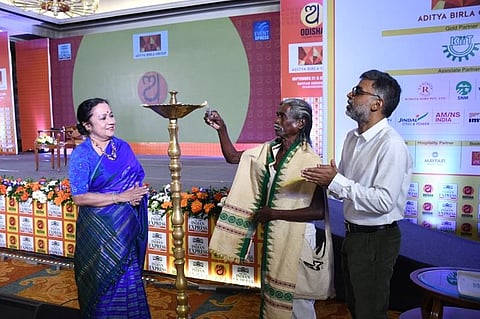
Haldhar Nag, born in Bargarh, Odisha, overcame poverty and limited schooling to become a celebrated Kosli poet with 20 epics
For 15 years, Nag has run the residential school Loka Kabi Haldhar Avasik Banavidyalaya in Kudopali, providing shelter and education
Every Rath Yatra, Nag personally prepares and serves his famous Raag Chana Ghugni in Ghens, maintaining his simple lifestyle
Popularly known as the “Loka Kabi,” Padma Shri awardee Haldhar Nag is admired not only for his poetry but also for his lifelong commitment to social service. Born in 1950 in Odisha’s Bargarh district, he lost his father at a young age and could study only up to Class III due to poverty. To survive, he worked at roadside eateries, washing dishes and serving customers. Later, with the help of a village leader, he worked as a cook in a local school for 16 years. He also took a small loan of ₹1,000 to start a stationery shop near the school.
In 1990, Nag wrote his first poem, Dhodo Bargachh (The Old Banyan Tree), which was published in a local magazine and received wide appreciation. Encouraged by the response, he began writing more and gradually gained recognition. Writing in the Kosli language, his works focus on nature, religion, mythology, and social issues. He has authored 20 epics and numerous poems. Despite limited formal education, five PhD theses have been written on his work. His collection Haldhar Granthavali-2 is part of Sambalpur University’s syllabus, while his translated work Kavyanjali has also gained recognition.
Alongside his literary journey, Nag has devoted himself to education and social welfare. For the past 15 years, he has been running a residential school, Loka Kabi Haldhar Avasik Banavidyalaya, in Kudopali village. The institution provides shelter and education to children from poor migrant families, as well as abandoned and orphaned children. He started the ashram and school in 2009 from a small hut with just a few children and the support of his admirers.
With limited resources, Nag went door to door seeking donations of food and essential supplies. Although many initially doubted whether the project would survive, his dedication and perseverance gradually earned public trust and support. Over time, with help from donors and the local community, the ashram expanded into a registered school with proper buildings, teachers, and basic facilities.
Recognised by the School and Mass Education Department, the school now offers education from Class I to IX. After completing Class IX, students are sent to KISS, Bhubaneswar, for higher studies. By 2016, when Nag received the Padma Shri, the institution was well established. Later, its daily operations were managed by secretary Janeka Kunwar.
Today, the school supports around 125 children and operates from a hostel built in 2022 with support from MCL. It has eight classrooms, nine teachers, and support staff. While children grow up in a family-like environment with strong community involvement, space shortages and limited resources remain major challenges. Nag continues to contribute his own grants and food supplies and hopes to expand the infrastructure in the future.
During the annual Rath Yatra, the village of Ghens becomes known not only for religious celebrations but also for Haldhar Nag’s famous Raag Chana Ghugni. Every year, he sets up a modest stall near his home and prepares the spicy yellow pea curry using an earthen stove, hand-ground spices, and traditional methods. For many visitors, the dish is more than just food; it is a cherished memory linked to faith, simplicity, and tradition.
Nag began selling Raag Chana in 1972 when he was struggling financially. What started as a means of survival gradually became a long-standing tradition. Today, he prepares around 15 to 20 kilograms of curry during Rath Yatra, which usually sells out within hours. He says there is no secret recipe—only experience, honesty, and dedication to traditional cooking. Now, he sells the dish only during Rath Yatra as a symbolic gesture.
Despite receiving national recognition, Nag continues to live a simple life. He believes that poetry gave him opportunities, but it has not changed who he is. For him, respect, public affection, and inner satisfaction matter more than money. He often declines invitations to literary events during Rath Yatra so that he can remain in his village and personally serve visitors.
In 2016, the Government of India honoured him with the Padma Shri for his contribution to literature. When he was informed about the award, some sources said he asked whether it could be sent by post, as he lacked money to travel. He later received the honour barefoot, wearing his traditional attire, from then-President Pranab Mukherjee. He also donated his ₹10,000 allowance to an orphanage.
Nag is known for never wearing footwear and for having an exceptional memory of his poems and epics. Close associates say he can instantly recite any of his compositions and regularly attends multiple programmes. He believes poetry should reflect real life and convey meaningful messages, and he continues to promote education and cultural awareness through his work.
[VP]
Suggested Reading:
Subscribe to our channels on YouTube and WhatsApp
Download our app on Play Store
