
- HOME
- OPINION
- ON GROUND
- INTERVIEW
- Neta Profile
- Editor's Pick
- INDIA
- NewsGram USA
- WORLD
- न्यूजग्राम
- POLITICS
- ENTERTAINMENT
- CULTURE
- LIFESTYLE
- ECONOMY
- SPORTS
- Jobs / Internships
- Misc.
- NewsGram Exclusive

Key Points
The Supreme Court is examining whether State-led social reform laws can legally override religious practices protected under Articles 25 and 26 of the Constitution
The hearing focuses on the Sabarimala issue, particularly whether restricting or allowing women’s entry qualifies as an “essential religious practice”
The Court indicated that no universal rule can be applied, and such disputes must be decided based on the specific facts and context of each case
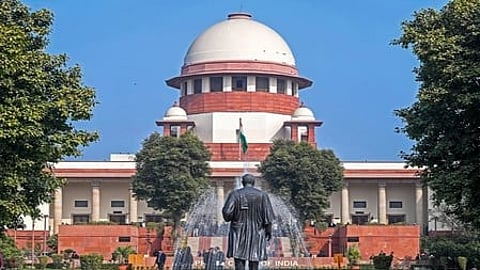
The Supreme Court of India on Wednesday, 22nd April 2026, examined a crucial constitutional question on the limits of State intervention in religious practices, focusing on women’s entry into the Sabarimala Temple in Kerala. The issue before the court was whether a law allowing women of menstruating age to enter the temple, in the name of social reform, would be a valid exercise of State power or an unconstitutional intrusion into religious freedom.
A nine-judge bench of the apex court, led by Chief Justice of India Surya Kant, is hearing a batch of review petition pertaining to entry of menstruating women, aged 10-50 years, to the Sabarimala temple. In addition to examining the alleged discrimination against women at places of worship, the case also raises broader questions about the scope of religious freedom under Articles 25 and 26 of the Constitution, and the extent to which the State can introduce reforms in religious practices. The first hearing of this reference case was held on 7th April, 2026.
In addition to the chief justice, the nine-judge benches also includes Justices B V Nagarathna, Ahsanuddin Amanullah, M M Sundresh, Aravind Kumar, Augustine George Masih, Prasanna B Varale, R Mahadevan and Joymalya Bagchi.
In the case, the bench expressed how difficult it would be to lay down ‘blanket rules’ relating to the State's interference on matters pertaining to religions and social reforms.
The bench noted that while the State represents the will of the people and may act to address social evils, the courts must assess each case individually.
During the hearing, Justice B V Nagarathna posed a key question to clarify this tension between reforms and religious autonomy. She asked whether a hypothetical State law explicitly permitting women aged 10 to 50 to enter the Sabarimala temple could be justified as a reform measure. “If the Kerala rules would have said in the name of social reforms, the entry of women between the ages of 10 to 50 to the temple is permitted, is it an invasion or could we say it is not an essential practice and therefore upheld,” she asked. Her question reflects a central legal test often used by courts, whether a practice is “essential” to a religion.
Appearing on behalf of the Thantri, the religious vedic head who sets temple rules, senior advocate Gopal Subramanium argued that religious practices which are limited in scope, based on reason, and part of an established denominational tradition should generally be protected.
At the same time, he cautioned that the idea of “social welfare and reform” should not be used casually to interfere with constitutionally protected religious freedoms. However, he acknowledged that practices considered superstitious or deeply harmful can be regulated through reform laws.
Another senior advocate, Aryama Sundaram, presented a different perspective. Representing stakeholders linked to the temple, he argued that while the Constitution promotes gender equality in areas such as employment and public life, this principle does not automatically apply to religious practices or access to places of worship. He emphasised that temples function as “a board of the deity,” where rituals and customs are shaped by the nature of the deity and long-standing traditions, and therefore should be respected within that religious framework.
Senior advocate Mukul Rohatgi added another layer to the debate by questioning the role of “constitutional morality.” Suggesting that courts should be cautious in using this concept to justify limitations on religious freedom, Rohatgi remarked: “Constitutional morality has no place in creating a restriction, the moment you add constitutional morality you are either expanding or adding another restriction.”
The next hearing of the case is scheduled to commence on Thursday, 23rd April.
Suggested reading:
Subscribe to our channels on YouTube and WhatsApp
Download our app on Play Store
