
- HOME
- OPINION
- ON GROUND
- INTERVIEW
- Neta Profile
- Editor's Pick
- INDIA
- NewsGram USA
- WORLD
- न्यूजग्राम
- POLITICS
- ENTERTAINMENT
- CULTURE
- LIFESTYLE
- ECONOMY
- SPORTS
- Jobs / Internships
- Misc.
- NewsGram Exclusive
By Shruti Venkatesh
Bokaro, Jharkhand: Ramvriksh Murmu does not speak in hyperbole. The simple, unassuming mukhiya of Jharkhand’s Siari panchayat instead prefers to state the facts, matter-of-factly. “Since childhood, I have witnessed my surroundings change from lush green forests and flowing rivers to rapid deforestation and dried-up rivers,” says the 36-year-old.
His coal-rich state has borne the brunt of rampant mining, industrial pollution, erratic power supply, stressed water resources, and the loss of cultivable land and biodiversity. Siari, home to over 340 households, faced a similar set of problems. Agriculture and allied activities, such as dairy farming, remain the primary sources of livelihood, alongside limited industrial opportunities.
The solution presented itself to Murmu in 2023, when he attended the Conference of Panchayats (COP), jointly organised by Asar Social Impact Advisors and the Policy & Development Advisory Group. “COP includes discussions with panchayat leaders on how local resources and various government schemes can be leveraged to counter the impact of climate change,” explains Munna Jha of Asar.
It was here that Murmu learnt about the potential of the District Mineral Foundation Trust (DMFT), a non-profit government body aimed at compensating and empowering communities affected by mining. While he had heard of the fund earlier, he had not fully understood how it could be leveraged.
Murmu saw DMFT as a pathway through which a village like his could begin repairing the damage it had endured. All it needed was proper planning.
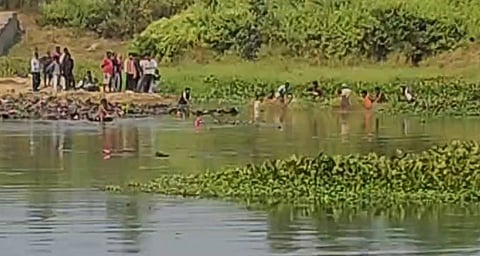
So, in consultation with the Gram Sabha, he identified the core issues and possible solutions. A key priority that emerged was the restoration of a six-acre lake—expected to improve irrigation, support fisheries, revive the local ecology, and strengthen livelihoods. The lake had deteriorated due to a combination of factors, including contamination from nearby mining activity and the absence of earlier restoration efforts.
Murmu then submitted a list of requests to the DMFT office. After nearly a year, the project work began, he says, speaking to 101Reporters on the sidelines of the Mumbai Climate Week summit in February 2026.

“DMFT sanctioned Rs 1.56 crore for the lake restoration project,” says Gulab Chandra Prajapati, CEO of Panch Sutra Foundation, which works with panchayats and grassroots networks on climate-resilient development. He noted that DMFT funds were earlier largely allocated for construction projects. “But we have initiated a shift and ensured they are increasingly used for projects that directly impact livelihoods,” he says.
As per DMFT rules, funds are not transferred to panchayat accounts. Instead, projects are sanctioned and executed by designated authorities, with the panchayat playing a facilitative role. Also, there is no fixed annual allocation under DMFT. The funding tends to depend on the nature of proposals submitted and approved.
At present, the polluted water has been removed from the site. Prajapati says that the design phase is underway, mapping out fisheries use and irrigation canals. The project is expected to be completed by June 1, 2026.
The District Mineral Foundation Trust, under the Pradhan Mantri Khanij Kshetra Kalyan Yojana, was established in 2015 through an amendment to the Mines and Minerals (Development and Regulation) Act, 1957. DMFTs operate across 645 districts in 23 states and are funded through contributions from mining leaseholders—10% to 33% of royalties for major minerals.
Guidelines mandate that 70% of funds be allocated to high-priority sectors such as environmental preservation, drinking water, and agriculture. The remaining 30% can be spent on other sectors, including infrastructure, energy, and watershed development.
Oversight rests with a two-tier structure: a governing council headed by the district collector, and elected representatives including MPs and MLAs. “We went through multiple rounds of approvals,” Prajapati recalls. After submission to the district DMFT office, the proposal underwent verification by the committee, clearance from elected representatives, and final sanction from the district collector.
Despite this structure, local participation in planning remains limited.
Siari’s bottom-up approach is an exception. “Any scheme under DMFT has to be approved by the Gram Sabha. But here’s the catch…while it is approved by the Gram Sabha, it is not planned by it,” says Richa Chaudhary, a social development practitioner based in Jharkhand.
In most cases, district committees decide which schemes to implement and where. These plans are then presented to Gram Sabhas for what often amounts to token approval. “Officials often arrive with a pre-decided plan and seek signatures, without involving communities in the planning process,” says Chaudhary. As a result, a significant portion of funds remains underutilised or misallocated. “Negligible funds are used for environmental and ecological restoration. Most Gram Sabhas are not even aware of the 70–30 allocation rule,” she adds.
The top-down approach has also led to instances of misuse. In September 2025, reports surfaced of alleged money laundering involving DMFT funds in Chhattisgarh. In Bokaro, financial irregularities worth Rs 1,100 crore have been reported since 2016, with contracts arbitrarily awarded and funds allegedly embezzled without work being completed, according to state reports. Prajapati said there have been instances of misuse within Bokaro itself, and that the matter is currently being heard in the High Court.
Accessing DMFT funds for locally proposed projects remains difficult, says Jha. “The rules are clear, but implementation often circumvents them,” Prajapati adds. However, he notes that awareness is increasing, with panchayat leaders beginning to question how funds are spent without Gram Sabha involvement.
As Siari’s case shows, outcomes improve when communities are involved.
Chaudhary argues that this needs to be institutionalised by integrating DMFT planning with the Gram Panchayat Development Plan (GPDP), an annual plan prepared between October and December that outlines local needs and development priorities. “If Gram Sabhas are aware of DMFT funds during GPDP planning, they can align projects and budgets better,” she said.
Though Siari did not formally merge DMFT with GPDP, it identified relevant projects, submitted proposals, and followed up persistently.
That persistence was key. When the proposal was first submitted, Prajapati says, officials questioned whether such a large amount could be allocated to a single panchayat. Murmu had to visit the office multiple times to explain the project’s benefits. Support from the local MLA also proved crucial before approval was granted.
Over time, participation in local planning has improved. While GPDPs have been prepared since 2015, their quality has evolved. Villagers now discuss needs in smaller tola-level meetings before consolidating them at the panchayat level.
Chaudhary points to a constitutional basis for deeper participation. “If Gram Sabhas have the right to approve plans under Article 243G, they should also have the right to plan them,” she says, adding that formalising this would require only an official notification.
Murmu puts it more simply: “Vikas jiske liye hai, yojana toh wahi se nikalni chahiye.” (Development plans must originate from those for whom they are meant.)
Until such structural reforms take place, the burden falls on awareness and persistence. Like in Murmu’s case, once he understood the system, he followed up consistently to secure approvals, Jha notes.
Now, the panchayat is looking ahead. “When coal is mined, people lose their land and move from being farmers to labourers. But after the energy transition, we want to rehabilitate land and help them return to farming,” says Prajapati. Through a Just Transition Network, they are identifying land losers, mapping remaining land, and exploring how livelihoods can be restored. The plan is to eventually leverage DMFT funds for this, though budgeting is still at an early stage.
Local action, rather than large, abstract plans, may ultimately drive impact. Speaking at the Mumbai Climate Week summit, Jagadananda, co-founder of the Centre for Youth and Social Development, said, “With over six lakh villages and 2.5 lakh gram panchayats, there is a vast ecosystem waiting to be activated. We need climate-smart panchayats that combine local action with technical knowledge and embed it into GPDP.”
In Siari, that process has already begun. Reinforcing his commitment to climate action, Murmu says, “If we don’t take climate change seriously, the time is not far when, just like bottled water, we will have to buy bottled air.” And that warning feels uncomfortably real.
This article was originally published in 101 Reporters under Creative Common license. Read the original article.
[DS]
Suggested Reading:
Subscribe to our channels on YouTube and WhatsApp
Download our app on Play Store
