
- HOME
- OPINION
- ON GROUND
- INTERVIEW
- Neta Profile
- Editor's Pick
- INDIA
- NewsGram USA
- WORLD
- न्यूजग्राम
- POLITICS
- ENTERTAINMENT
- CULTURE
- LIFESTYLE
- ECONOMY
- SPORTS
- Jobs / Internships
- Misc.
- NewsGram Exclusive

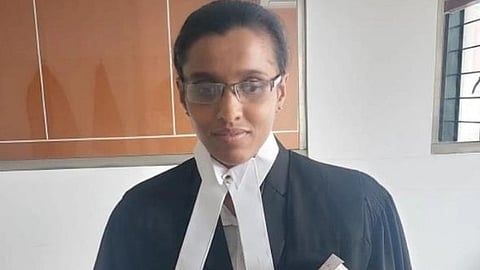
Thanya Nathan becomes Kerala’s first fully visually impaired candidate to clear the Judicial Service Examination.
Her success follows the Supreme Court’s 2025 ruling allowing visually impaired candidates to enter judicial services and prohibiting discrimination based on disability.
The story highlights accessibility challenges in courts while it advances towards disability inclusion and representation in India’s judiciary.
Kerala is going to get its first fully visually impaired Civil Judge (Junior Division) as 24-year-old Thanya Nathan has achieved the milestone by clearing the Kerala Judicial Service Examination. In the recent selection process of the Kerala High Court, she secured first rank in the merit list among persons with benchmark disabilities, marking a major step for disability inclusion in India’s legal system.
The Supreme Court passed a landmark judgment in March 2025 which provided eligibility to visually impaired candidates to be appointed to judicial services across the country. It further added that a person cannot be denied consideration only because of their disability. The selection process has reportedly been completed in the High Court, with the list being forwarded to the State government for the issuance of the appointment order. There was also another candidate with cerebral palsy named Joyson Sajan who secured the second position in the same category.
A bench of Justices J.B. Pardiwala and R. Mahadevan passed the judgment, marking a turning point in judicial recruitment policy. The court delivered that visually impaired candidates cannot be deemed “unsuitable” for judicial service as they were hearing a batch of petitions which even included a suo motu case regarding denial of reservation in certain States.
The court directed the State to adopt measures that provide inclusivity as it dismissed any discrimination faced by a person with disabilities while accessing their judicial careers. The judgment stated, “No candidate can be denied such opportunity solely on account of disability.” Earlier, 100% visually impaired candidates were barred from appearing in judicial service examinations in several States, which has now been removed. In a statement, Nathan herself admitted to having applied after the verdict as she was unsure earlier if she would be permitted to sit for the examination.
Thanya Nathan could not perceive light at all right from her birth. She studied in a special school for the blind till Class 7 and later went on to join mainstream schooling in Kannur district, from where she completed her studies till 12th.
Later, she pursued law, graduating as a first rank holder in LLB from Kannur University, which showcases her academic excellence despite inborn physical challenges. She then started her legal career under advocate K.G. Sunilkumar at Taliparamba in Kannur following her enrollment as an advocate. She accessed digital material through screen-reading software and prepared case notes in Braille.
She explained how technology allows visually impaired lawyers to effectively read and understand legal texts. She said, “My senior and a few others encouraged me to take the recruitment exam, and the Supreme Court verdict came as the right support.” She started preparing for the exam independently by making her notes in Braille script. She further added, “At that time many people asked whether I would be able to do it. Law has a heavy syllabus, but I thought taking a chance is never wrong,” showcasing her determination.
Although Thanya uses Braille and technology to overcome her visual challenges, she has acknowledged the practical difficulties in accessing older case records that cannot be read through software. There is also the challenge of navigating physical court infrastructure to add to her difficulties. She said, “As a lawyer I prepared arguments in Braille. Accessing old documents could be a hassle in future. Accessibility in courtrooms could be a major hurdle, yet I am confident of overcoming the challenges.”
Judicial sources have also come forward to talk about the improvements required in court halls, dais, offices and chambers to upgrade them to accommodate differently abled judicial officers following Thanya’s appointment.
Thanya Nathan’s selection comes less than a year after the Supreme Court’s inconclusive judgment that ensures equality in public employment. The ruling serves as a symbol of diversity and equal opportunity when the constitutional institution itself is under the radar. Nathan shared her insights on the same by saying,
Nathan would not just be an advocate but a judge in the courtroom with the government’s formal appointment letter, which would push forward institutional reforms to add accessibility and potentially influence recruitment practices in other States.
Suggested Reading:
Subscribe to our channels on YouTube and WhatsApp
Download our app on Play Store
