
- HOME
- OPINION
- ON GROUND
- INTERVIEW
- Neta Profile
- Editor's Pick
- INDIA
- NewsGram USA
- WORLD
- न्यूजग्राम
- POLITICS
- ENTERTAINMENT
- CULTURE
- LIFESTYLE
- ECONOMY
- SPORTS
- Jobs / Internships
- Misc.
- NewsGram Exclusive

Key Points:
A Grand Vitara owner complaint in Raipur consumer court that his car's fuel pump was damaged due to ethanol-blended petrol despite the company's user manual claiming vehicle was E20 compatible.
The consumer court ruled in favour of the vehicle owner, ordering Maruti to either replace the Grand Vitara or pay ₹20 Lakh in compensation.
Maruti challenged the ruling, claiming that the lab testing found ethanol fuel to be contaminated, raising questions over appropriate infrastructure to store E20 petrol.
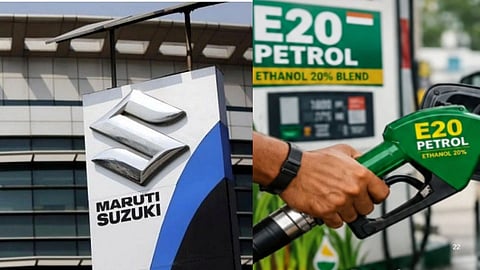
A LANDMARK RULING in the Raipur consumer court, ordering Maruti Suzuki to replace a customer's Grand Vitara over alleged E20 petrol-related damage, has taken a new turn. The automobile manufacturer challenged the decision claiming that the ethanol-blended fuel was contaminated and the vehicle was not at fault. While the final judgement might be contentious, critics believe that the case exposes deeper problems with India's infrastructure to implement the government’s rushed ethanol fuel policy.
The controversy began after the District Consumer Disputes Redressal Commission in Raipur ruled in favour of a Grand Vitara Strong Hybrid owner, who alleged that E20 petrol damaged his vehicle. The commission directed Maruti Suzuki and the dealer to either replace the SUV with a new E20-compatible vehicle of the same variant or pay nearly ₹20 lakh to the owner, including the cost of the vehicle and registration charges.
The verdict is the first major consumer victories in India involving compensation for E20 petrol damage.
Maruti Suzuki has contested the landmark ethanol ruling and announced that it will officially appeal before a higher forum. In their public statement, they claim that the Grand Vitara Strong Hybrid involved in the case was already certified as E20-compatible, and this was clearly mentioned in the owner's manual.
The Indo-Japanese manufacturer claims that laboratory analysis of the fuel sample collected from the vehicle showed evidence of contamination. It argued that several important technical facts were not adequately considered by the consumer commission while passing the order.
"Maruti Suzuki will take necessary steps to challenge the impugned order before the appropriate higher forum in accordance with law," the company said, while reiterating its commitment to quality, safety and customer satisfaction.
The company's stand was later shared by BJP IT Cell chief Amit Malviya, who said consumer rights are important but judicial decisions should be based on complete technical evidence. However, a politician spreading the message of an automobile company over consumer rights quickly became part of another controversial debate.
The Raipur case has reignited criticism of the Centre's E20 fuel rollout, with many social media users questioning whether ordinary vehicle owners are being left to bear the cost of a rushed government policy.
Many users criticized a politician from a ruling party publicly defending a large private company instead of a consumer who had already won relief in a consumer court. Several users argued that when citizens are suffering expensive damages after using fuel promoted by the government, the least the administration could do is stand with consumers rather than corporations.
The controversy also revived long-standing concerns over E20 petrol itself. E20 is a blend containing 20% ethanol and 80% petrol. The government maintains that ethanol fuel will reduce crude oil imports and cut emissions harmful for environment. However, vehicle owners, mechanics, and even petrol pump operators have repeatedly raised concerns over storage infrastructure and fuel quality.
Experts have pointed out that ethanol is hygroscopic, i.e., it absorbs moisture from the atmosphere much more easily than petrol. Critics argue that many underground storage tanks at fuel stations were originally built for conventional petrol and were not upgraded adequately before the government started rolling out higher ethanol blends.
The moisture entering the fuel can contaminate it, potentially causing corrosion, fuel injection issues and engine damage. Therefore, even if Maruti’s claim that the fuel was contaminated turns out to be true, it still poses questions on whether it was a failure for the government to set up proper infrastructure for the ethanol-blended petrol.
Petrol pump owners have also flagged similar concerns in the past, saying infrastructure upgrades did not keep pace with the policy rollout.
Many motorists claim they have experienced lower mileage, starting problems and component failures after shifting to E20 fuel. While automakers maintain that modern E20-compatible vehicles can safely run on the blend, they also acknowledge that fuel efficiency typically drops by around 3-3.5%.
Critics argue that if contamination is indeed the problem, then responsibility cannot rest only with consumers. They say oil marketing companies and authorities must ensure proper storage standards and fuel quality before asking crores motor vehicle owners to abruptly switch to the “environment-friendly” option.
Watch Full Report:
Suggested Reading:
Subscribe to our channels on YouTube and WhatsApp
Download our app on Play Store
