
- HOME
- OPINION
- ON GROUND
- INTERVIEW
- Neta Profile
- Editor's Pick
- INDIA
- NewsGram USA
- WORLD
- न्यूजग्राम
- POLITICS
- ENTERTAINMENT
- CULTURE
- LIFESTYLE
- ECONOMY
- SPORTS
- Jobs / Internships
- Misc.
- NewsGram Exclusive

Ayaan Hirsi Ali says while Western forces dismantled Al-Qaeda and ISIS, the ideological driver of radical political Islam continues to spread
She says Western leaders relied on military force after 9/11 while ignoring the long-term ideological push for a Sharia-based Islamic state.
Hirsi Ali warns that without confronting political Islam as an ideological movement, military victories will be hollow
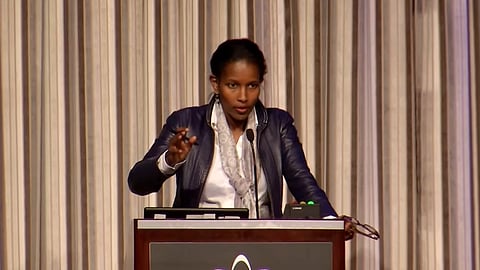
Nearly 25 years after the September 11, 2001 terror attacks on the United States, writer and activist Ayaan Hirsi Ali has warned that the threat posed by radical political Islam has not diminished but has instead evolved into a more dangerous and less visible form.
Speaking in an interview published on May 26, 2024, on Triggernometry, Hirsi Ali said that while Western military interventions succeeded in dismantling violent jihadist groups such as Al-Qaeda and ISIS, the ideological force driving them continues to spread. She argued, western leaders have failed to confront what she described as the ideological engine behind these movements—Da’wah, the non-violent propagation of political Islam aimed at establishing an Islamic state governed by Sharia law.
“I think we’re in a worse place today than we were in 2001,” Hirsi Ali said. “We’ve spent trillions of dollars and a lot of blood. What is wrong with our Western leaders?” she asked. “Do we have some kind of curse on us that prevents us from seeing the determination of radical political Islamists?” According to her, their ultimate objective remains the establishment of an Islamic state based on Sharia law.
Reflecting on the aftermath of 9/11, Hirsi Ali said Islamist extremists initially pursued their goals through violence and jihad. “They took passenger planes, they knocked down the Twin Towers, they were on their way to knocking down the White House, and they managed to knock a wing off the Pentagon,” she recalled, describing the attacks as a form of “shock and awe” intended to accelerate the creation of an Islamic state.
The Western response, she noted, was overwhelmingly military—and initially effective. Al-Qaeda’s organisational structure was dismantled, and its leader, Osama bin Laden, was eventually killed. Later, the Islamic State, which emerged under Abu Musab al-Zarqawi and seized large swathes of territory in Iraq and Syria, was also defeated through coordinated military action.
“There is no structure called the Islamic State of Iraq and Syria anymore,” Hirsi Ali said. “They were met with military deterrence, and they were removed.”
However, she stressed that the defeat of armed groups did not amount to the defeat of the ideology behind them. According to Hirsi Ali, Western governments focused almost exclusively on violent manifestations of Islamism while neglecting its long-term ideological spread through cultural, educational, and political channels.
“What over the years we have failed to see is the other side—the Da’wah side,” she said, warning that this approach seeks to normalise Islamist objectives without violence, making them harder to confront and easier to overlook.
Hirsi Ali, a Somali-born Dutch-American writer and former politician, is a longstanding critic of Islam and an advocate for the rights of Muslim women. She has campaigned against forced marriage, honour killings, child marriage, and female genital mutilation, and was a prominent figure in the New Atheism movement.
In 2023, Ayaan Hirsi Ali announced her conversion to Christianity in an essay titled Why I Am Now a Christian, saying atheism no longer offered sufficient moral grounding or spiritual meaning. She argued that only the Judeo-Christian tradition provides a cohesive foundation capable of defending Western civilisation against radical Islamism, authoritarianism, and “woke” ideology.
She said christian teachings on compassion, humility, critical thinking, and the separation of church and state offer a stronger civilisational framework. Hirsi Ali warned that unless Western leaders confront political Islam not only as a security threat but as an ideological movement, military victories alone will ultimately prove hollow.
[VP]
Suggested Reading:
Subscribe to our channels on YouTube and WhatsApp
Download our app on Play Store

