
- HOME
- OPINION
- ON GROUND
- INTERVIEW
- Neta Profile
- Editor's Pick
- INDIA
- NewsGram USA
- WORLD
- न्यूजग्राम
- POLITICS
- ENTERTAINMENT
- CULTURE
- LIFESTYLE
- ECONOMY
- SPORTS
- Jobs / Internships
- Misc.
- NewsGram Exclusive

Key Points:
Skyrocket's Vikram-1 was successfully launched on July 18, 2026, as part of Mission Aagaman (sanskrit word for "Arrival")
Vikram-1 is India's first private spacecraft into space which reached the orbit on its first attempt.
The launch was briefly halted and delayed from its scheduled time of 11:30 pm, before lifting of at 12:05 pm.
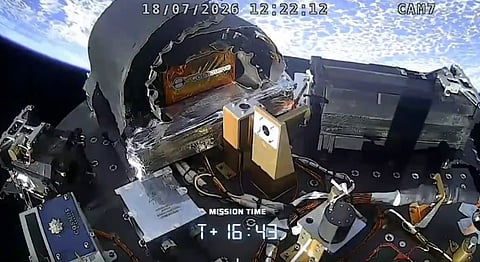
ON JULY 18, 2026, India scripted a new chapter in its space history with the successful launch of Vikram-1, the country's first privately developed small orbital launch vehicle, also being called India's first "space taxi." The launch came as part of the Mission Aagaman, with the spacecraft reaching the orbit on its very first attempt.
Launched from the Satish Dhawan Space Centre (SDSC) in Sriharikota, the mission was halted after a brief hiccup before liftoff. Scheduled to take off at 11:30 AM, the launch was put on a "planned hold" by the mission control team. After that brief delay, Vikram-1 lifted off successfully at 12:05:30 and was officially declared a success at 12:21 pm after it precisely injected its payloads into the designated orbit.
Prime Minister Narendra Modi congratulated Skyroot Aerospace CEO Pawan Kumar Chandana and the young team behind the mission, calling the achievement a major milestone for India's growing private space sector. The Indian PM, in his video call to Skyroot co-founder, said, “You have planted India's aspirations in space and have also given roots to the dreams of the youth.”
Vikram-1 is a seven-storey, four-stage small orbital launch vehicle designed for launching small satellites for commercial purposes. Named after Dr. Vikram Sarabhai, the founder of ISRO and known as the father of the Indian space programme, the rocket has been developed by Hyderabad-based startup Skyroot Aerospace.
It is the first-ever orbital launch vehicle developed by a private Indian company. Unlike Vikram-S, the sub-orbital rocket successfully launched in November 2022, Vikram-1 is capable of placing satellites into orbit and is expected to work as a real-time "space taxi" for deploying payloads into space.
See Also: ISRO Tightens Exit Rules for Scientists Amid 100+ Departures From Gaganyaan Mission
The rocket stands around 24 metres tall, roughly the height of a seven-storey building, and features an all-carbon composite airframe that makes it lighter while maintaining strength.
Its four-stage propulsion system consists of Skyroot's proprietary Kalam series solid rocket motors, which includes Kalam-1200, Kalam-250, and Kalam-100 powering the first three stages. The fourth and final stage is powered by the Raman-I liquid fuel engine.
The success also comes as India prepares for ISRO's ambitious Gaganyaan mission, the country's first human spaceflight programme. Gaganyaan aims to send Indian astronauts into Low Earth Orbit after a series of uncrewed test missions. As India expands into private sector for its space tech innovations, companies like Skyroot are expected to play a larger role in the future missions.
Mission Aagam (Sanskrit word for "Arrival") marked the launch of India's first privately developed orbital launch vehicle, Vikram-1. The orbital vehicle has been built by Hyderabad-based space tech startup Skyroot Aerospace.
Beyond reaching orbit, the mission's biggest objective was to collect real-time flight data from every major system onboard the rocket. The information gathered during the launch will help engineers validate the rocket's performance and prepare it for future missions.
Days before the launch, Skyroot co-founder and CEO Pawan Kumar Chandana had explained the significance of the mission. As quoted by The Times of India, he said, "The single most important objective of Mission Aagman is to capture the real in-flight performance data from every system on Vikram-1. This data cannot be fully replicated through ground testing. The moment Vikram-1 lifts off, India's private space industry will cross a threshold it has never crossed before." His prediction proved accurate on Saturday, July 18, 2026.
Why is Vikram-1 being called India’s first space taxi?
Vikram-1 is called India’s first “space taxi” because it provides on-demand small-satellite launches, offering custom orbits. Its restartable upper stage enables precise deployments of small satellites in a single mission.
What is the objective of Mission Aagaman?
The main objective of Mission Aagaman (“Arrival”) was to collect real-time flight data from Vikram-1’s orbital flight to validate its systems. It successfully placed the rocket into orbit while carrying custom payloads into space.
Who was Dr. Vikram Sarabhai?
Dr. Vikram Sarabhai (1919–1971) was the founder of ISRO and the father of the Indian space programme. He envisioned using space technology for national development, and the Vikram rocket series is named in his honour.
Suggested Reading:
Subscribe to our channels on YouTube and WhatsApp
Download our app on Play Store
