
- HOME
- OPINION
- ON GROUND
- INTERVIEW
- Neta Profile
- Editor's Pick
- INDIA
- NewsGram USA
- WORLD
- न्यूजग्राम
- POLITICS
- ENTERTAINMENT
- CULTURE
- LIFESTYLE
- ECONOMY
- SPORTS
- Jobs / Internships
- Misc.
- NewsGram Exclusive

At the request of the United States, the UN Security Council met to discuss Iran’s violent suppression of nationwide protests.
While President Donald Trump left potential US actions unclear, Washington warned that “all options remain on the table"
Amid growing concerns for Indian nationals, India has prepared contingency evacuation plans.
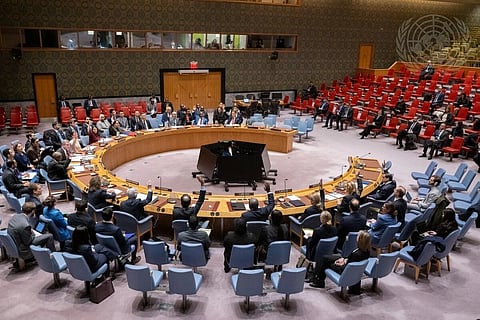
On Thursday, January 15, 2026, the United Nations Security Council held an emergency meeting at UN headquarters in New York at the request of the United States to discuss Iran’s deadly crackdown on nationwide protests. The session took place even as US President Donald Trump left unclear what specific actions Washington might take against the Islamic Republic. The meeting came amid escalating tensions after Trump warned that the United States could intervene to stop further killings of protesters.
In the lead-up to the session, Tehran issued conciliatory statements in what appeared to be an effort to defuse the situation. White House Press Secretary Karoline Leavitt said ahead of the meeting that “all options remain on the table for the President.” On the ground in Iran, the sound of gunfire faded in Tehran on Thursday, while authorities abruptly closed the country’s airspace to commercial flights for several hours without explanation. At the same time, some personnel at a key US military base in Qatar were advised to evacuate, and the US Embassy in Kuwait ordered its staff to temporarily halt travel to multiple military bases in the Gulf country.
During the meeting, the United Nations warned that any possible military strikes on Iran would further increase instability. UN Assistant Secretary-General Martha Pobee told the Security Council that UN Secretary-General António Guterres had called for “maximum restraint at this sensitive moment,” urging all parties to refrain from actions that could lead to further loss of life or ignite a wider regional escalation. Guterres, she said, remains convinced that all issues concerning Iran, including its nuclear programme, must be addressed through diplomacy and dialogue, reaffirming the UN Charter principle that disputes must be settled peacefully and that the threat or use of force is prohibited.
US Ambassador to the United Nations Mike Waltz sharply criticised Iran’s handling of the protests. “The people of Iran are demanding their freedom like never before in the Islamic Republic’s brutal history,” Waltz said. He issued a stark warning, adding, “President Trump is a man of action, not endless talk like we see at the United Nations. He has made it clear that all options are on the table to stop the slaughter.”
The Security Council also heard testimony from Iranian civil society representatives invited by the United States, including Iranian-American journalist and government critic Masih Alinejad. Alinejad accused the United Nations and the Security Council of failing “to respond with the urgency this moment demands,” telling members that they had forgotten “the privilege and responsibility of sitting in this room.”
Ahead of the emergency meeting, Iranian Foreign Minister Abbas Araghchi spoke by phone with Secretary-General Guterres to discuss the recent deadly protests and Iran’s request for the world body to do more to condemn what Tehran described as foreign influence in the Islamic Republic, according to a readout published by Iranian state media.
Amid rising tensions in Iran, the Indian government has prepared contingency plans to evacuate Indian nationals from the country. However, sources told India Today that no immediate evacuation is underway following the latest assessment of the situation on the ground.
The Indian Embassy in Tehran has begun reaching out to Indian students across the region to assess their safety and willingness to return if required. Students have been advised to remain in close contact with the embassy and follow official advisories. Due to widespread internet shutdowns and unreliable phone networks, embassy officials are conducting physical outreach to locate students and collect their details. Officials said the situation is being closely monitored.
Concerns for Indian nationals have grown as protests, triggered by the sharp fall of the Iranian rial last month, have spread across all 31 provinces. Rights groups claim at least 3,428 people have been killed in the crackdown, while a state-imposed internet blackout continues and unrest appears largely suppressed.
(Edited by Dhruv Sharma)
Suggested Reading:
Subscribe to our channels on YouTube and WhatsApp
Download our app on Play Store
