
- HOME
- OPINION
- ON GROUND
- INTERVIEW
- Neta Profile
- Editor's Pick
- INDIA
- NewsGram USA
- WORLD
- न्यूजग्राम
- POLITICS
- ENTERTAINMENT
- CULTURE
- LIFESTYLE
- ECONOMY
- SPORTS
- Jobs / Internships
- Misc.
- NewsGram Exclusive

Key Points
Denmark is considering a legal ban on public broadcasts of the Islamic azaan.
Immigration Minister Morten Bødskov said the prayer call has "no place" in Danish society.
Any nationwide ban is expected to face constitutional challenges over religious freedom.
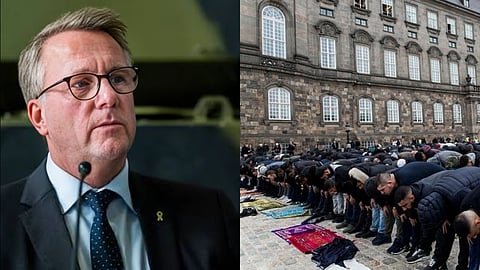
IN A MOVE TO CURB the growing ‘Islamisation’ of the country, Denmark has announced plans to legally ban azaan, the Islamic morning prayer call. Immigration Minister Morten Bødskov remarked that such a practice does not fit into Danish public life, and stated that the broadcast of the morning prayer “shouldn't be heard over Danish rooftops.” The proposition has sparked fresh debate in the country over religious freedom, integration, and immigration.
The Islamic azaan, a call to Muslims to pray, is broadcast five times per day. The announcement is done via loudspeakers mounted at the top of Mosque’s minaret.
Speaking to Ritzau, the leading Danish news agency, Morten stated that azaan has “no place in Denmark.” “You shouldn’t be in any doubt whether you’ve ended up in a suburb of Islamabad when you walk around Denmark,” Bødskov said as quoted by the agency. The minister has raised doubts about the escalating phenomenon of ‘Islamisation,’ in the country, which he says is taking up too much space in Danish society.
Morten, a member of Denmark’s center-left Social Democrats Party, is the third immigration minister to have raised the issue of the Islamic prayer call. The azaan ban, as of yet, is still under-consideration and not a complete policy. The officials are still debating whether such a ban would be legally possible under Denmark’s constitutional protections for religious practice.
Similar efforts to ban azaan have been taken up by Danish authorities previously. This marks the third such effort by Danish Immigration ministers to establish a legal framework to address the issue, with previous ones done in 2022 and 2025.
This announcement doesn't come as much of a surprise, as already in many Danish cities, including the capital Copenhagen, local noise rules have already limited loudspeaker-based Islamic prayer calls. In 2023, Denmark introduced a law targeting the desecration of religious texts after Quran-burning protests drew international attention.
Ever since the Prime Minister Mette Frederiksen took charge, beginning her third term in office in June 2026, Denmark has witnessed stricter immigration laws. One of the most controversial steps in the country are the “ghetto laws” which allow authorities to relocate migrants from neighborhoods with high concentrations of foreign residents. Denmark has also introduced other strict measures for asylum seekers, including rules requiring some applicants to contribute towards their living expenses.
See also: Communism, Fascism, and Islamism Are All Expansionist Forces, Says Historian Raymond Ibrahim
Any attempt to impose a nationwide ban on public Azaan broadcasts is likely to face significant legal hurdles. Denmark’s constitution guarantees the right to practice religion publicly, although restrictions already exist for activities considered anti-democratic or linked to banned organizations.
Officials are expected to examine whether such a ban can be justified by balancing religious freedom with the rights of residents living near mosques.
Denmark has a population of around six million, including roughly 270,000 Muslims. The country has approximately 100 mosques, including the Grand Mosque of Copenhagen, which currently does not broadcast the azaan outdoors under an agreement with the local authorities.
(Edited by Anshika Verma)
Suggested reading:
Subscribe to our channels on YouTube and WhatsApp
Download our app on Play Store
