
- HOME
- OPINION
- ON GROUND
- INTERVIEW
- Neta Profile
- Editor's Pick
- INDIA
- NewsGram USA
- WORLD
- न्यूजग्राम
- POLITICS
- ENTERTAINMENT
- CULTURE
- LIFESTYLE
- ECONOMY
- SPORTS
- Jobs / Internships
- Misc.
- NewsGram Exclusive

Key Points
Delhi government has unveiled a winter pollution action plan running from November 1, 2026, to January 31, 2027, with vehicle restrictions, a ban on construction activities, and mandatory work-from-home for 50% office staff.
"No PUCC, No Fuel" expands to all 500 ANPR-equipped fuel stations, and non-BS-VI vehicles from outside Delhi will be barred from entering starting November 1.
Government and private offices must have 50% of staff work from home during the winter pollution season, alongside staggered timings and doubled parking fees (except at Delhi Metro sites).
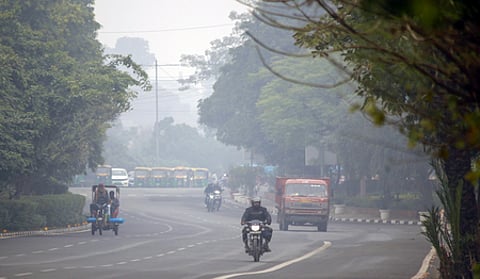
WITH THE WINTER SEASON APPROACHING FAST and the national capital bracing for the inevitable pollution, the Delhi government has announced several new measures meant to contain pollution levels within the Delhi-NCR region. Addressing a press conference on Monday, September 28, 2026, Delhi’s environment minister, Manjinder Singh Sirsa, announced a slew of measures to curb pollution following deliberations held with key state and central government leaders. The meeting, chaired by Union Environment Minister Bhupender Yadav, concluded in the creation of an “action-based plan” meant to reduce pollution levels in the region and included top government officials such as Delhi Chief Minister Rekha Gupta, Delhi Public Works Development (PWD) Minister Parvesh Verma, and Sirsa in addition to senior officials of the Commission for Air Quality Management (CAQM).
One of the key measures is the strict enforcement of the “No PUCC, No Fuel” campaign. PUCC stands for Pollution Under Control Certificate, a government-issued document that confirms that a vehicle’s exhaust emissions meet approved environmental and pollution standards. On September 26, 2026, Delhi CM Rekha Gupta announced that vehicles without a valid PUCC will not receive fuel from pump stations starting October 1, 2026. As part of efforts to tackle vehicular pollution, the ‘No PUCC, No Fuel’ campaign will be extended to all 500 fuel stations equipped with authorized number plate registration (ANPR) systems.
Restricted Entry, Vehicle Inspection, And 50% Work-From-Home Policy
Delhi will restrict the entry of vehicles registered outside the capital that do not comply with BS-VI emission standards from November 1, 2026. The action plan also stated that government and private offices would be required to have 50% of their employees work from home during the winter pollution season.
Sirsa said a strict enforcement drive against “end-of-life” vehicles — which have bypassed the lifespan of 15 years for petrol vehicles and 10 years for diesel vehicles — would be carried out at all 500 petrol pumps in Delhi fitted with ANPR cameras. A public awareness campaign on the issue is scheduled to begin in October 2026, while Pollution Under Control (PUC) centers will be upgraded in November 2026. The government will also conduct fitness tests for 2.5 lakh vehicles through three Automated Testing Stations.
Sirsa said the Delhi government would add 150 electric buses to its fleet, taking the total number of e-buses in the city to more than 700. At present, 588 electric buses are operational in Delhi. He further said a comprehensive plan had been prepared to keep activities around air-quality and traffic-congestion hotspots under control.
Parking fees at authorized parking facilities will be doubled to discourage the use of private vehicles, with the exception of sites owned and operated by the Delhi Metro Rail Corporation.
Office timings will also be staggered as part of the pollution control action-plan. According to a presentation made during a press briefing by officials of the Commission for Air Quality Management on Monday, September 28, 2026, Municipal Corporation of Delhi offices will function from 8.30 am to 5 pm, while Delhi government offices will operate from 10 am to 6.30 pm.
Meanwhile, demolition work that generates dust and outdoor civil construction activities will be prohibited from November 1, 2026, to January 31, 2027.
The plan further proposes weekly inspections of pollution hotspots, a mechanism for citizens to report local pollution-related issues, a new portal for citizen suggestions, daily evening AQI (Air Quality Index) bulletins and coordinated measures with cities across the National Capital Region under an airshed-based approach.
These restrictions will be in effect from November 1, 2026, until January 31, 2027.
Suggested reading:
Subscribe to our channels on YouTube and WhatsApp
Download our app on Play Store
