
- HOME
- OPINION
- ON GROUND
- INTERVIEW
- Neta Profile
- Editor's Pick
- INDIA
- NewsGram USA
- WORLD
- न्यूजग्राम
- POLITICS
- ENTERTAINMENT
- CULTURE
- LIFESTYLE
- ECONOMY
- SPORTS
- Jobs / Internships
- Misc.
- NewsGram Exclusive

An X user posted images and videos showing garbage and sewage-filled streets in Faridabad, calling the city “disgusting,” which quickly went viral.
After claiming he received threatening calls, the user later said there had been a “miscommunication” and began praising the city and local officials.
The incident sparked political reactions and renewed discussion about civic governance, corruption allegations, and the role of social media in highlighting urban issues.
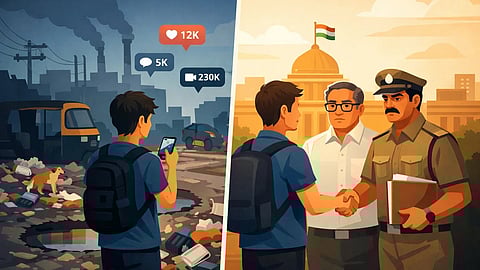
On March 1, 2026, a social media user operating under the handle Biased Indian posted a series of photos and videos about the condition of Faridabad that quickly went viral. The posts drew widespread attention online, especially from people in the city, and later appeared to lead to trouble for the user himself. What began as a sharp criticism of the city’s civic conditions soon turned into a sudden shift in tone, with the same user later praising authorities and saying the issues would be resolved.
The account, using the username @RakeshK32229480b and the display name “Biased Indian,” claimed that the person had recently started an internship in Faridabad. In his first post on March 1, he wrote that he had “never lived or visited such a disgusting place,” adding that people in the city seemed to have accepted their fate. Calling it “the horror of traveling in this country,” he also alleged that the area was run by “the most corrupt and vile MPs and babus in India.”
Along with the comments, the user shared four images showing piles of garbage and sewage water stagnating along roads while people walked beside them. In another post the same day, he questioned the condition of Indian cities more broadly, writing: “Imagine if we went to war—how much worse would our cities look, when they already look worse than war-torn countries?”
The posts continued through like a daily “journal” of his work visit in the city. He shared photos of roads, alleys, and residential areas where sewage water had accumulated and garbage had piled up. In one video, an alley lined with houses and shops appeared flooded with dark sewage water, with even the wheels of a scooter half-submerged. The user remarked that people seemed to have accepted living in such conditions.
In another post on March 2, 2026 which he described as “Day 2.5 of being in Faridabad,” he shared more images from residential sectors. He wrote: “Travelling in India’s 34th clean city,” and clarified that the pictures were not from slums but from regular residential areas. He also criticised civic authorities, saying that for a “smart city,” civic sense and administration should be much better.
In other posts, the user alleged that local governance had failed to maintain the city properly. In one tweet, he tagged the SDM and the Municipal Corporation of Faridabad (MCF), claiming that locals had told him the area’s Member of Parliament — without naming the MP — demanded “60–65 percent commission on all tenders due to Modi goodwill.” In separate posts, he also shared images of what he described as “posh areas” that, according to him, appeared poorly maintained. Referring to one road, he wrote that it “looks like Tehran after a missile attack.”
However, the tone of the viral posts changed abruptly on March 3, 2026. The user claimed he had begun receiving threatening calls from Babus (bureaucrats). In one tweet he wrote that he was “very scared” after allegedly receiving repeated calls and questioned why larger influencers had not spoken about civic issues. “Big influencers like Carry Minati didn’t raise their voice for city apathy. Main toh ek aam aadmi hoon,(i am just a common man)” he wrote, sharing a screenshot of his phone’s call logs with phone numbers blurred.
Soon after, he posted another message stating that there had been “some miscommunication gaps” and that he had not actually received threats. Continuing his daily Journal as “Day 3.5 of Faridabad,” the user said he might have given a “false impression” of the city on social media. According to him, most of Faridabad was “well developed,” though some areas were neglected. He added that Municipal Corporation of Faridabad (MCF) officials had assured him that the issues would be fixed.
By “Day 4,” the tone had shifted further. Sharing a video of Faridabad–Mathura Road, he wrote that he was “pleasantly surprised by how good the roads are in Faridabad.” He also apologised to viewers for the earlier posts, saying they may have created a misleading impression. “Every city has its strengths and weaknesses,” he wrote, adding that he had only encountered neglected pockets such as Sector 91 and Sector 37.
After this, the user began posting images of problematic areas while tagging civic authorities, describing it as “the power of social media.”
Although there has been no official statement or clarification from the authorities of Faridabad, many people have claimed that the social media user who highlighted the civic issues in the city may have succumbed to pressure from local authorities and changed the tone of his posts on X. Meanwhile, a meme fest has erupted online, with people sharing photos of highly developed Western cities and sarcastically claiming them to be Faridabad.
In one post, a user shared an AI image of a highly digitalised area with the caption: “Day 5 in Faridabad. Me and my GF are apparently heading to the moon for shopping directly from Faridabad’s ‘multimodal launch pad.’ The stations are so unique that not a single station in the world can compare. Truly historic, thanks to the government and babus for making this possible.”
In another post, a user shared a clip of Shivaji: The Boss featuring Rajinikanth walking from a rural area while development follows him, with the caption: “Faridabad after the intern met with police and municipality officials.”
The episode also drew reactions from political figures. Dr. Munish Kumar Raizada, president of the Bharatiya Liberal Party, commented on one of the posts where the user had shared screenshots of calls from officials. Raizada highlighted the institutional corruption in the hierarchy of governance in Faridabad. He said that he had deep links with Faridabad and alleged that the Municipal Corporation of Faridabad was “a universally acknowledged corrupt body.”
He further criticised the broader political system, writing that corruption existed across levels of administration. According to him, from local officials to national leaders, “the political machinery profits from it.” Raizada argued that citizens often complain about corruption but rarely organise to challenge it. If people are truly angered by such issues, he said, they must be prepared for “an andolan (revolution) to bring new and real azadi.”
The incident has since sparked debate online, with many questioning whether the user’s sudden change in tone was genuine or the result of pressure. Others argue the controversy highlights the growing influence of social media in exposing civic issues—and the risks that sometimes follow.
Suggested Reading:
Subscribe to our channels on YouTube and WhatsApp
Download our app on Play Store
