
- HOME
- OPINION
- ON GROUND
- INTERVIEW
- Neta Profile
- Editor's Pick
- INDIA
- NewsGram USA
- WORLD
- न्यूजग्राम
- POLITICS
- ENTERTAINMENT
- CULTURE
- LIFESTYLE
- ECONOMY
- SPORTS
- Jobs / Internships
- Misc.
- NewsGram Exclusive

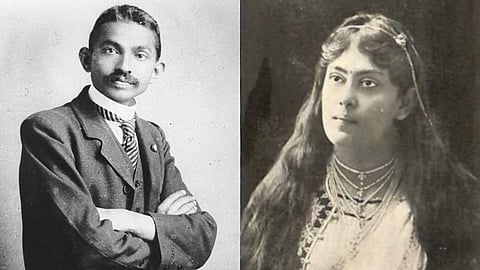
After meeting in Lahore in 1919, Mahatma Gandhi and freedom fighter Sarala Devi Chaudhurani grew close while working together in Punjab
Gandhi called Sarala Devi his "spiritual wife" despite her being married and his vow of celibacy.
Under pressure from trusted aide C. Rajagopalachari, Gandhi ended the relationship around 1920, prioritizing the independence movement
MOHANDAS KARAMCHAND GANDHI, who is famously and affectionately known as Mahatma Gandhi, is a name that everyone in India and many outside India knows and admires. He was a prominent figure in India's freedom struggle and worked to secure India's independence through non-violence. He cultivated the image of a saint and took a vow of celibacy in 1906 when he was 38 years old.
Gandhi has many controversial chapters in his life, from his controversial celibacy experiments to being called racist because of his early articles and petitions in South Africa. Today, we are going to look at one such controversial relationship of Gandhi with an already married freedom fighter, Sarla Devi.
Gandhi married Kasturba in 1883 in an arranged child marriage. After marriage, Gandhi went to South Africa in 1893 to work on legal cases. After returning from South Africa in 1915, Gandhi started working for the freedom movement to secure India's independence. In 1919, the British government took two actions that drew sharp criticism from people in India and intensified the freedom struggle. During this period, the British government imposed the Rowlatt Act, and after that, the dark chapter of history, the Jallianwala Bagh massacre, took place in Punjab.
Following that, Gandhi came to Lahore in 1919 and stayed at the house of prominent lawyer, journalist, and freedom fighter Rambhuj Dutt Chaudhuri. When Gandhi came to live in his house, Chaudhuri had been imprisoned in a British jail along with other nationalist leaders for protesting against the Rowlatt Act. His wife, Sarla Devi Chaudhurani, who was herself a prominent figure, was present at home. Chaudhurani was a highly educated, independent writer and activist who was also the niece of Rabindranath Tagore.
Although Gandhi had first met Sarala Devi at the 1901 Calcutta Congress, it was during his stay at her house that his admiration for her deepened. He greatly admired her political views, opinions, and writings. He believed that Sarala was among the most prominent female leaders of the freedom struggle. Soon, political admiration turned into something much deeper, and Gandhi and Sarala Devi started travelling and working together predominantly in the Punjab region, drawing massive crowds.
Soon, Gandhi became so deeply infatuated with her that he called her his "spiritual wife" to describe their relationship. He believed that their relationship was not physical but intellectual and emotional and transcended traditional boundaries. When Gandhi and Sarala were apart, they used to send letters to each other.
Geraldine Forbes, in her book Lost Letters and Feminist History: The Political Friendship of Mohandas K. Gandhi and Sarala Devi Chaudhurani, mentions how the political discussions in their letters gradually turned into personal exchanges. In some accounts, it is written that the salutation in the letters changed from "My Dear Sarla Devi" to "My Dearest Sarla."
In some accounts, it is written that at one point Gandhi even thought of publicly declaring their spiritual partnership. He believed that because their bond was spiritual and not physical, it transcended earthly marriage vows. But his inner circle had different views. The thought of Gandhi, who had vowed celibacy, being in a relationship with Sarala Devi, who was already married to a comrade, alarmed his close aides. They thought the British press would destroy Gandhi's reputation and that this might create problems for the freedom struggle.
See Also: Why Godse Killed Mahatma Gandhi ?
C. Rajagopalachari, who was one of the closest aides of Mahatma Gandhi and his most trusted political adviser, pressured Gandhi to end the relationship. He told Gandhi to focus entirely on the freedom struggle, as it was more important at that point, and to end this intense emotional entanglement with Sarala Devi. This intervention worked. Between spiritual marriage and national duty, Gandhi chose national duty. With this, the chapter of Sarala Devi and Mahatma Gandhi, which started in 1919, ended in 1920.
Sarala Devi was a famous leader of the freedom movement in India. Born in 1872 in Kolkata, she was an Indian educationist and political activist. She was a woman ahead of her time, with radical feminist ideologies. She was born into the celebrated Tagore family, a niece of Rabindranath Tagore and the daughter of nationalist writer Swarnakumari Devi and reformist Janakinath Ghosal. She grew up in an intellectual and artistic background.
She was a singer, a writer, a political activist, a reformist, and an orator. Her presence carried a revolutionary spirit, and hence she influenced many people. That is why Mahatma Gandhi called her Shakti (the feminine energy). She had immense willpower, brilliant intellect, and the power to influence many women. She founded the Bharat Stree Mahamandal in Allahabad in 1910, which was the first national-level women's organization in India. Its primary goal was women's education.
Suggested Reading:
Subscribe to our channels on YouTube and WhatsApp
Download our app on Play Store


