
- HOME
- OPINION
- ON GROUND
- INTERVIEW
- Neta Profile
- Editor's Pick
- INDIA
- NewsGram USA
- WORLD
- न्यूजग्राम
- POLITICS
- ENTERTAINMENT
- CULTURE
- LIFESTYLE
- ECONOMY
- SPORTS
- Jobs / Internships
- Misc.
- NewsGram Exclusive

Key Points:
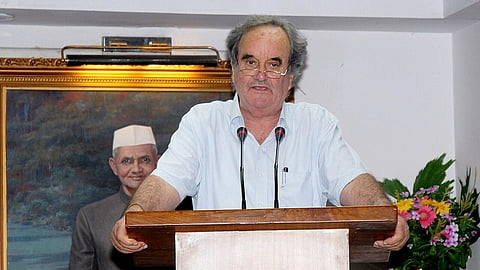
Sir Mark Tully, a British broadcaster and journalist for the BBC India, passed away on January 25, 2026, aged 90. He served as the Bureau Chief for BBC New Delhi for 20 years and was respected among international and Indian journalists alike.
Born on October 24, 1935 in Calcutta, Mark Tully spent a significant period in India and was well versed in both English and Hindi. Although he remained a British citizen, he also received Overseas Citizenship of India late in his life.
Tully covered crucial events including the India-Pakistan War 1971, Bhopal Gas Tragedy 1984, Operation Blue Star 1984, Rajiv Gandhi’s assassination 1989, and Babri Masjid demolition 1992. He also reported on military rule in Pakistan and the Soviet invasion of Afghanistan.
Sir Mark Tully, a British broadcaster and journalist for the BBC (British Broadcasting Corporation) India, passed away on January 25, 2026, aged 90. He was a prominent journalist, with roots in India, and had extensively covered India during most of his lifetime. He served as the Bureau Chief for BBC New Delhi for 20 years. Respected among international and Indian journalists alike, he was also known for being a brilliant writer. He penned down nine books during his course of life, and several other essays.
Mark Tully was born on October 24, 1935 in Calcutta, India. His father was a businessman and mother a housewife, born in Bengal. At the age of nine, Tully’s parents took him to Britain for schooling and higher education. He studied history and theology at Trinity Hall, Cambridge, and later went to Lincoln Theological College. He intended to become a clergyman, but dropped out of the aforementioned college after having second thoughts.
His career saw all kinds of turbulence. Spending a significant period in India, he was well versed in both English and Hindi. Although he remained a British citizen, he also got an Overseas Citizenship of India late in his life.
Mark Tully covered several crucial events during his journalistic career, mostly reflecting significant political developments in India. He covered the India-Pakistan War, 1971, Bhopal Gas Tragedy, 1984, Operation Blue Star, 1984, Rajiv Gandhi’s assasination, 1989, and Babri Masjid Demolition, 1992 among others. He also covered prominent geopolitical events, including the periods of military rule in Pakistan, Soviet Union’s invasion in Afghanistan and Tamil Tigers’ rebellion in Sri Lanka.
Tully joined the BBC in 1964 and was sent to India in 1965. His journalistic career got a huge growth here, where he travelled around India, and the neighbouring countries reporting on and covering crucial issues. During the period of emergency, in 1975, he was expelled from India. After the emergency ended, he came back and worked for BBC India till 1994.
Tully faced a moment of crisis in 1992, while reporting on the Babri Masjid in Ayodhya, 1992. While reporting on the Babri Masjid, Ayodhya, 1992, he got surrounded by several hard liner Hindutva activists and protesters, who claimed their distrust in the BBC, and chanted “Death to Mark Tully”. The protesters locked him into a room, but he got rescued later by a local official and a Hindu priest.
Tully always appreciated the religious richness and cultural diversity of India. He reported that the demolition of the Babri Masjid harmed Indian secularism. Ayodhya’s environment was tense during those times, but Tully did not indulge in providing sensational news. He reported on ground reality, and the failure of law and order during the period that led to riots. Mark Tully’s reporting is often cited in journalism schools because it showed how a foreign correspondent, deeply familiar with India, could report a sensitive internal conflict, letting facts and consequences speak louder than outrage.
Among the nine books Tully authored, his first book: “Amritsar: Mrs. Gandhi’s Last Battle” (1985) remains quite popular. He described the crucial moments that led to Operation Bluestar, where the Indian military stormed Harmandir Sahib (Golden Temple) between June 1, 1984 to June 4, 1984. The Operation Bluestar led to the elimination of Jarnail Singh Bhindrawala, the Khalistani extremist leader.
His “India in Slow Motion”, released in 2002 is also praised widely. The Observer’s Michael Holland spoke of Tully regarding the book that his knowledge about India- world’s largest democracy was brilliant, despite him being a foreigner in India.
Mark Tully received prestigious honours of Padma Shri (1992) and Padma Bhushan (2005) by the Government of India. He was also knighted by Queen Elizabeth II for exceptional services to broadcasting and journalism in 2002. Profound of his love for India, Sir Mark Tully described the award as “an honour to India”.
(GP)
Suggested Reading:
Subscribe to our channels on YouTube and WhatsApp
Download our app on Play Store

