
- HOME
- OPINION
- ON GROUND
- INTERVIEW
- Neta Profile
- Editor's Pick
- INDIA
- NewsGram USA
- WORLD
- न्यूजग्राम
- POLITICS
- ENTERTAINMENT
- CULTURE
- LIFESTYLE
- ECONOMY
- SPORTS
- Jobs / Internships
- Misc.
- NewsGram Exclusive
By Basharat Amin
Jammu, Jammu and Kashmir: For nearly four generations, around 250 households of the tribal Muslim Gujjar community have lived across Upper and Lower Bermeni, leading largely pastoral lives on the forested fringes of Jammu’s Sujwan block. That continuity was shattered on the intervening night of August 26-August 27, 2025.
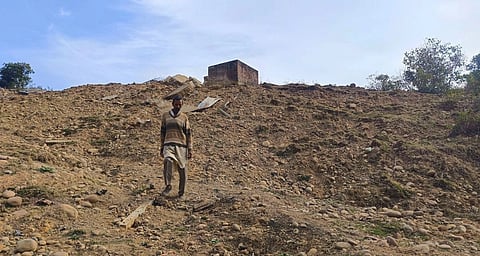
Triggered by intense rainfall, flash floods tore through the surrounding hills, causing massive soil erosion and sending torrents of debris into Lower Bermeni. Fifteen families living in a remote forest-bordering hamlet, around five kilometres from the main block headquarters, lost their homes entirely. Several others suffered partial damage.
“This was like doomsday,” said Sheeraz Ahmad (25), a resident of Bermeni. “We had never seen anything like this. People here have lived peacefully for generations.”
Among the worst affected is Murad Ali (58) who estimates his losses at Rs 60 lakh - Rs 70 lakh.
“I had two concrete houses. Today, there is nothing left, everything has been razed to the ground,” he told 101 Reporters. “My two sons and I worked as daily labourers for years to build those houses. Now we are living under the open sky.”
Murad said the only assistance provided by the government so far was evacuation during the floods. “We were rescued so that we would not be swept away by the water. Beyond that, we have not received a single penny,” he said.
The 15 affected families are currently living in makeshift tents about three kilometres from their original settlement. The temporary site has no electricity or sanitation facilities. While a municipal water tanker visits the area, residents say the supply is inadequate.
For the first ten days after the floods, the families were housed in a government school in Sujwan. “Later, the government deployed labourers and machinery to clear a small patch of forest land so tents could be erected,” Murad said, recalling that the land was once dense jungle.
According to residents, officials repeatedly asked the families to continue staying in the school, but they refused. “We have children and cattle. There was no privacy, and no space to keep our animals,” Murad said.
Women say the conditions have stripped them of basic dignity. “We have to perform ablution in the open because there are no toilets or washrooms,” said Rehti (50), a resident. “Living like this is extremely difficult.”
Livestock losses have compounded the crisis. Many animals were either swept away or killed in the floods, depriving families of their primary source of income.
Waseem Akram (45) said his family has lived in Bermeni for over a century. He lost two concrete houses and all his cattle. “We knocked on every door for compensation, except the Chief Minister, but nothing happened,” he said. “Now we are forced to work as daily labourers. Making ends meet has become extremely hard.”
Under existing norms, immediate relief to disaster victims is processed by the Disaster Management Department based on requisitions submitted by the deputy commissioners of affected districts.

According to residents, officials have cited land ownership issues as the reason for denying compensation.
“We are being told that we were living on state land,” Waseem said. “If this land was unsafe, why would our grandparents have settled here? Why would we invest everything we had?”
Murad pointed to alleged discrepancies in the compensation list issued by the Revenue Department last month.
“The list includes people whose houses are intact or suffered negligible damage, while the worst-hit families are missing,” he said. “Some of those included share the same khasra number as us. If their land is marked as private, how is ours suddenly state land?”
Shabana, a panchayat representative from Bermeni, said the local body had no role in preparing the compensation list.
“The list needs thorough re-verification,” she said. “Families that suffered maximum damage are not included. There is no difference in settlement history between those included and those excluded.”
Environmental expert Bhushan Lal Parimoo, president of the Jammu and Kashmir Environment Awareness Forum, said the disaster was not sudden.
“This was not an unexpected event. Nearly 80% of Jammu and Kashmir is affected by soil erosion,” he said, attributing the damage to deforestation and loss of green cover.
Parimoo noted that areas from Sidra to Chowadi, including Bathandi and Sujwan, were once part of the Bahu Rakh wildlife zone. “Declared a protected area in 1982, it has shrunk from 59.5 square kilometres to barely six,” he said.
Darshan Singh, Naib Tehsildar of Sujwan, said compensation decisions rest with the government. “Our duty was to complete the paperwork, which has been submitted to the Deputy Commissioner’s office,” he said.
A senior official from the Disaster Management and Relief Department, who requested anonymity, said relief is provided under State Disaster Response Fund norms.
“Immediate assistance of around Rs 1.2- Rs 1.3 lakh for house damage is released based on requisitions from district administrations,” the official said. “Funds are regularly received from the Centre, and no shortage of relief has come to our notice.”
For the displaced families of Lower Bermeni, however, relief remains elusive, leaving them to rebuild their lives amid uncertainty, loss, and a growing sense of exclusion.
This article was originally published in 101 Reporters under Creative Common license. Read the original article.
[DS]
Suggested Reading:
Subscribe to our channels on YouTube and WhatsApp
Download our app on Play Store
