
- HOME
- OPINION
- ON GROUND
- INTERVIEW
- Neta Profile
- Editor's Pick
- INDIA
- NewsGram USA
- WORLD
- न्यूजग्राम
- POLITICS
- ENTERTAINMENT
- CULTURE
- LIFESTYLE
- ECONOMY
- SPORTS
- Jobs / Internships
- Misc.
- NewsGram Exclusive

AI generated summary, newsroom-reviewed
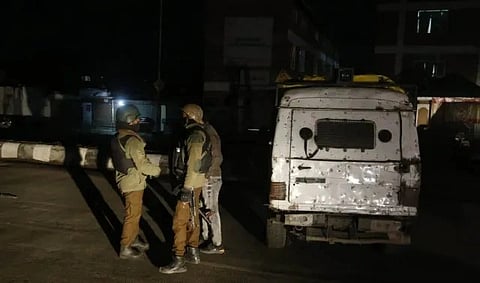
TWO NON-LOCAL LABORERS were killed when terrorists opened fire in South Kashmir’s Kulgam district. On Friday evening, July 31, 2026, in the district’s Kellam village, armed terrorists broke into the village that had over 250 residents, and shot the two laborers after singling them out and verifying their religious identity. This marks the second terror attack in South Kashmir, despite a high security alert in the region.
The terror attack happened on Friday evening in the Kellam village situated 2 kilometers away from the Kulgam district. One laborer succumbed to his injuries while he was being taken to the hospital. The second laborer was referred to Government Medical College, Anantnag, and later died during treatment at a hospital in Srinagar.
The deceased laborers have been identified as 24-year-old Deepak Ratray and 28-year-old Bopinder. Both of them hailed from Chhattisgarh.
Security officials said that the terrorists fled from the spot after committing the terror attack. A massive search operation has been ordered in the Kellam village and other neighboring areas. Over 3,000 suspects have been detained so far.
Condemning the incident, Jammu and Kashmir's Lieutenant Governor Manoj Sinha stated that he had directed security forces to step up their operations and eliminate the terrorists.
In a statement posted to X, Sinha wrote: “I spoke with the DGP, Shri Nalin Prabhat and top security officials following the brutal terror attack in Kulgam in which a laborer from Chhattisgarh was killed. I strongly condemn this cowardly act. I have directed our security forces to step up their operations and eliminate the terrorists.”
Giving further details about police action on this terror attack, Sinha continued: “J&K Police and Security forces have cordoned off the area and launched an operation to bring the perpetrators to justice. Another injured laborer from Chhattisgarh has been rushed to the hospital for urgent medical care. My deepest condolences to the bereaved family and I am praying for the speedy recovery of the injured. J&K administration and the entire nation stand with the families.”
A similar terror attack had taken place in South Kashmir just a few days ago. On July 22, 2026, a policeman was shot dead by terrorists at Lal Chowk in Anantnag district. The policeman was deployed as a security officer during the Amarnath Yatra Pilgrimage tour. Both Anantnag and Kulgam are areas on high-security alert due to the Amarnath Yatra.
A day before the Kulgam terror attack, Pakistan’s Director General of Inter-Services Public Relations (ISPR), Ahmed Sharif Chaudhry, held a two-hour long press conference. The general spoke extensively about security concerns in Pakistan’s Balochistan province, blamed India for causing unrest in the region and pledged strong retaliation. “India made the protesters ask about rights.. But Kashmir is the darling of Pakistan when it comes to rights. Their (Joint Awami Action Committee, or JAAC) protest is agenda based,” Chaudhry remarked.
See also: One Year of Operation Sindoor: How India Redefined Its Anti-Terror Doctrine After Pahalgam Attack
Just a couple hours later after Chaudhry’s press conference concluded, the Kulgam terror attack took place and claimed 2 lives.
In a statement posted on X, Senior Executive Editor for Geopolitics at NDTV Aditya Raj Kaul draws parallels between the Kulgam terror attack with the Pahalgam terror attack that took place over a year ago. Kaul pointed how a similar tactic — statement by a Pakistani official and then a terror attack — played out before the deadly Pahalgam attack that took place on April 22, 2025.
Days before Pahalgam, Pakistan's Army Chief Asim Munir, speaking at an Overseas Pakistanis Convention, stated: “Kashmir is our jugular vein, it will be our jugular vein and we will not forget it.” Munir also placed emphasis on the “two nation theory” and talked about the ideological differences between Hindus and Muslims. Days later, armed terrorists shot down 26 Hindu men in the Pahalgham valley after confirming their religious identity.
Calling the Kulgam terror attack as “Pahalgam Playbook,” Kaul pointed toward the alleged role of Pakistan’s “deep state” in terror attacks like Kulgam.
Watch Full Report:
Suggested reading:
Subscribe to our channels on YouTube and WhatsApp
Download our app on Play Store
