
- HOME
- OPINION
- ON GROUND
- INTERVIEW
- Neta Profile
- Editor's Pick
- INDIA
- NewsGram USA
- WORLD
- न्यूजग्राम
- POLITICS
- ENTERTAINMENT
- CULTURE
- LIFESTYLE
- ECONOMY
- SPORTS
- Jobs / Internships
- Misc.
- NewsGram Exclusive
The Centre proposed increasing Lok Sabha seats to 850 and fresh delimitation, along with 33% women’s reservation, during a special Parliament session.
Leaders like K. C. Venugopal and Asaduddin Owaisi alleged the move threatens federalism and could reduce representation of certain states and communities.
Opposition also argue population-based delimitation may benefit more populous states while penalising those with better population control.
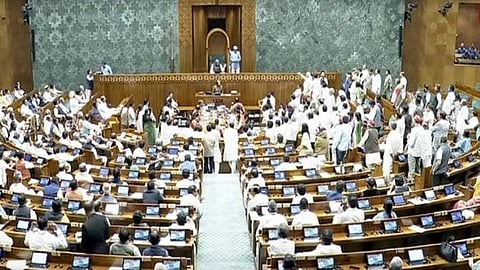
The Centre on April 14, 2026 circulated draft legislation to Members of Parliament proposing a major increase in the strength of the Lok Sabha to 850 seats and enabling fresh delimitation of constituencies. Parliament of India decided to introduce the bill during a special three-day session from April 16–18, 2026. The bill also aims to reserve 33 percent of seats for women in Parliament and redraw constituency boundaries based on population data.
The special session began on April 16, 2026, to take up three bills — the Constitution (One Hundred and Thirty-First Amendment) Bill, 2026, the Union Territories Laws (Amendment) Bill, 2026, and the Delimitation Bill, 2026. Opposition parties have strongly opposed the delimitation bill, alleging that it is being rushed under the guise of implementing women’s reservation. Several MPs argued that delimitation based on population could reduce the representation of states with lower population growth, thereby weakening opposition-ruled states in the Lok Sabha.
K. C. Venugopal was among the first to oppose the bill. “Sir, this actually is a fundamental attack on Indian federal structure. What exactly is the intention of the introduction of the bill?” he asked, questioning the government’s motive. Referring to the earlier women’s reservation law, he pointed out that Parliament had already passed a bill in 2023 ensuring 33 percent reservation for women and asked, “Why don’t you implement it in 2024?”
He further alleged that safeguards earlier ensured by leaders like Indira Gandhi and Atal Bihari Vajpayee are being diluted. Accusing the government of political motives ahead of the 2029 elections, he said “your intention is to hijack the Indian democracy,” and termed the proposal an “anti-constitutional bill,” arguing that it undermines the federal structure and democratic principles.
Dharmendra Yadav also opposed the move, stating that Parliament’s duty is to protect the Constitution, not weaken it. He argued that separating delimitation from the population census goes against public sentiment and that the process is being presented in the name of women’s reservation. Warning of broader consequences, he said, “What has happened to Kashmir and Assam is the same condition they are trying to impose on the entire country.” He also demanded that women’s reservation must include representation for Muslim women and those from backward classes.
N. K. Premachandran raised constitutional concerns, arguing that the amendment is being framed in a misleading way. “The 131 amendment is not meant for the women reservation but it is meant for the delimitation that is the basic objection we are raising,” he said, adding that the government is highlighting women’s reservation while the core focus remains delimitation. He also pointed out that the statement of objects and reasons does not align clearly with the substance of the bill.
T. R. Baalu criticised the Centre for combining multiple bills, saying it makes proper scrutiny difficult. He clarified that his party supports the 2023 women’s quota law but believes the current proposal is primarily about delimitation rather than reservation.
Asaduddin Owaisi also opposed the bill, stating, “I oppose this introduction of this constitutional amendment bill because it violated the parliamentary form of democracy and federalism which are both parts of the basic structure of the constitution.” He argued that the move could shift political power toward more populous states, reducing the representation of OBCs and Muslims, and making decisions of smaller states less impactful compared to larger ones like Uttar Pradesh.
Outside Parliament, M. K. Stalin strongly opposed the move on April 16, 2026, protesting by burning a copy of the bill and wearing black. He described it as a strategic attempt to reduce the influence of southern states with lower population growth and warned that it could harm their political power.
Several leaders also criticised the timing of the bill, calling it “extremely ill-timed.” They argued that delimitation based solely on population appears to penalise states that have successfully implemented population control measures. In India, delimitation exercises have previously been carried out in 1952, 1963, 1973, and 2002, making the current proposal a significant and contentious shift in the country’s electoral framework.
(Edited by Dhruv Sharma)
Suggested Reading:
Subscribe to our channels on YouTube and WhatsApp
Download our app on Play Store

